SS2 Examination Questions For Second Term
Senior Secondary School Questions 2nd term SSS 2. Year 11/SS2 Examination Questions for second term with answers Obj – Edudelight Exam
Agricultural Science SS2 Examination Questions For Second Term
SENIOR TWO (2) S.S. 2
AGRICULTURAL – SCIENCE
2ND TERM EXAMINATION
SECTION A – OBJECTIVE
- The indiscriminate removal of trees is called____. A. afforestation B. deforestation C. Taungya farming D. weeding
- The following are forest trees except ____. A. Iroko B. Obeche C. hibiscus D. ebony
- Process of establishing a forest plantation is called ____. A. afforestation B. deforestation C. taungya D. weeding
- The process of cutting only matured trees in a forest is called ______. A. selective exploitation B. selective exploration C. taungya D. afforestation
- The best soil for Agriculture is _____. A. loamy soil B. sandy soil C. clay soil D. silt soil
- The following are ornamental trees except _____. A. frangi pani B. balsam C. royal palm D. ixora
- Which of the following is not an ornamental shrubs? A. allamenda B. crotons C. hibiscus D.casuarinas
- The following are ornamental flowers except ____. A.justicia B. cana lilyC. crotalaria D. balsam
- The following are legumes except ______. A. centro B. stylo C. calapo D. panicum maximum
- ______ are cultivated purposedly for feeding animals. A. arable crops B. ornamental crops C. forage crops D. farm trees
- The following are pathogens except _____. A. viruses B. bacteria C. fungi D. algae
- Maize rust is caused by ______. A. bacteria B. fungi C. virus D. nematodes
- Rosette disease of groundnut is caused by ____. A. fungus B. virus C. bacteria D. nematodes
- Cocoa blackpod disease is caused by ______. A. virus B. bacteria C. fungi D. nematodes
- Root knoll of tomato is caused by ______. A. nematode B. fungus C. bacteria D. virus
- Plant diseases are caused by pathogens. (a) true (b) false (c) maybe
- Pathogens are disease causing organism which passes through a regular cycle of development and reproduction. (a) maybe (b) true (c) false
- _____ is responsible for damages in crops. A. weeds B. water C. air D. pests
- The following are rodents except _____. ?A. rat B. grasscutter C. squirrel D. monkey
- The following are bitting and chewing insect except ____. A. termites B. capsids C. Locust D. beetles
- Stem burrowers will attack A. cereals B. legumes C. tubers D. spices
- Cotton strainers and meleabugs are examples of _____ insects. A. biting B. chewing C. piercing and sucking
- Avicides are used to control _____. A. rodents B. birds C. insects D. pests
- The mode of action of liquid insecticide is_____. A. contact B. systemic C. stomach D. fumigation
- Weevils are _____ insects. A. biting B. chewing C. burrowing D. piercing
- The following are pests except. A. rodents B. earthworm C. monkeys D. nematodes
- The following are biting chewing insects except ___. A. butterfly B. locust C. grasshopper D. cricket
- Which of the following is not a climatic factor affecting pasture distribution? A. Temperature B. Light C. Humidity D. Soil PH
- The following are edaphic factors except___A. soil PH B. soil texture C. soil structure D. relative humidity
- Diseases, pests, predators and parasites are ____ factors. A. biotic B. abiotic C. edaphic D. climatic
Agricultural Science Exam Questions Objectives (OBJ) Answers
1.B 2.C 3.C 4.B 5.A
6.D 7.D 8.D 9.D 10.C
11.D 12.B 13.B 14.C 15.A
16.A 17.B 18.D 19.D 20.B
21.A 22.C 23.B 24.D 25.C
26.B 27.A 28.D 29.D 30.A
THEORY
1a. Define forest and List ten uses of forest
1b. Define deforestation list 2 effect
2a. Define Taungya farming and regeneration?
2b. 2 types of regeneration 2 causes of deforestation
3a. What is Floriculture, list 4 ways in which ornamental plants is beneficial to man
3b. List 3 ways to maintain horticultural plants/flowers
4a. What is plant disease? And crop pest?
4b. List four common disease causing organisms.
5a. What are pathogens? List 2 examples of it
5b. List and explain 3 general control of crop plant disease
6a. List four economic importance of insect pest
6b. List two side effects each of using
- Cultural control of pests
- Biological control of pests
- Chemical control of pests
- Physical control of pests
- List three pasture grass and their botanical names.
- List three pasture legumes and their botanical names.
- List three factors affecting the distribution of pastures.
Biology SS2 Examination Questions For Second Term
SENIOR TWO (2) S.S. 2
BIOLOGY
2ND TERM EXAMINATION
SECTION A – OBJECTIVE
- Hydra feeds on___aquatic organisms (a) small (b) big (c) large
- _____ captures its food through its structure called nematocysts found on its tentacles (a) digestive (b) canal (c) hydra
- ____ is a parasitic worm which has no alimentary canal (a) tadpole (b) tapeworm (c) (c) hydra
- _____ has a simple alimentary canal with one opening (a) Planaria (b) Pharynx (c) cavity
- The alimentary canals of insects consist of ___major parts (a) 4 (b)3 (c) 2
- Insects such as grasshoppers feed on____(a) sand (b) soil (c) leaves
- The broken down into simple, soluble and diffusible substances through some chemical and mechanical processes is called__(a) absorption (b) ingestion (c) digestion
- Digested food absorbed into the body fluids and assimilated while the undigested food is removed (egested) (a) True (b) False (c) IDK
- All holozoic animals have structures for obtaining their food. (a) false (b) true (c) IDK
- The wall of the esophagus is muscular and it contracts and relaxes to push each bolus of food downward, this process is called____(a) peristalsis (b) hydra (c) Pepsinogen
- The first part of the small intestine is___ (a) liver (b) duodenum (c) enzymes
- The liver produces bile, which is stored in the gall bladder (a) True (b) False (c) Maybe
- ___ is a greenish liquid that emulsifies fat, which does not contain digestive enzymes (a) liver (b) duodenum (c) Bile
- The pancreatic juice contains____important enzymes (a) 4 (b) 3 (c) 2
- Sucrase – converts sucrose___(a) glucose+gluclose (b) glucose + fructose (c) glucose + galactose
- Chemical digestion of starch starts in the ……A. intestine B. Mouth C. stomach D. pancreas
- The enzyme involved in the coagulation of milk into thick curds is …A. ptyalin B. pepsin C. Rennin/Rennet D. Lipase
- The end product of starch digestion is …….. A. glucose B. maltose C. glycogen D. amino acids
- The process by which digested food is absorbed into the body cells is called _A. ingestion B. egestion C. assimilation D. digestion
- ___ system is the movement of metabolic materials from various parts of an organism where they are produced and transported to other parts (b) excretory (b) transport (c) digestive
- ____ is a fluid with extra lymphocytes (W.B.C with no red blood cells present). (a) blood (b) cytoplasm (c) Lymph
- The blood cells (corpuscles); which are ____(a) solid (b) liquid (c) broad
- ___ Helps to transport oxygen from lungs to the body cells through its pigment (haemoglobin) (a) red blood cell (b) white blood cells (c) blood platelets
- ____ Help to defend the body against diseases by engulfing and intruding pathogens (bacteria and virus) (a) red blood cell (b) white blood cells (c) blood platelets
- lymphatic system which ingest bacteria, viruses and dead cells to prevent diseases in a process called___(a) lymphocytes (b) phagocytosis (c) cells
- The following metabolic materials are transported from body cells to the skin and kidney A. sugar B. hormones C. excess salt D. protein
- The transport medium which plays active roles in the defense and metabolism of lipids is … A. cytoplasm B. lymph C. blood D. platelets
- The following animals except one has open circulatory system A. goat B. house fly C. snail D. grasshopper
- One of the following has nucleus__A. red blood cell B. white blood cells C. platelets D. hydra
- ____circulatory system involves the blood vessel called arteries which divides capillaries which later join up with other vessels called veins (a) open (b) close (c) single
THEORY- Answer only 3
1a. Mention 3 circulatory system in animals,explain 1
1b. State 3 Differences between artery and vein
2a. Draw a well labelled diagram of the heart
2b.Why is blood a tissue? And Differentiate between blood and lymph.
3a. State the 3 types of blood cell and explain 2
3b. State five functions of blood.
4a. What is transport system? And State the needs for transport system.
4b. What is an enzyme? And State the various feeding habits animal
SSS 2 Biology Exam Questions Objectives (OBJ) Answers
1.A 2.C 3.B 4.A 5.B
6.C 7.C 8.A 9.B 10.A
11.B 12.A 13.C 14.B 15.B
16.B 17.C 18.A 19.A 20.B
21.C 22.A 23.A 24.B 25.B
26.B 27.C 28.C 29.B 30.B
SS2 Chemistry Examination Questions For Second Term
SENIOR TWO (2) S.S. 2
CHEMISTRY
2ND TERM EXAMINATION
SECTION A – OBJECTIVE
- The rate of a chemical reaction is the number of____ of reactants converted or products formed per unit time (a) moles (b) chemical (c) acids
- ____ is one of the properties of a reaction that can change with time (a) intensity (b) gas (c) concentration
- Collisions, which result in a chemical reaction, are called____(a) effective collisions (b) activation energy (b) energy barrier
- The minimum amount of energy required by reacting particles for chemical reaction to occur is called____(a)effective collisions (b) activation energy (b) energy barrier
- A chemical reaction occurs only when the energy of the colliding reactant particles is not equal to or more than the activation energy (a) true (b) false (c) maybe
- Reactions with low activation energy have a high rate of reaction and occur spontaneously (a) true (b) false
- A____catalyst increases the rate of reaction by lowering the activation energy of the reaction (a) positive (b) negative (c) catalyst
- The one which increases the activation energy is known as a ____(a) positive (b) negative (c) catalyst
- The minimum amount of energy that colliding molecules must possess for their collisions to be effective is (a) Thermal energy (b) Collision energy (c) Activation energy (d) Kinetic energy
- The units of rate of reactions is a. moldm-3s-1 b. mol-1s-1 c. mol-1 d. smol-1
- What do we do to increase the surface area of solid reactants to high rate of reaction? a. grinding them into powder b. subjecting the reactants to high pressure c. altering the directing of the reaction d. using reactants of different densities.
- To increase the rate of a reaction we should___the concentration of one or all reactants (a) decrease (b) increase (c) summarize
- The oxidation of nitric oxide to nitrogen dioxide takes place ____(a) slowly (b) rapidly (c) unexpectedly
- The oxidation of carbon monoxide to carbon dioxide takes place____(a) slowly (b) rapidly (c) unexpectedly
- _____ represent the oxidation of nitric oxide to nitrogen dioxide (a) 2NO2 + O2 ——–> 2 NO2 (b) 5NO2 + O2 ——–> 2 NO2 (c) 2NO2 + O2 ——–> 22 NO2
- _____ The oxidation of carbon monoxide to carbon dioxide (a) 4CO + O2 ——–> 2 CO2 (b) 2CO + O2 ——–> 2 CO2 (c) 3CO + O2 ——–> 2 CO2
- ___ is the amount of force or power when applied can move one object from one position to another (a) machine (c) effort (c) energy
- Which of the following is not group of energy? (a) renewable (b) gas (c) non-renewable
- ____ energy is the energy which is generated from natural sources (a) renewable (b) gas (c) non-renewable
- ____ energy is the energy which is taken from the sources that are available on the earth in limited quantity and will vanish fifty-sixty years from now. (a) renewable (b) gas (c) non-renewable
- Which of the following is not a uses of energy? (a) to plait hair (b) to do work (c) for cooking
- The law of conversation of energy states that the total amount of energy after and before the change remains the same. (a) true (b) false (c) maybe
- ____ reaction is a type of reaction in which heat is absorbed from the surroundings (a) endothermic (b) exothermic (c) catalyst
- _____ reaction is a type of reaction in which heat is given off to the surrounding (a) endothermic (b) exothermic (c) catalyst
- ____ is the study of the relationship between heat and other forms of energy (a) solar system (b) chemical reaction (c) thermodynamics
- ____ law of thermodynamic states that a spontaneous process occurs only if there is an increase in the entropy of a system and its surroundings (a) first (b) second (c) third
- ___ can be defined as the state of a system where there is no observable or detectable change in the properties of the system with respect to time (a) equilibrium (b) concentration (c) catalyst
- Pure water is only weakly ionized and hence is a poor conductor of electricity but presence of an acid or a base makes it a better conductor of electricity (a) True (b) false (c) maybe
- ___ stage is when the whole of iron has being oxidised, the steam supply is cut off and a steam of water gas is passed to reduce Fe3O4 back to iron (a) oxidation (b) reduction (c) combustibility
- _____ combines with halogens to form hydrogen halides (a) dihydrogen (b) dinitrogen (c) hydrides
SSS 2 Chemistry Exam Questions Objectives (OBJ) Answers
1.A 2.C 3.A 4.B 5.B
6.A 7.A 8.B 9.C 10.B
11.A 12.B 13.B 14.A 15.A
16.B 17.C 18.B 19.C 20.C
21.A 22.B 23.A 24.B 25.C
26.B 27.A 28.A 29.B 30.A
THEORY
1a. What is rate of reaction?
1b. State two ways of measuring reaction rate
1c. State collision theory
2a. State THREE characteristics of catalyst
2b. Explain in terms of collision theory, how rate of gaseous reaction is affected by an increase in pressure
2c. Give the reason why red-hot iron wool reacts more readily with oxygen than red-hot iron nail
3a. What is energy?
3b. State two ways by which energy is classified
4a. State the meaning of renewable and non-renewable energy
4b. Give two examples each of renewable and non-renewable energy.
5a. What is enthalpy?
5b. Giving TWO examples each, define endothermic and exothermic reactions
6a. Heat of combustion
6b. Heat of neutralization
7a. State the first law of thermodynamic
7b. Calculate:
(a) The heat absorbed by a system when it does 72J of work and its internal energy decreases by 90J
(b) U for a gas that releases 35J of heat and has 128J of work done on it.
8a. State Le Chatelier’s principle
8b. Explain the effect of
- Increase in temperature
- decrease in pressure
on the following reaction
2SO2(g) + O2(g) 2SO3(g) H = -3957KJmol-1
Civic Education SS2 Examination Questions For Second Term
SENIOR SECONDARY SCHOOL ( S.S.S. 2)
CIVIC – EDUCATION
2ND TERM EXAMINATION
SECTION A:
Instruction: Answer all question
- Which of the following is classified under political right of individuals? (a) fight to fair and equal hearing (b) right to work and receive commensurate compensation (c) right to freedom from slavery and forced labour (d) right to just and favourable condition of work
- Which of the following is not a limitation to human right? (a) being detained by the law (b) wars (c) state of emergency (d) freedom of the press
- Which of the following is not one of the causes of drug abuse? (a) doubt (b) psychological suppression (c) inspiration (d) political instability
- Which of the following is not a feature of constitutional democracy? (a) popular sovereignty (b) one party system (c) majority rule (d) basic freedom
- A process of inculcating into a citizen the inalienable rights is known as ______ (a) fundamental human rights (b) natural rights (c) civic education (d) governing
- The body of law that relates to crimes is known as _______ (a) criminal law (b) political law (c) crimatic law (d) court law
- Every citizens of Nigeria is entitled to move freely throughout Nigeria and resides in any parts thereof with the help of _________ (a) right to freedom of expression (b) right to peaceful assembly and association (c) right to freedom of movement (d) right to personal liberty
- Nigeria was ruled by the British government from ________ until 1st of October 1960 (a) 1918 (b) 1916 (c) 1912 (d) 1914
- _______ role could also be extended to consciousness to serve humanity across national boundaries (a) democratic (b) capitalist (c) nationalism (d) governmental
- The Nigerian National Democratic party (NNDP) was formed on June 24th, _______ (a) 1932 (b) 1913 (c) 1924 (d) 1923
- ________ is the first Nigerian political party (a) NNDP (b) NCNC (c) SDP (d) AD
- Popular participation is the complete involvement of ________ (a) government (b) minority people (c) citizens (d) majority people
- The following are the reasons why some people do not participate in politics except (a) political system (b) violent campaign (c) discrimination (d) free and fair election
- Human rights are the following except ________ (a) natural (b) constitutional (c) political (d) legal
- Rights to vote and be voted for is under which right? (a) natural right (b) economic rights (c) political rights (d) civil rights
- Rights to ownership of property under which rights? (a) economic rights (b) political rights (c) civil rights (d) natural right
- Rights to freedom of movement are under which rights? (a) civil rights (b) political rights (c) natural right (d) economic rights
- A right to freedom of peaceful assembly and association is under which rights? (a) economic rights (b) political rights (c) civil rights (d) natural right
- A right to work and received commensurate compensation is ender which rights? (a) political rights (b) economic rights (c) civil rights (d) natural right
- Right to private and family life is under which right? (a) economic rights (b) political rights (c) civil rights (d) natural right
- The following are symptoms of drug abuse except ________ (a) family signs and symptoms (b) governmental signs and symptoms (c) physical signs and symptoms (d) school signs and symptoms
- What is the full meaning of W. H. O? (a) Wide Health Organization (b) Word Heath Organization (c) Work Health Organization (d) World Health Organization
- Drug abuse is the following use except _______ (a) illegal (b) legal (c) wrong (d) exercise
- The following are the mode of the usage of TOBACCO Nicotine except _______ (a) smoked (b) swallowed (b) snorted (d) chewed
- The following are the mode of usage of stimulants cocaine except _______ (a) snorted (b) smoked (c) injected (d) chewed
- What is the full meaning of NAFDAC? (a) Nigerian Agency for Food and Drug Administration and Control (b) Nigerian Agency for Feed and Drug Administration and Control (c) Nationality Agency for Food and Drug Administration and Control (d) National Agency for Food and Drug Administration and Control
- NAFDAC was officially established by the ministry of the health on January 1st, ________ (a) 1994 (b) 1995 (c) 1996 (d) 1993
- What is the full meaning of NDLEA? (a) Nigeria Drug Law Enforcement Agency (b) National Drug Law Enforcement Agency (c) National Drug Law Enforcement Agent (d) Nigerian Drug Law Enforcement Agency
- Drug laws can be traced back to _______ (a) 1965 (b) 1967 (c) 1966 (d) 1968
- The following are the negative effects of drug and drug abuse on an individual’s except _______ (a) loss of job (b) broken home (c) death (d) waste of government fund
- Right to freedom from unlawful imprisonment is under which rights? (a) civil rights (b) political rights (c) economic rights (d) natural rights
- A right to freedom from slavery and forced labour is under which rights? (a) economic rights (b) political rights (c) civil rights (d) natural right
- Right to hold public office is under which rights? (a) economic rights (b) political rights (c) civil rights (d) natural right
- A right to freedom of thought, conscience and religion is under which rights? (a) (a) economic rights (b) political rights (c) civil rights (d) natural right
- What is the full meaning of OPC? (a) Odus people’s Congress (b) Odua Persons Congress (c) Odua people’s Congress (d) Oduduwa Peoples Congresssion
- What is the full meaning of UN? (a) Unity Nations (b) United Nationals (c) Universal Nations (d) United Nations
- What is the full meaning of UDHR? (a) Universal Declaration of Human Rights (b) United Declaration of Human Rights (c) Unity Declaration of Human Rights (d) Unified Declaration of Human Rights
- There are ________articles in the UDHR? (a) 32 (b) 31 (c) 30 (d) 29
- What is the full meaning of PDP? (a) Parliament Democracy Party (b) Peoples Democracy Party (c) Person’s Democratic Party (d) Peoples Democratic Party
- What is the full meaning of APC? (a) Action People’s Congress (b) Action Party Congress (c) Acting People’s Congress (d) Acting Persons Congress
SSS 2 Civic Exam Questions Objectives (OBJ) Answers
1.D 2.D 3.D 4.A 5.A 6.C 7.C 8.C 9.C
10.A 11.C 12.D 13.B 14.C 15.A 16.A 17.A
18.B 19.C 20.D 21.D 22.B 23.B 24.C 25.D
26.D 27.B 28.B 29.D 30.A 31.C 32.B 33.C
34.D 35.D 36.A 37.C 38.D 39.B 40.A
SECTION B THEORY
ANSWER THREE (3) QUESTIONS FROM THESE SECTION
- What do you understand by the term “Popular Participation”
b. Enumerate five (5) reasons that can prevents people from participating in politics
c. What is Popular Organization?
2. Explain the term Fundamental Human Right
b. Identify some limitations of human right
c. in what two (2) perspectives can emergency period be viewed
3. What do you understand by the term Drug Abuse
b. List and explain five (5) types of Drugs, their common names and mode of usage
c. Give three (3) differences between the positive and negative effects of drugs
4. List and explain three (3) ways of curbing drug abuse
b. State any three (3) laws against drug abuse
c. Explain the activities of NDLEA.
SS2 Commerce Examination Question For Second Term
S.S.S TWO ( SENIOR CLASS 2)
COMMERCE
2ND TERM EXAMINATION
SECTION A:
Instruction: Answer all questions
- Where a number of insurance companies are liable under one policy, the principle applicable is ______ (a) subrogation (b) contribution (c) indemnity (d) utmost good faith
- Which of the following is an example of life assurance? (a) third party policy (b) comprehensive policy (c) fidelity guarantee policy (d) endowment policy
- Which of the following legislations aims primarily at protection of consumers (a) law of contract (b) trade description Act (c) company’s Act (d) partnership Act
- Fidelity guarantee insurance is a cover against loss arising from ____ (a) trade debt (b) personal accident (c) dishonest staff (d) fire disaster
- Goods become the property of the buyer on the transfer of liability and possession without immediate payment under the _____ (a) hire purchase agreement (b) credit sale agreement (c) auction sales agreement (d) conditional sales agreement
- Which of the following ensures that the quality of a product is maintained? (a) price control board (b) chamber of commerce (c) food and drugs Act (d) standards organization of Nigeria
- An insurance policy which benefits one’s family only in the event of one’s death is known as ______ (a) a comprehensive insurance (b) a whole life assurance (c) an endowment policy (d) an annuity
- A group of people in the same line of business which come together for the interest of its members is called ____ (a) chambers of commerce (b) trade association (c) trade union (d) consortium
- An organization formed mainly by traders and manufacturers from different commercial fields to cater for interest of members is ____ (a) trade union (b) co – operative society (c) trade association (d) chamber of commerce
- Which of the following function is NOT performed by trade association? (a) research and development (b) standardization of product (c) credit facilities (d) technical information
- The main purpose of branding is to ______ (a) increase the quantity of goods demanded (b) increases the selling prices of goods (c) differentiate goods from other similar goods (d) enhances turnover of goods
- Which of the following is a type of marine insurance? (a) endowment (b) hull (c) accident (d) fidelity
- Insurance is necessary because of the need to ______ (a) pool resources together (b) meet uncertainties in future (c) make profit (d) lend money to individuals
- A hire purchase transaction becomes a sale when the _____ (a) hirer accepts the hire purchase terms (b) finance company agrees to pay (c) hirer takes possession of goods (d) hirer pays full cost of the goods
- Which of the following is not a means of consumer protection (a)price control (b) sales of goods Act (c) trade description Act (d) tax laws
- Where two or more companies agree to work on a project too large for one of them, this is called ______ (a) consortium (b) merger (c) combination (d) cartel
- The main features of a holding company is _______ (a) that resources are used for the interest of the community (b) accepting responsibilities beyond the aims of private enterprises (c) that it has financial control over other companies (d) that it has profit sharing schemes for employees
- Which of the following types of insurance is taken against claims made by staff who get injured while at work? (a) fidelity guarantee insurance (b) consequential loss insurance (c) product’s liability insurance (d) employers liability insurance
- The main advantages of sea transport over air transport is _____ (a) capacity (b) safety (c) speed (d) patronage
- The term “Utmost Good Faith” in insurance requires that the insured must _____ (a) not make profit from any loss suffered (b) received his compensation fully in the event of loss (c) disclose all relevant facts on what is being insured (d) pay his premium regularly
- Which of the following is referred t as the oldest form of insurance? (a) marine insurance (b) burglary insurance (c) whole life assurance (d) accident insurance
- Which of the following insurance principles states that a suffer financially in the evnt of a loss? (a) proximate cause (b) indemnity (c) insurable interest (d) subrogation
- The assured is the _______ (a) insurance company (b) insurance company’s client (c) insurance broker (d) insurance agent
- Which mode of transport would you suggest as the most suitable for natural gas? (a) air (b) sea (c) pipeline (d) road
- In insurance the term Uberrimae fide stands for _____ (a) utmost good faith (b) subrogation (c) insurable interest (d) indemnity against loss
- Fidelity guarantee is an insurance cover against loss arising from _____ (a) trade debt (b) personal accidents (c) dishonest staff (d) fire disaster
- The method by which insurance companies spread their risks to other insurance companies is called ______ (a) double insurance (b) under insurance (c) re – insurance (d) over – insurance
- Restoring the insured to his former position by the insurer in the event of his suffering the specified los is called _____ (a) subrogation (b) compensation (c)indemnity (d) contribution
- The principle of subrogation in insurance means that ______ (a) the insured could make a profit from his loss (b) the insured must be fully indemnified (c) those insured should pull their risks (d) the insurer takes the place of the insured in respect of claims due from third parties
- Which of the following ensures that manufactured goods conform to the required standard? (a) Nigerian industrial research centre (b) standard organization of Nigeria (c) consumer consultation committee (d) price control board
- The term Subrogation relates to ______ (a) finance (b) banking (c) premium (d) insurance
- The difference between an overdraft and a loan is that an overdraft ________ (a) does not yield interest (b) is given to savings account holders only (c) yields interest on the total balance in the account (d) yields interest only on the sum drawn
- Air transport is of considerable importance’s today because it _____ (a) is faster than other means of transport (b) can deliver gods to owners destination (c) is relatively cheaper (d) can carry bulky goods
- An association of firms, producing similar commodities formed in order to keep up prices by restricting output is called ____ (a) a chamber of commerce (b) a customs union (c) an amalgamation (d) a cartel
- The storing of goods under proper conditions until they are required is a function of _______ (a) stock taking (b) warehousing (c) stock control (d) merchandising
- Which of the following takes possession of goods and sells in his own name? (a) factor (b) decrement agent (c) auctioneer (d) broker
- A group of firms that agrees to operate a common price is a _____ (a) cartel (b) customs union (c) price ring (d) holding company
- A retirement insurance policy which enables the assured to receive income for a specific period is _____ (a) annuity (b) endowment (c) whole life (d) fidelity guarantee
- When an insurance company indemnifies the insured and takes over his rights, this is known as ____ (a) abandonment (b) subrogation (c) proximate cause (d) contribution
- The primary objective of insurance is to _____ (a) prevent accidents (b) meet uncertainties in the future (c) give loan to businessmen (d) control the flow of cash
- Labour and entrepreneur are example of _____ (a) factors of production (b) division of labour (c) direct services (d) primary production
- House builders belong to _____ (a) manufacturing industry (b) constructive industry (d) commercial occupation
- When an insured person admits that he has been indemnified he means that _____ (a) the insurance company has accepted his claims (b) the damaged property has been recovered (c) he has paid his premium filly (d) the insurance company has restored him to his former position
- Which of the following is not a trade association? (a) Nigerian union of teachers (b) Nigerian medical association (c) patent medicine dealers association (d) motor spares part dealer union
- Which of the following does not aim at protecting the consumer? (a) hire purchase Act (b) weights and measures Act (c) indigenization Act (d) food and drugs Act
- In a hire purchase contract, the consumer becomes the legal owner of the goods by ____ (a) taking possession of the goods (b) paying the first installment (c) paying the last installment (d) paying the monthly hire charges
- When an insurance policy is declared void because of a false Declaration, the principle involved is ____ (a) indemnity (b) insurable interties (c) proximate cause (d) utmost god faith
- Which of the following makes it an offence for a dealer to give misleading information about goods to consumers? (a) food and drugs Act (b) restrictive trade practices Act (c) consumer credit Act (d) trade description Act
- The process of buying, selling and distribution of goods and services is ______ (a) retail trade (b) commerce (c) marketing concept (d) marketing
- Foods and drugs Act, weights and measures Act, standards organization of Nigeria etc. are aimed at _____ (a) raising revenue for government (b) regulating balance of trade (c) checking exports (d) protecting consumers
(25 marks)
SSS 2 Commerce Exam Questions Objectives (OBJ) Answers
1.B 2.C 3.C 4.A 5.B 6.A 7.B 8.B 9.C
10.B 11.C 12.C 13.C 14.D 15.C 16.D 17.C
18.A 19.B 20.C 21.D 22.A 23.B 24.C 25.B
26.B 27.C 28.A 29.B 30.A 31.C 32.A 33.B
34.B 35.A 36.B 37.B 38.B 39.B 40.C 41.D
42.C 43.A 44.B 45.B 46.A 47.D 48.B 49.A
50.D
THEORY SECTION B
(ANSWER ALL QUESTIONS)
- What is Insurance?
b. List at least five (5) insurance companies in Nigeria
c. Differentiate between Insurable risk and Non insurable risks
d. Explain three (3) basic principles of insurance (15 marks)
2. What is Credit?
b. Explain three (3) ways by which bank grants credit to consumers
c. Give three (3) differences between Higher Purchase and Deferred Payment (10 marks)
3. What is Trade Association?
b. Give three (3) aims and objectives of Trade Association. (10 marks)
SS2 CRS Examination Question For Second Term
SENIOR TWO (2) S.S. 2
CHRISTIAN RELIGIOUS STUDIES
2ND TERM EXAMINATION
SECTION A – OBJECTIVE
- _____shows the way of our living which can be responsible or irresponsible (a) life (b) live (c) behaviour
- ______ was dedicated to God all the days of his life (a) John (b) Samuel (c) Peter
- Eli have ____ sons (a) 3 (b) 2 (c) 4
- ______ is an act of rebellion against God and His words (a) disobedience (b) disregard (c) obedience
- Saul was anointed by Prophet _____ (a) Elijah (b) Samuel (c) Elisha
- God promise to Eli childrens was ____ (a) peace (b) death (c) forgiveness
- God instructions to Saul to the Amalekites was to ____(a) kill all (b) save some (C) save all
- The rejection of Saul as King made him to be in state of ____(a) insanity (b) joy (c) sadness
- _____ is the believe to heal mental disease (a) dance (b) music (c) instruments
- Who did not submit to the will of God? (a) David (b) Moses (c) Jonah
- Friendship can be mutual or ____(a) choice (b) casual (c) confidential
- Which one of these is NOT example of characteristics of bad friends (a) gossip (b) betrayal (c) keeping secret
- Which one of these is NOT an example of characteristics of good friends (a) interest shared (b) stealing (c) truthfulness
- Friendship of the world is enmity with God can be found in the Bible book of ____ 4:4 (a) James (b) 1 Peter (c) 1 John
- ____is a selfish or excessive desire for more than is needed or deserved (a) jealousy (b) greed (c) envy
- Which one of these is an effect of greed? (a) joy (b) death (c) friendship
- Which of these person had greed in the Bible? (a) James (b) Gehazi (c) Moses
- Which one of these does not have greed in the bible (a) Matthew (b) Judas (c) Ahab
- The sons of Eli_____ (a) abuse God (b) defile God’s law (c) abusive the prophet
- ____ made a wise decision before God (a) David (b) Solomon (c) Elijah
- _____ made unwise decisions in the bible (a) Solomon (b) Rehoboam (c) Paul
- One of the consequences of disobedience is ____(a) sacrifice (b) punishment (c) forgiveness
- One of the consequences of obedience is _____ (a) reward (b) joy (c) punishment
- Which one of these is not parent responsibilities (a) provision (b) accommodation (c) lack of trust
- Which one of the following is parental responsibilities (a) unhealthy (b) communication (c) disrespect
- The making of decision by Christians should be based on ____ (a) religion (b) Holy spirit (c) Pastors
- Parents will be Judge according to the responsibilities to their children? (a) True (b) False (c) Maybe
- _____ means the act of given into higher power or authority (a) admission (b) submission (c) submissive
- _____is an act of choice or judgment (a) awarded (b) contest (c) decision
- _____ means the follower of Christ known by the life of Christ they live (a) believers (b) Christians (c) Jews
SSS 2 CRS Exam Questions Objectives (OBJ) Answers
1.C 2.B 3.A 4.A 5.B
6.B 7.A 8.A 9.B 10.C
11.B 12.C 13.B 14.A 15.B
16.B 17.B 18.A 19.B 20.B
21.B 22.B 23.A 24.D 25.B
26.B 27.A 28.B 29.C 30.B
SECTION B- THEORY
– Answer 3 out of 5
1A. Define Parental responsibilities
1B. List 3 parental responsibilities
2A. What is friendship?
2B. List 2 characteristics of bad friendship
2C. List 3 characteristics of good friendship
3A. Define Greed
3B. List 3 effects of Greed
4A. List 2 consequences of obedience
4B. List 3 consequences of disobedience
5A. ‘spear the road, you spoil the child’ is in _____ ( Proverbs or Psalm )?
5B. List 2 wise decisions to be made as a Christian before God
SS2 Data Processing Examination Question For Second Term
SENIOR TWO (2) S.S. 2
DATA PROCESSING
2ND TERM EXAMINATION
SECTION A – OBJECTIVE
- Records in a____file are inserted as they arrive(a) Serial (b) sequential (c) indexed (d) random
- ___ is the collection of related data items or field.(a) Data base (b) Field (c) Record (d) File
- ___ is the smallest unit of information stored in computer file. (a) Data item (b) Field (c) Record (d) Bytes
- ___ file is referred to as direct access file. (a) Random (b) Indexed (c) Serial (d) Sequential
- A file that is sorted on a sequence of fields is called……(a) Heap file (b) random file (c) Stack file (d) hash file
- An internet benefit that helps people to get materials and read them in preparation for examination is called……….. (a) E-Learning (b) reference files (c) E-resources (d) E-coordination
- A term used to refer to the process of accessing and viewing web pages on the Internet is called___(a) Browse (b) Opera (c) Internet (d) scroll
- All are examples of internet browsers except___(a) Opera (b) Safari (c) Chrome (d) Emotion
- A global system of interconnected computer network that uses the standard Protocol suite is called___ (a) Internet (b) Selection (c) user net (d) Sequential
- A browser can also be called___ (a) Web browser (b) Organization browser(c) Storage browser (d) Correction browser
- A Mail that one has not requested for is called___ (a) Spam (b) View (c) Delete (d) Creation
- ___ is not a measure of internet security (a) Encryption (b) protocols (c) Cryptographic methods(d) Usenet
- A secret word or string of characters that is used for authentication, to prove identity or gain access to a resource ___(a) Computer file (b) Manual file (c) Password (d) Overwriting
- A branch of computer security specifically related to the internet is called__ (a) Internet security (b) Encryption (c) dotted file (d) Anti-spam
- ___ is not a way in which the internet can be abused (a) Mail bomb (b) Hacking (c) Spam mails (d) TCP transponder
- PowerPoint can use existing documents of___ (a) Word (b) Access (c) pseudo codes (d) Excel
- ___ is a software used for making presentations (a) PowerPoint (b) Excel (c) Access(d) Publisher
- ___ Means use of sounds in presentations (a) Animation (b) Backing (c) media (d) storage
- ____ is not a feature of presentation packages (a) Creation of slides (b) Insertion of video and audio (c) Animation (d) SMS
- One of these is not an example of a presentation package? (a) Harvard graphics (b) Ms-PowerPoint (c) Hacking (d) None
- ___is included which allow users to create a single template that could be used across multiple pages and even the whole web site (a) Dynamic web template (b) Access (c) pseudo codes (d) Excel
- ___gives users the advantage to create snippets (a) Code Snippets (b) Excel (c) Access(d) Publisher
- A form of auto completion is a key feature that assists the user while typing in code view. (a) Animation (b) Backing (c) intellisense (d) snippets
- ___ give users a new easy way to create web graphics for navigation and links (a) Interactive buttons (b) Insertion codes (c) Animation (d) SMS
- One of these is not an example of a Web design package? (a) Adobe Dreamweaver (b) Shuttle (c) Amaya (d) Net Objects
- FrontPage helps you to create an effective and professional web page quickly without the knowledge of HTML programming language (a) true (b) false
- The full meaning of ISP is__ (a) internet service provider (b) Internet Protocol Service (c) Internet protocol sending
- A___ package is used to create web pages in the Hyper text markup Language (a) web browser design (b) web design (c) web net
- The Hyper-text markup Language (HTML) format to be rendered by a client application called a___(a) web designer (b) web client (c) web browser
- Which of the following is not components of web design package? (a) advertising (b) animated button (c) table tennis
SSS 2 Data Processing Exam Questions Objectives (OBJ) Answers
1.B 2.A 3.D 4.A 5.B
6.A 7.C 8.D 9.A 10.A
11.A 12.D 13.C 14A 15.D
16.A 17.A 18.C 19.D 20.C
21.A 22.A 23.C 24.A 25.B
26.A 27.A 28.B 29.C 30.C
THEORY
– ANSWER ONLY 3
1a. Clearly distinguish between sequential and random file organization
1b. Define the term “ Internet”
2a. State FIVE benefits of the Internet to the society.
2b. List Five Examples of an internet browser
3a. What is E-Banking?
3b. State any THREE internet security method you know, and explain ONE
4a. What is a Presentation Package?
4b. State three (3) Examples of Presentation package
5a. Define a Web Design Package
5b. Mention FIVE uses of Web Design package
SS2 Economics Examination Question For Second Term
SENIOR TWO (2) S.S. 2
ECONOMICS
2ND TERM EXAMINATION
SECTION A – OBJECTIVE
- ____________ is a point of contact, place, means of communication whereby sellers and buyers exchange goods and services (a) production centers (b) market (c) communication centers (d) none of the above
- The profit maximization of a firm is where marginal cost is equal to _________ (a) marginal revenue (b) price commodity (c) average cost (d) average revenue
- The following are the wages determination except one (a) forces of demand and supply (b) government policy (c) type of market (d) activities of trade unions
- _________ is situation in which a persons of working age are unable to find work (a) employment (b) trade union (c) perfect market (d) unemployment
- ___ cost is defined as the cost of production which varies or changes directly with the level of output (a) variable (b) fixed (c) total
- The higher the cost of living, the higher the wages are likely to be (a) True (b) False
- ___________ is the total number of people of working age in a country who are able and willing by the law to work (a) labour force (b) peer group (c) graduate (d) workers
- In _________ markets economy, private individuals play greater role than government (a) mixed (b) socialism (c) capitalism (d) all of the above
- _________ is the money income accruing to a firm from the sale of goods and services, assets or investment (a) capital (b) revenue (c) cost (d) money
- There are ________ types of cost concepts (a) 10 (b) 7 (c) 8 (d) 5
- The full meaning of P. P. C. means __________ (a) production possibility curve (b) possibility production curve (c) production provision cost (d) production product cost
- ___________ for labour is the total number of workers employers are willing to employ at a particular period of time at a given wage rate (a) supply (b) demand (c) increase (d) none of the above
- Examples of __________ are uni – levers Nig. Plc, Tenco Nig. Ltd, Texaco Nig. Let (a) industry (b) firm (c) plant (d) construction
- Location of __________ is the sitting of a firm in a particular place (a) plant (b) industry (c) factory (d) business
- The following are conditions necessary for a perfect market except one (a) common price (b) poor table goods (c) primary product (d) no preferential treatment
- The abnormal profit are completely wiped off in a long run (a) True (b) False
- __________ employment occurs when a workers is not working in his full capacity (a) under (b) upper (c) safe (d) all of the above
- The following are the factors that affect efficiency of labour except one (a) language barriers (b) education and training (c) promotion (d) weather condition
- One of these is not a features of mixed economy (a) joint decision (b) fair competition (c) checks and balances (d) freedom of choice
- There are ________ types of revenue (a) 7 (b) 2 (c) 5 (d) 10
- Marginal cost are also called _________ (a) fixed cost (b) variable (c) total cost (d) incremental cost
- The downward slope of the P. P. C. indicates that there is an opportunity cost of producing more (a)True (b) False
- Variable cost is also called __________ (a) direct cost (b) fixed cost (c) variable cost (d) none of the above
- _________ market is where price of gods or services is influenced by the sellers or buyers (a) perfect market (b) free market (c) imperfect market (d) competitive market
- _________ unemployment is when industries reduce their workforce (a) seasonal (b) mass (c) structural (d) casual
- The following are the factors affecting occupational mobility of labour except one (a) wage rate (b) language barriers (c) families ties (d) discrimination
- In ________ system, individuals or citizens work collectively for the advancement of the country (a) capitalism (b) free market (d) socialism (d) mixed economy
- _________ is the total number of people of working age offered for employment at a particular point in time a given wage rate (a) supply of labour (b) demand for labour (c) labour (d) employment
- _________ market is for medium term and long term loans (a) money (b) capital (c) factor (d) labour
- _________ Industry is concerned with the extraction of mineral resources from the soil by the special devices (a) manufacturing (b) processing (c) mining (d) transport
- Labour is said to be _________ when workers will find it easy to move from one place to another (a) efficiency (b) demanded (c) successful (d) mobile
- The following countries operate mixed economy except one (a) Mexico (b) Britain (c) Kenyan (d) Nigeria
- __________ is the revenues per unit of product sold (a) AR (b) MR (c) TR (d) MC
- The marginal revenue falls faster than the ___________ (a) total revenue (b) marginal revenue (c) average revenue (c) none of the above
- VARIABLE COST is calculated by this formulae: (a) F C = T C – V C (b) V C = T C – F C (c) A T C = A F C + A V C (d) T C = A T C X Q
- The following are the conditions for an imperfect market except one (a) free entry and exit (b) no perfect information (c) few buyers and sellers (d) portable goods
- __________ is the factor of production which is usually bought and sold in the market (a) labour (b) capital (c) land (d) entrepreneur
- The following are the features of capitalism except one (a) promotion of welfare (b) accumulation of wealth (c) individual satisfaction (d) freedom of choice
- When the supply of labour exceeds the demand, wage rate will fall (a) True (b) False
- __________ market situation is where there is only one producer or supplier of goods and services that has no substitute (a) duopoly (b) monopoly (c) oligopoly (d) monophony
- One of the following is not an example of fixed cost (a) building (b) land (c) labour (d) plant
- In fixing wages, the government agency takes the following factors into consideration except __________ (a) cost of living (b) level of production (c) types of occupation (d) cost of production
- _________ industry is concerned with the conversion of some raw materials into finished products that can be used to satisfy human wants (a) transport (b) power and energy (c) processing (d) mining
- It is only government that can establish industry? (a) True (b) False
- _________ market is where workers and employers are in close contact for the purpose of rendering services (a) Labour (b) stock (c) exchange (d) factor (d) money
- Socialism is also called _______ (a) free market (b) economic rivalry (c) controlled economic system (d) non – profit economy
- __________ is obtained by dividing fixed cost by the number of units of output (a) average variable cost (b) average fixed cost (c) average cost (d) total cost
- Imperfect market is also called _________ (a) monopolistic market (b) duopoly competition (c) monopoly market (d) monopolistic competition
- Profit maximization is not a features of ________ economy (a) free market (b) mixed (c) socialism (d) capitalism
- There are ________ types of mobility of labour (a) 10 (b) 2 (c) 6 (d) 8
- ________ of labour is the ability of labour to increase output without increasing the quantity of labour (a) efficiency (b) demand (c) supply (d) none of the above
- _________ unemployment is common with the unskilled type of labour (a) residual (b) casual (c) mass (d) seasoned
- The following factors influences the location of an industry except one (a) nearness to the market (b) political stability (c) creation of competition (d) availability of capital
- One of these is not a factor affecting the size of labour force (a) wages (b) migration (c) government policies (d) role of women
- When a musician change to becomes a footballer, it is called _________ mobility of labour (a) efficiency (b) geographical (c) occupational (d) all of the above
- The major aim of socialist economy is to produce goods and services for profit making (a)True (b) False
- __________ product is the output per unit of the variable factors employed (a) total (b) variable (c) wages (d) marginal
- ________ is a market for short term loan (a) money market (b) factor market (c) capital market (d) labour market
- _________ is a group of firms producing similar products and under separate administration of management (a) firm (b) plant (c) industry (d) factory
- The following are the factors affecting geographical mobility of labour except one (a) government polices (b) discrimination (c) language barriers (d) wage rate
SSS 2 Economics Exam Questions Objectives (OBJ) Answers
1.B 2.C 3.D 4.D 5.A 6.A 7.A 8.C 9.B
10.B 11.A 12.B 13.A 14.B 15.B 16.B 17.A
18.B 19.D 20.B 21.C 22.A 23.B 24.C 25.B
26.C 27.A 28.A 29.B 30.C 31.D 32.C 33.A
34.C 35.B 36.A 37.A 38.A 39.A 40.B 41.C
42.D 43.C 44.B 45.A 46.D 47.B 48.A 49.C
50.B 51.A 52.C 53.B 54.D 55.C 56.B 57.A 58.A 59.C 60.B
SECTION B (THEORY PART)
ANSWER THREE (3) QUESTIONS ONLY
- A. What is Economic System
b. List and explain the types of Economic System
2. A. What is Imperfect market
b. List and explain the types of imperfect market
3. A. Define Location of Industry
b. State five (5) factors influencing the Location of an Industry
4. A. Explain demand and Supply of labour
b. Write out the full meaning of the following terms:
i. M R
II. A R
III. A F C
iv. A C
V. A S U U
SS2 English Language Examination Question For Second Term
SENIOR TWO (2) S.S. 2
ENGLISH STUDIES
2ND TERM EXAMINATION
SECTION A – OBJECTIVES
- _____ is the correct use of the capital letters, full stop, comma and questions marks (a) exclamation (b) punctuation (c) pronunciation
- ____ is used for shortened words and to show ownership (a) column (b) semi-colon (c) apostrophe
- ____ are the words people used generally when talking about a particular subject or human activity (a) career (b) register (c) record
- The _____ mark is used at the end to show an expressions of feelings (a) exclamation (b) punctuation (c) passion
- Which of these is NOT features of a formal letter? (a) two address (b) one address (c) closure
- The ___ tone represents the pitch falls (a) rising (b) falling (c) average
- Which one of the following words is NOT an examples or types of register? (a) art (b) agriculture (c) country
- Which of these words is NOT associated with environment (a) pollution (b) disposal (c) election
- ____ involves a pair of lines that end with the same sequence or sound or verse (a) serve (b) rhyme (c) chorus
- The most important tenses are the present, the past and the _____(a) past participle (b) past perfect (c) present perfect
SECTION B: SPEECH WORK
11. The _____ tones rises from low pitch slowly until it gets to the highest level (a) falling (b) rising (c) tone
12. Rhymes is divided into peak and____(a) codo (b) code (c) codec
13. A _____consonant sound must go with another voiceless consonant (a) voice (b) voiceless (c) voices
14. _____is a long vowel sound (a) port (b) gun (c) pull
15. ___ is a short vowel sound (a) bird (b) said (c) part
16. ‘Can I see you, please? Is an example of making _____ (a) controversial (b) request (c) command
17. ‘Really” expresses ____ (a) surprise (b) controversial (c) request
18. Ohh , Has he? Is an example of ___ tone (a) falling (b) rising (c) tone
18. Example of /tʃ/ is ___(a) brush (b) church (c) fish
20. Example of /dʒ/ is___ (a) capture (b) jump (c) run
SECTION C: VOCABULARY WORDS
21. Ministers and other important persons in public life speak to journalist at a press ____ A. assembly B. conference C. opinion poll D. meeting
22. A report written word for word is known as ____ A. verbatim B. copy right C. verbose D. news item
23. A newspaper with small pages (usually half the size of those in larger papers) is called ___(a) column (b) tabloid (c) newspaper
24. The title of a newspaper or article printed in large letters especially at the top is ____ (a) headline (b) byline (c) newsreel
25. A journalist is known as ____(a) press conference (b) press man (c) press journal
26. The work of collecting and writing news, stories for newspapers, magazines, radio is ____(a) journal (b) press man (c) journalism
27. A short film of news that was shown in the past in cinemas/movie theaters is ____(a) newsreel (b) byline (c) opinion poll
28. A person, machine or company that prepares a book etc. for printing is _(a) editor (b) typesetter (c) news
29. The environmental sanitation ins Lagos is on every _____(a) Friday (b) Wednesday (c) Thursday
30. Another name for environment is not surrounding? (a) True (b) False (c) Maybe (d) I don’t know
LEXIS AND STRUCTURES- Compulsory
31. The shortened form of “There are” is___ (a) They’re (b) There’are (c) There’re
32. The shortened forms of “will not” is___(a) Will’nt (b) Will’nt (c) won’t
33. This is the girl_____ I spoke to on Monday. (a) whose (b) whom (c) who
34. Here is the book____ our teacher recommended (a) whose (b) which (c) whom
35. Which of these is NOT an examples of Phrasal verb (a) of that (b) make out (b) agree with
36. Supervision has ___syllables (a) 5 (b) 4 (c) 3
37. Which word rhyme with ‘detain” (a) detail (b) claim (c) obtain
38. Ease rhyme with _(a) seize (b) peace (c) asks
39. They did not greet us. They is __(a) object (b) subject (c) verb
40. ______ point to or is related to a noun or pronoun going before (a) personal pronoun (b) relative pronoun (c) interrogative pronoun
COMPOSITION: Write a letter to the General Manager of a book shop, complaining about some shortcomings of a branch located in your neighbourhood. It should be about 400 words long.
SUMMARY- Choose 1 out 2
1. Summarize in 5 sentences for each those symptoms of COVID-19
2. Summarize in 3 sentences why herdsmen move their cattle from one place to another e.g. food and shelter
COMPREHENSION
1. Write 2 ways of reading to grasps main point
2. Write 2 ways of reading for implied meaning
3. Write ways reading for critical evaluation
4. write a short poem on love
5. Write 5 words associated with technology
SSS 2 English Studies Exam Questions Objectives (OBJ) Answers
1.B 2.C 3.B 4.A 5.B 6.B 7.C 8.C 9.B
10.B 11.B 12.A 13.B 14.A 15.B 16.B 17.A
18.B 19.B 20.B 21.B 22.A 23.B 24.A 25.B
26.C 27.A 28.B 29.C 30.B 31.C 32.C 33.B
34.B 35.A 36.B 37.C 38.A 39.B 40.B
Senior Secondary School Questions 2nd term SSS 2. Year 11/SS2 Examination Questions for second term with answers Obj – Edudelight Exam
SS2 Financial Account Examination Question For Second Term
SENIOR TWO (2) S.S. 2
FINANCIAL – ACCOUNTING
2ND TERM EXAMINATION
SECTION A – OBJECTIVE
- Debtors control account reveals (a) debtors (b) creditors (c) cash received (d)sales
- In incomplete records creditors control account is prepared to reveal (a) sundry creditors (b) purchases (c) cash paid to creditors (d) discount received
- In adjustment accounts prepaid rent A/C should have _______ balance (a) credit (b) Debit (c) both debit and credit (d) either debit or credits
- In adjusting for final account, accrued wages should have ______ balance (a) debit (b) credit (c) debit and credit (d) credit and debited
- Calculation of provisions for doubtful debts, depreciation, etc is done in step ____ in other to prepare P&L a/c and balance sheet from incomplete records (a) 1 (b) 2 (c) 5 (d) 6
- Which of the following is NOT a source of revenue to a non-profits-making organization? (a) Donation (b) Entry fee (c) fine (d) Provision
- Subscriptions prepaid is (a) current capital (b) current liabilities (c) fixed asset (d) working capital
- Subscription outstanding is (a) current asset (b) current liabilities (c) working capital (d) fixed asset
- The capital of a non-profit organization is referred to as (a) Net profit (b) gross profit (c) accumulated fund (d) net deficiency
- For a non-profit-making organization the equivalent of a profit and loss account in a profit-making business concern is (a) trading account (b) receipt and payment (c) accumulated fund (d) income and expenditure account
- Life subscription A/C should have a (a) debit balance (b) credit balance (c) neutral balance (d) none of the above
- Club sports equipment A/C should have a balance (a) credit (b) debit (c) debit and credit (d) neutral
- Sales of a equipment to members is a form of (a) asset (b) trading (c) gambling (d) debating
- Subscriptions accrued is an/a_______ (a) asset (b) liabilities (c) accumulated fund (d) working capital
- Repair of club equipment is a ______ expenditure (a) revenue (b) capital (c) fixed (d) floating
- Where there is no partnership agreement the Partnership Act 1890 section _______ should be applied (a) 20 (b) 25 (c) 24 (d) 34
- Which of the following is not true where there is no laid down an agreement for the partnership? (a) Profits and losses to be shared equally (b) interest in drawings at rate of 5% per annum (c) No interest in capital (d) Members of the public can invest in the shares of the business.
- Which of the following increases the profit of a partnership? (a) Drawings (b) Interest on capital (c) Interest on drawings (d) Partnership salary
- Which of the following statements is NOT true? When (a) we keep fixed capital accounts for partners we open their current accounts (b) losses are made they are to be shared by the partners (c) we keep floating capital account no current account is kept (d) A partnership can exist forever.
- The capital contribution by the partners is treated in the___account? (a) current (b) capital (c) trading (d) balance sheet
- Williams and Jacob are in partnership but there is no partnership agreement. The capital contributed are N60,000 and N40,000 respectively. Profit for the year is N20,000. Interest on capital is 10%. If Williams introduces cash of N10,000 by way of loan to the partnership, how much interest will he earn per annum on the loan? (a) N2,000 (b) N1,500 (c) 1,000 (d) 500
- Goodwill is__(a) Fixed Asset (b) Current Asset (c) Current Liability (d) Intangible Asset
- Goodwill can be classified into (a) Liquid (b) tangible (c) intangible (d) Inherent and purchased
- _________ A/c is credited with increase in values of assets (a) goodwill (b) capital (c) revaluation (d) current
- For a reduction in the value of an asset ___ the asset A/c and debit Revaluation A/c (a) debit (b) credit (c) deduct (d) Add
- The double entry for discount received from creditors on dissolution is (a) Cr. creditor A/c Dr. Cash A/c (b) Cr. Creditors A/c, Dr. Cash (c) Cr. realization A/c; Dr. Creditors (d) Dr. Bank, Cr. Capital A/c
- Loss on an asset realized is debited to realization A/c and credited to ________ A/c (a) Cash (b) Asset (c) Realization (d) Revaluation
- Assets taken over by partners on dissolution are credited to realization A/c and debited to __________ (a) asset A/c (b) cash A/c (c) Capital A/c (d) all of the above
- Discount allowed is debited to ____ A/c (a) capital (b) realization (c) current (d) Profit and Loss account
- For goodwill on dissolution debit _________ A/c and credit _________ A/c respectively (a) cash and capital (b) goodwill and realization (c) realization and goodwill (d) capital and cash
SSS 2 Accounting Exam Questions Objectives (OBJ) Answers
1.A 2.B 3.C 4.D 5.D
6.D 7.B 8.A 9.C 10.B
11.B 12.B 13.A 14.B 15.B
16.C 17.B 18.B 19.A 20.B
21.D 22.B 23.C 24.C 25.A
26.A 27.C 28.B 29.D 30.B
THEORY
1a. List and explain the six steps necessary to prepare a P&L a/c and balance sheet from incomplete records.
1b. Prepare debtors and creditors control accounts formats and highlight what each of them reveals.
1c. State three characteristics of single entry accounting system
2a. What is the purpose of the opening statement of affairs incomplete records?
2b. What is the debtors’ control account prepared to reveal?
2c. List and explain five special characteristics of the accounts of non-profit-making organizations
3a. List eight errors that will affect the agreement of the trial balance
3b. Give five reasons for preparing departmental accounts
3c. List five methods of providing for depreciation of fixed assets
3d. State five differences between cash discount and trade discount
4a. Define Cheque
4b. State the means of making payments
4a. Write short notes on (a) annual subscription (b) life subscriptions (c) subscription prepaid (d) subscription accrued
5a. Differentiate between life membership subscriptions and annual subscription of a non-profit-making organization.
5b. State five uses of a Control Account
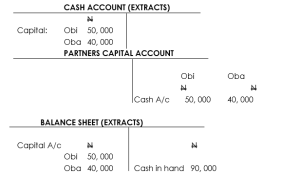
5c. Obi and Oba are partners in a firm of chartered accountants with initial capital contributions of N50,000 and N40,000 respectively which are to be kept fixed in the partnership books. You are required to show the cash account, partners’ capital accounts and balance sheet extracts.
Solution
6a. Define Partnership
6b. List seven items that should be contained in a partnership deed
6c. Explain the term Goodwill.
6d. List five circumstances that can give rise to the valuation of goodwill in partnership accounts
SS2 Further Maths Examination Question For Second Term
SENIOR TWO (2) S.S. 2
FURTHER – MATHEMATICS
2ND TERM EXAMINATION
SECTION A – OBJECTIVE
- The parabola is a locus of points, equidistant from a given point is called the_____(a) Focus (b) directrix (c) direct
- The parabola is a locus of points, equidistant from a given line is called the_____(a) Focus (b) directrix (c) direct
- Find the focus and directrix of the parabola y2 = 16x (a) F=3,0 , x = +4 (b) F=7,0 , x = -14 (c) F=4,0 , x = -4
- Find the equation of the tangent to a parabola y2 = 12x at point (3,6) ___is the equation of the tangent. (a) y + 2x +2 =1 (b) y + 2x +2 =0 (c) y + 2x +4 =0
- The _______ is the locus of a point P, moving in a plane such that the distance from two fixed points called the foci have a constant difference (a) parabola (b) hyperbola (c) perpendicular
- Find the vertices of the Hyperbola 25x2 – 16y2 = 400 (a) V1(4,0) and V2(-4,0) (b) V1(4,4) and V2(-4,6) (c) V1(4,3) and V2(-4,9)
- Find the foci of the Hyperbola 25x2 – 16y2 = 400 (a) F(
) and F(
) (b) F(
) and F(
) (c) F(
) and F(
)
- A ___ general may be defined as the locus of a moving point P, such that its distance fixed Point its distance from a fixed line (a) parabola (b) hyperbola (c) conic
- This constant ratio is called the___of the conic denoted by e. (a) electricity (b) eccentricity (c) elementary
- The coordinates of the centre of a circle is (-2, 3). If its area is 25πcm2, find its equation. (a) x2+y2−4x−6y−12=0 (b) x2+y2−4x+6y−12=0 (c) x2+y2+4x+6y−12=0 (d) x2+y2+4x−6y−12=0
- Find the equation of a circle with centre (2, -3) and radius 2 units. A. x2+y2−4x+6y+9=0. B. x2+y2+4x−6y−9=0. C. x2+y2+4x+6y−9=0.
- ______ could also be defined as the ratio of required outcome to the total outcome (a) range (b) probability (c) inequality
- If two fair dice are tossed together. What is the probability that the total score will be ten? (a) ½ (b) 1/12 (c) 1/14
- A class consists of 8 men and 7 ladies. Two students were selected randomly to represent the class in a debate. Find the probability that two students selected are (a) both ladies (b) both men A. 1/5, 4/15 B. 1/5 , 15/4 C. ¼, ¼
- _____ is defined as the number of arranged of objects. The different orders of arrangement are important (a) Probability (b) permutation (c) hyperbola
- Under permutation, Simplify this A. 5! (a) 130 (b) 140 (c) 120
- Under permutation , Simplify this
(a) 53 (b) 35 (c) 25
- Which of the following is not a type of permutation? (a) cyclic (b) conditional (c) contemporary
- Using Pascal’s triangle, expand and simplify completely: (2x + 3y)4 A. 16x4 + 96x3y + 216x2y2 + 216xy3 + 81y4 B. 19x4 + 96x3y + 216x2y2 + 216xy3 + 88y4 C. 17x4 + 94x3y + 216x2y2 + 216xy3 + 81y4
- Using Pascal’s triangle, simplify, correct to 5 decimal places (1.01)4 (a) 1.04060 (5 d.p) (b) 1.4060 (5 d.p) (c) 1.04077 (5 d.p)
- If the point of application of a force is displaced, the force is said to do___(a) work (b) constant (c) force
- ____ is the rate at which work is being done (a) work (b) power (c) force
- The work done in bringing a particle of mass m from rest to a velocity v is called the___ (a) velocity 9b) heat energy (c) kinetic energy
- A_____ is an object launched into the air and allowed to move on its own freely under gravity (a) probability (b) projectile (c) energy force
- A stone is thrown vertically upwards from the front with a velocity of 50m/s, Calculate The maximum height reached (a) 124m (b) 126m (c) 125m
- _____ is the idle resources of any organization or enterprise. It is the physical stock of goods that are kept for future use. (a) stock (b) inventory (c) purchase
- ___ is when you keep some stock of goods to meet the uncertainty demand and supply (a) buffer inventory (b) anticipatory inventory (c) inventory
- _____ denote the horizontal projectile motion or the horizontal component of displacement of the projectile motion (a) y (b) x (c) yx
- _____ denote the vertical projectile motion or the vertical component of displacement of the projectile motion (a) y (b) x (c) yx
- The distance from the starting point on the ground to the landing point on the ground is called the range of the____ (a) projectile (b) trajectory (c) probability
SSS 2 Further Maths Exam Questions Objectives (OBJ) Answers
1.A 2.B 3.C 4.B 5.B
6.A 7.A 8.C 9.B 10.D
11.A 12.B 13.B 14.A 15.B
16.C 17.B 18.C 19.A 20.A
21.A 22.B 23.C 24.B 25.C
26.B 27.A 28.B 29.A 30.B
THEORY
1a. Write down the equation of the parabola y2– 4y-12x+40 = 0 , in its canonical form and hence find (i) the vertex; (ii) the focus; (iii) the directrix of the parabola
SOLUTION
y2– 4y-12x + 40 = 0
y2– 4y-+4-12x+40 = 0+4 …. (completing the square)
y2– 4y+4 = 12x – 36 …… (rearranging)
(y – 2)2 = 12(x-3) …… (factorising)
But (y – y1)2 = 12(x-x1)
i) hence vertex (x1,y1) = (3,2)
ii) since 4a = 12, a = 3 then the focus (x1+a,y1) = (3+3,2) = (6,2)
iii)the equation of the directrix is x = 3-3 ie x=0
note that the thedirectrix is of equal but opposite distance from the vertex with thefocus
this means the distance between the focus and the vertex = the distance between the directrixand the vertex
1b. Find the equation of the tangent and normal to a parabola (i) y2 = 12x at point (3,6)
ii) y2 = 16x at point (1, -4)
SOLUTION
ii)y2 = 16x , compare with y2 = 4ax, thus a= 4
equation of tangent
=
‘
=
Thus
y + 2x +2 =0 is the equation of the tangent
equation of the normal
= –
,
= –
Thus
2y –x + 9 = 0 is the equation of the normal
2.. Find the foci and four vertices of the ellipse +
= 1
3. Write down the equation of the ellipse 25x2+ 4y2-50x-16y-59 = 0 in the canonical form and
hence find
i) the coordinates of the centre of the ellipse
ii) the four vertices of the ellipse
iii) the two foci of the ellipse
SOLUTION
1. +
= 1
Since a>b , then
+
=
+
By inspection,
a2=25 and b2=9 thus a=+5 or -5 , b= +3 or -3 and c = + or –
c2=a2-b2 , c= +4 0r -4
i) the foci f(0,c) = f1(0,4) and f2(0,-4)
ii) the vertices V(a,0) = V1(3,0) and V2(-3,0)
the co-vertices V(0,b) = V3(o,5) and V4(o,-5)
2. 25x2+ 4y2-50x-16y-59 = 0
25x2-50x + 4y2-16y = 59
25(x2-2x +1-1)+ 4(y2-16y+4-4) = 59
25(x2-2x +1) -25+ 4(y2-16y+4)-16 = 59
25(x2-2x +1) + 4(y2-4y+4) = 100
25(x-1)2+ 4(y-2)2 = 100
+
= 1
But +
= 1
By inspection,a = +5 or -5 and b = +2 or -2
i) the coordinates of centre = (1,2)
ii) the vertices of the vertical axis are
V(0+x1,a+y1 ) = V1(1,7)
V(0+x1,-a+y1 ) = V2(1,-3)
vertices of the vertical axis are
V(b+x1 , 0 + y1) = V3(3,2)
V(-b+x1 , 0+y1) = V4(-1,2)
iii) the two foci are
F(0+x1,c+y1 ) = F1(1 , +2)
F(0+x1,-c+y1 ) = F1(1 , +2)
4. Find the equation of the circumcircle of the triangle whose vertices are A (2,3) B (5,4) and C (3,7)
SOLUTION:
The equation of the circle x2 + y2 + 2gx + 2fy + c = 0
22 + 32 + 4g + 6f + c = 0
52 + 42 + 10g + 8f + c = 0
32 + 72 + 6f + 14f + c = 0
Simplify the 3 equations
f = – 107 / 22
g = – 67 / 22
c = – 312 / 11
Hence, the equation of the circle is
x2 + y2 + 2 x + 2
y +
= 0
11x2 + 11y2 – 67x – 107y + 312 = 0
a = 3, b = -2, r2 = 16,
r = = 4
hence the centre is (3, -2) and the radius is 4 unit
- 5. From a box containing 2 red,6 white and 5 black balls, a ball is randomly selected . What is the Probability that the selected ball is (i) black (ii) white (iii) not black?
Solution:
Sample space = 2+ 6 + 5 = 13
n(red) = 2, n(white) = 6, n(black) = 5
- Prob. (black) = 5/13 (ii) Prob. (white) = 6/13
- Prob. (not black) = 1 – prob. (black)
- = 1 – 5/13 = 8/13
6. In a single throw of two fair coins. Find the probability that : (i) two tails appear (ii) one head one tail appear (iii) two heads appear (iv) one tail one head in that order.
SOLUTION:
S= {HH, HT, TH, TT} = 4
- Pr (two tails) = {TT} = ¼
- Pr (=one head one tail) = {HT, TH} = 2/4 = 1/2
- Pr (two heads) = {HH} = ¼
- Pr (1 head 1 tail in that order) = (HT) = 1/4
7. Two gubernational aspirants A and B in two different states of Nigeria have probabilities 2/9 and 4/11 respectively of winning in an impending election. Fid the probability that: (a) both of them win in their respective states; (b) both of them lose in their respective states; (c) at least one of them wins in his state.
Solution:
Aspirants: A B
Pr (A wins) + pr (A losing) = 1, Pr(Bwins) + Pr(B losing) = 1
Pr (A losing) = 1 – 2/9 Pr (B losing) = 1- 4/11
=7/9 7/11
- Pr(both winning) =2/9 x 4/11
= 8 /99
- Pr(both winning) = 7/9 x 7/11 = 49/99
- Pr (at least one wins) = Pr (A wins & B loses) or Pr(Bwins&Aloses) or Pr (A wins & B wins)
= (2/9 x 7/11) + (4/11 x 7/9) + (2/9 x 4/11)
= 11/99 + 28/99 + 8/99 = 50/99.
- 8.. Using permutation to solve this, Find the number of ways of arranging the letters of the word MACHINE
SOLUTION:
There are seven different letters in the word MACHINE, therefore the number of permutation is 7! = 7x6x5x4x3x2x1 = 5040 ways
- Simplify (n + 1)! = (n+1)n! = n+1
(n-1)! (n-1)n! n-1
9.. Evaluate: (a) 8p3 (b) 11p9
SOLUTION:
- 8P3 =
=
=
= 8x7x6 = 336
- 11P9=
= 11x0x9x8x7x6x5x4x3x2! = 19958400
- In how many ways can three people be seated on eight seats in a row?
Solution:
1st seat can be occupied by any of the 8 = 8 ways
2nd seat can be occupied in 6 ways
Hence, the number of ways = 8x7x6 = 336 ways
Alternatively, n = 8, r = 3
nPr = =
=
= 8x7x6 = 336 ways
10.. What is the acceleration at the time when the car is moving up the inclined plane at 40ms-1? (Take g= 10ms-2)
Solution
Let P be the power developed by the car.
Let W be the work done.
Let F be the tractive force of the car
P = (w)
= (f
)
A tennis ball is projected horizontally from the top of a vertical cliff 50m high with a velocity of 10ms-1.
Find:
(a) The time to reach the ground.
(b) The vertical component of the velocity when the ball hits the ground.
(c) The distance from the foot of the cliff where the ball hits the ground.
SOLUTION
(a) The ball falls vertically under the influence of gravity. Its vertical motion is independent of the horizontal motion.
Initial vertical velocity = 0, acceleration a = g, h = 50m
Recall from equations of motion, S = ut + ½at2
h = ut + ½gt2
50 = 0 + ½ x 10 x t2
50 = 5 t2
t2 = 10
t =
t = 3.16s.
(b) Let v be the vertical component of the velocity when the stone hits the ground.
From equations of motion, v = u + at.
v = u + gt
v = 0 + 10 x 3.16
v = 31.6ms-1.
(c) Let s be the distance from the foot of the cliff where the ball hits the ground. The initial horizontal velocity is 10ms-1 and not affected by vertical acceleration therefore, a = 0.
From equations of motion, S = ut + ½at2
S = ut + 0 (since a = 0)
S = 10 x 3.16
S = 31.6m.
11. (a) Define Inventory (b) List 3 types of inventory and explain 2 (c) Write the full meaning of (I) DAV (II) TL (III) DL
SS2 Geography Examination Question For Second Term
SENIOR TWO (2) S.S. 2
GEOGRAPHY
2ND TERM EXAMINATION
SECTION A – OBJECTIVE
- The type of water that is tightly held by the soil particles such that it is never available to the plant is known as (a) Capillary water (b) Hygroscopic water (c) Gravitational water (d) Field capacity.
- Which of the following soils is made up of mainly quartz particles?(a) Clay soil (b) Sandy soil (c) Loamy soil (d) Humus soil
- The best soil for agricultural activities is (a) Loamy soil (b) Sandy soil (c) Clay soil (d) Compost soil
- The remains of the decomposition of plants and animals in soil constitute…….. (a) mineral matter (b) organic matter (c) soil water (d) living organisms
- The smallest soil particle is __________ (a) Silt (b) Sand (c) Gravel (d) Clay
- The cheapest means of transportation is (a) air (b) water (c) rail (d) road
- The best way to get an urgent medi-care service internationally is by (a) water transport (b) road transport (c) air transport (d) rail transport
- The safest means of moving goods and passengers from one country to another is by ________ transport (a) air (b) road (c) rail (d) water
- The means of transport that is more prone to accident is (a) water (b) air (c) road (d) rail
- One advantage of inland water-ways is that (a) they are flexible (b) they are fast (c) goods are transported cheaply (d) it is affected by seasonality
- Which of these industries produce biro, slippers, and school wears (a) Heavy industries (b) Primary industries (c) Tertiary industries (d) Light industries.
- The following are primary industries except (a) nursing (b) fishing (c) lumbering (d) hunting
- One of the following is not a reason for sitting industries in Nigeria (a) large labour force (b) Nearness to banks (c) Availability of market (d) presence of social amenities
- The following are characteristic of manufacturing industries except (a) small scale in nature (b) produce mainly exported goods (c) absence of indigenous skilled labour (d) they require large labour force
- Which of these towns is known for textile making (a) Akwette (b) Bida (c) Lagos (d) Benin city
- Light industry is predominant in West Africa because of (a) inadequate capital (b) sparse population (c) inadequate power supply
- The role of transport in economic development of any nation include all except (a) national disintegration (b) movement of goods and services (c) opening up new areas
- Which of the following is the major export commodity of Nigeria? (a) cocoa (b) palm oil (c) crude oil
- All are commodities exported by Nigeria except (a) groundnut (b) corn beef (c) rubber
- All are benefits of international trade to Nigeria except (a) makes the country a dumping ground (b) increases foreign exchange (c) creates employment
- Enlarge the scale 1:100,000 by 3 times (a) 1:300,000 (b) 1:33,000 (c). 1:150,000 (d) 1: 500,000
- The presence of marshy area signifies —————- (a) Educational function (b) Social function (c) Swamp rice cultivation (d) Livestock and farming
- The presence of features like forest indicates —————- (a) Farming and lumbering (b) Commercial function (c) Administrative function (d) Residential function
- The presence of hotels and stadium signifies ( a) Social function (b) Educational function (c) Farming and lumbering (d) Administrative function
- In relating communication to settlement, the presence of minor roads and foot paths are common features of ———————– (a) Urban settlement (b) Rural settlement (c) Town (d) City
- The most populous country in the world is ____ (a) Nigeria (b) Indonesia (c) China
- The best type of population concept is _______population. (a) under (b) optimum (c) over
- One of these cannot reduce world population? (a) polygamy (b) monogamy (c) celibacy
- The major reason for the high population density in India is the _______ (a) presence of Iron ore in the Ganges (b) Early marriages in the Ganges delta (c) India is the seat of civilization for Hindus religion
- One of these areas is sparsely populated _________ (a) The Rurh region of Germany (b) The Pittsburgh region of North-East USA (c) The Amazon basin of South America
- One of these is NOT a factor for siting a settlement. (a) Good soil condition (b) Good communication network (c) To preserve slavery
- The smallest type of settlement is called ______ (a) Village (b) Hamlet (c) Homestead
- When several towns join together but each town still retains its identity it is called ______(a) conurbation (b) nuclear town (c) Megalopolis
- The type of settlement located along major transportation routes is called ______ settlement. (a) dispersed (b) Linear (c) Nucleated
- One of these is not a major function of a rural settlement? (a) Agricultural function (b) Industrial function (c) Religious function
- There are ____main patterns of settlement. (a) three (b) four (c) five (d) two
- There are_____major types of urban settlements. (a) five (b) two (c) Four (d) six
- _____ is the largest type of urban settlement made up of large cities with several millions of people (a) conurbation (b) megalopolis (c) city (d) town
- _____ is a large nucleated rural settlement formed from the combination of several hamlets (a) village (b) hamlet (c) homestead (d) city
- There are____main types of settlements.(a) three (b) one (c) two (d) five
- Some of the factors that promote the growth of towns, cities or states and finally lead to be called ______(a) urbanic (b) urban (c) tourbanization (d) organization
- A _______is defined as a place containing one or more buildings with people living in them. (a) home (b) settlement (c) town (d) rural
- The following problems are associated with high population growth except ____(a) increase in crime rate (b) inadequate housing (c) traffic congestion (d) monogamy
- ________ population exists when the given population of a country is considered too large for the available resources for people to enjoy the highest possible standard of living. (a) over (b) under (c) optimum
- _____ is defined as the number of persons per unit area of land or per square kilometer of land. (a) over-population (b) under-population (c) population density
- ____ is defined as the number of people living in an area at a particular time. (a) density (b) population (c) settlement (d) country
- In Africa,_______is the most populous country with approximate population of over 160million people. (a) Nigeria (b) Ghana (c) Cameroon (d) Togo
- ____ is defined as a way of knowing whether one point or place on the map can be seen from another point or place on the same map. (a) topographical (b) maps (c) inter-visibility (d) intra-visibility
- _____ is a permanent mark made on objects like walls, building and bridges. It indicates the actual height which is usually written on the object. (a) bench mark (b) contours (c) layering (d) form lines
- ____ sign represents hospital or dispensary (a) +++++++++ (b) + (c) ==========
SSS 2 Geography Exam Questions Objectives (OBJ) Answers
1.B 2.B 3.A 4.B 5.D 6.B 7.C 8.A 9.C
10.C 11.D 12.A 13.D 14.A 15.A 16.A 17.A
18.B 19.B 20.A 21.A 22.C 23.A 24.A 25.B
26.C 27.B 28.C 29.B 30.C 31.C 32.C 33.A
34.B 35.B 36.A 37.C 38.B 39.A 40.C 41.C
42.B 43.D 44.A 45.C 46.B 47.A 48.C 49.A
50.B
OBJECTIVES = 50 ÷2 = 25
THEORY
(ANSWER 9 QUESTIONS ONLY )
( 9 x 5 = 45)
- What is soil?
- State factors affecting soil formation.
- Mention five processes of soil formation.
- Differentiate between rotation and revolution.
- What is transportation? And State the mode of transportation.
- What are the problems facing transportation in Nigeria?
- Define an industry? And State the types of industry.
- Which type of industry engages in provision of finance for other industries?
- Explain the classification of manufacturing industries in Nigeria.
- Choose any one of these countries and name three major products which Nigeria imports from her.
- State three procedures in interpreting communication on topographical maps.
- What do you understand by “land use”?
- Explain map reduction. And Explain the procedures involved in reducing a map.
- What is settlement? And Mention two types and reasons for settlement.
- Outline any four functions of either the rural or the urban settlement.
SS2 Government Examination Question For Second Term
SENIOR TWO (2) S.S. 2
GOVERNMENT
2ND TERM EXAMINATION
SECTION A – OBJECTIVE
- _____ is a form of government that is controlled or headed by a traditional ruler (a) traditional government (b) village government (c) local government (d) state government
- ______is a group of people chosen or elected to make rules and regulations to guide the behaviour of the citizens.(b) democracy (b) society (c) government (d) community
- _____ is a form of traditional government in which supreme power is in the hands of one person in which the country is ruled by a king or queen. (a) oligarchy (b) monarchy (c) government (d) system
- ______ is another traditional form of government in which a few people who are powerful or privileged rule. (a) monarchy (b) oligarchy (c) aristocracy (c) democracy
- In ____ government, what we now have is constitutional monarch or ceremonial monarch whose powers are controlled by the constitution. (a) modern (b) ancient (c) old (d) time
- _____is the traditional government rule by the wealthiest in society. (a) aristocracy (b) plutocracy (c) oligarchy (d) government
- _____ is a government of individuals who own land and command great respect among the people. (a) aristocracy (b) plutocracy (c) oligarchy (d) government
- ______is a form of oligarchy in which the affairs of the state and religion are controlled by one person. The laws of God are taken to be the laws of the state. (a) oligarchy (b) aristocracy (c) monarchy (d) theocracy
- A constitutional government could either be presidential or parliamentary. (a) True (b) False (c) Maybe (d) I don’t know
- ______ system of government is headed by the prime minister. The executive and the legislative arms of government are not separated. (a) presidential (b) parliamentary (d) democracy
- ______ system of government is headed by a president elected by the people. He rules for a fixed period, e.g. four years or five years. The three arms of government are separate in their composition. (a) presidential (b) parliamentary (d) democracy
- West African countries came under the colonial rule of Britain, France, Germany and Portugal (a) True (b) False (c) Maybe (d) I don’t know
- the whole of West African countries came under the colonial rule of Britain, France, Germany and Portugal except ______country (a) Cameroon (b) Gambia (c) Uganda (d) Liberia
- _____ rule is a system adopted by the British to rule her colonies with use of local chiefs or other appointed intermediaries and traditional laws and customs with British officials merely supervising the administration. (a) direct (b) indirect (c) directed (d) non-directed
- Which one of the following is NOT a reason for colonialism. (a) search for raw materials (b) introduction of slavery (c) to kill the missionaries
- Which one of the following is NOT a role of traditional rulers in indirect rule system. (a) collection of taxes (b) link between local and government (c) control the white men
- Nigerian state by 1900 and subsequent Amalgamation by 1914, it would be recalled that classical Lugardian indirect rule is nothing other than ______________ (a) economic exploitation (b) economic finances (c) economic pandemic (d) economic development
- The territories of Nigeria nation state by Lord Lugard and his colleagues the indirect rule system was a success in ______Nigeria (a) Southern (b) Northern (c) Eastern
- Which of the following was a positive impacts of colonial rule in West Africa. (a) Absence of rulers (b) Appointment of warrants (c) Aba women riot (d) Exposure of western education
- Which of the following was a negative impacts of colonial rule in West Africa. (a) development of political parties (b) introduction of currency (c) creating problems of unity (d) education
- _______ formed the Nigerian National Democratic party in 1923 to provide a platform on which he spripad his anti-colonialist ideas He co-founded the daily news with Dr caulcrick. (a) Dr Nnamdi Azikwe (b) Herbert Macaulay (c) Chief Obafemi Awolowo (d) Buhari
- ______ was co-founder and the editor of the West Africa pilot from 1937 1940 (a) Dr Nnamdi Azikwe (b) Herbert Macaulay (c) Chief Obafemi Awolowo (d) Buhari
- _______was a co-founder of the Trades Union Congress in 1943, a very active nationalist trader union. As the premier of the western region from 1954-1959, he introduced important reforms, one of which was the policy of free education in 1955. (a) Dr Nnamdi Azikwe (b) Herbert Macaulay (c) Chief Obafemi Awolowo (d) Buhari
- MacPherson’s constitution gave rise to ______ constitutional conferences in 1953 and 1954, the first in London and the other in Lagos (a) 2 (b) 3 (c) 4 (d) 5
- The Governor General of Nigeria in 1954 was (a) NnamdiAzikiwe (b) Oliver Lyttleton (c) Sir Bourdillon (d) Sir Lord Lugard
- The following were the main provision of the Lyttleton’s constitution except (a) Elective principle (b) Establishment of federalism (c) Division of power(d) establishment of the office of the regional premier
- The 1953 Constitutional Conference was held in (a) Calabar (b) Lagos (c) London (d) Ghana
- One of the failures of the Lyttleton’s Constitution was that (a) no provision was made for the office of the prime minister (b) it introduced federal structure (c) it made ministers heads of departments
- ______ is regarded as the first Federal Constitution of Nigeria (a) Clifford’s constitution (b) Macpherson’s constitution (c) Lyttleton’s constitution
- The Lagos constitutional conference was held in (a) 1953 (b) 1958 (c) 1957
- All but one of the following were the recommendations made by the Willinks commission (a) to entrench fundamental human rights in the constitution (b) to create more states (c) to establish special development board for Niger Delta
- The last constitutional conference held before independence was in (a) Lagos (b) London (c) Calabar
- According to the recommendation made at the end of the London Constitutional conference of 1957, the northern was to be granted self government in (a) 1959 (B) 1952 (C) 1956
- The first Nigerian prime minister was (a) Alhaji Tafawa Balewa (b) Nnamdi Azikiwe (c) Yakubu Gowon
- The first Nigeria prime minister was (a) Abubarka Tafawa Balewa (b) Shehu Shagari (c) Aguiyi Ironsi (d) Obafemi Awolowo
- The 1960 constitution adopted —– in Nigeria (a) Presidential system (b) parliamentary system (c) unitary system (d) con-federal
- The following were the provisions of the 1960 constitution except (a) It adopted a parliamentary system (b) The senate was given power over money (c) it introduced unicameral legislature (d) Governor general became the ceremonial president.
- Nigeria got her independence on (a) 2nd October 1960 (b) 1st October 1960 (c) 1st November 1960 (d) 3rd of February 1961
- The head of state under the 1960 constitution was (a) Nnamdi Azikiwe (b) Tafawa Balewa (c) Yakubu Gowon (d) Obafemi Awolowo
- The 1963 Constitution adopted—system of government (a) federal (b) unitary (c) parliamentary (d) con-federal
- Under the 1963 constitution—-was supreme (a) the parliament (b) the constitution (c) the congress (d) the President
- The following were the features of the 1963 constitution except (a) it was a republican government (b) supreme court replaced privy council (c) Queen of England was still the head of state (d) fundamental human rights were fully guaranteed
- One of the following was the achievement of the 1963 constitution (a)Elected president became the head of state (b) The privy council was still the final court (c) Rights of citizen was not guaranteed (d) the queen of England was still the head of State
- The head of state under the 1963 Constitution was (a) Abubakar Tafawa Balewa (b) Nnamdi Azikiwe (c) Olusegun Obasanjo (d) Obafemi Awolowo
- The term used in removing a president in a Presidential System of Government is called (a) vote of no confidence (b) impeachment (c) suspension (d) termination
- Under the 1979 Constitution, other members of the federal executive council other than the president were called (a) senators (b) supervisory councilors (c) ministers (d) commissioners
- Under the 1979 Republican Constitution, the president was elected by (a) electorates (b) senate (c) electoral college (d) National Assembly
- All but one of the following was a feature of the 1979 Constitution (a) Clear separation of power (b) Lobbying was allowed (c) There was fusion of power (d) The president was popularly elected.
- Under the 1979 Republican Constitution, ministers were responsible to the (a) parliament (b) president (c) senate (d) Chief Judge
- The 1999 constitutions provides for _______local government councils (a) 774 (b) 775 (c) 760
SSS 2 Government Exam Questions Objectives (OBJ) Answers
1.A 2.C 3.B 4.B 5.A 6.B 7.A 8.D 9.A
10.B 11.A 12.A 13.D 14.B 15.C 16.C 17.A
18.B 19.D 20.C 21.B 22.A 23.C 24.A 25.B
26.A 27.C 28.A 29.C 30.B 31.B 32.A 33.A
34.A 35.A 36.B 37.C 38.B 39.B 40.C 41.B
42.C 43.A 44.B 45.B 46.C 47.A 48.B 49.B
50.A
OBJECTIVES = 50 ÷2 = 25
THEORY
(ANSWER 5 QUESTIONS ONLY )
( 5 x 9 = 45)
- Discuss the features of the 1979 Constitution.
- Discuss the merits of the 1979 Constitution.
- Highlight 5 achievements of the Second Republican Constitution of 1979.
- What is Lobbying?
- State 5 differences between 1963 and 1979 Republican Constitution.
- (a) What is Policy of Assimilation? (b) Give 5 features of the policy.
- What is collective responsibility?
- Mention five achievement of the 1979 constitution
- Highlight the features of the independence constitution
- What were the achievements of the constitution?
- What were the major decisions reached at the 1957 constitutional conference?
- What were the recommendations made by the Willinks commission?
- Explain the major important provisions of the Lyttleton constitution.
- State 3 Advantages and Disadvantages of colonial rule
- Define direct Rule and Indirect rule
SS2 ICT Examination Question For Second Term
SENIOR ONE (2) S.S. 2
I.C.T
2ND TERM EXAMINATION
SECTION A – OBJECTIVE
- A _____ is a collection of wires through which data is transmitted from one part of the computer to another (a) address (b) host (c) web (d) BUS
- Which of the following is NOT a type of register? (a) C.I.R (b) SQR (c) OS (d) MDR
- Main memory is also known as ____ (a) ROM (b) EPROM (c) RAM (d) Register
- _____ is a temporary storage in the CPU that hold the data when the processor is currently working on (a) register (b) main memory (c) device (d) memory
- ________is used to reference a storage location in main memory (a) driver (b) address (c) bucket
- There are ___ basic categories steps in data conversion (a) 6 (b) 5 (c) 4 (d) 3
- Which one of the following is NOT parts of the cycle instruction (a) decode (b) encode (c) fetching
- Which one of these is NOT factors affecting speed of data transfer? (a) bus speed (b) code (c) bus width (d) data transfer medium
- Which one of these is NOT comprises of Code? (a) numbers (b) data (c) letters (d) special characters
- _____ item is the smallest unit of information stored in computer file (a) field (b) data (c) file (d) record
- ______is a collection of related data items or fields (a) field (b) record (c) data (d) basic
- Which one of the following is NOT types of organization method? (a0 serial (b) categorized (c) indexed (d) random
- Which one of these is NOT method of Accessing files? (a) Random (b) Sequential (c) Serial (d) Alphabetical
| A | B | C | D | |
| Students Name | Maths | English | Total | |
| 1 | Nifemi | 90 | 80 | |
| 2 | Ade | 75 | 85 | |
| 3 | Segun | 46 | 87 | |
| 4 | James | 94 | 68 |
14. The name of the application package above is called____(a) Ms Excel/Spreedsheet (b) Ms words (c) Ms Powerpoint
15. What is the total score of Bola using the formula of_____(a_ =sum (B:C) (b) SUM= (B:D) (c) =Sum (B1:C1) (d) SUM (B1:C1)=
16. What is the total score of all students using the formula of ____ (a) =SUM ( B:C) (b) SUM= (B:C) (c) SUM= (B1:C4 (d) =SUM (B4:C4)
17. This symbol / IN Ms excel or spreadsheet is called _____(a) average (b) division (c) sqaureroot (d) addition
18. One of the function of the above application is (a) payroll (b register note (c) game play (d) typing
19. CLS in Basic statement is ____(a0 clear screen (b) clear view (c) clear input (d) clear
20. Computer____ means computer system is vulnerable to attack and constant battle to improve security (a) file manager (b) file insecurity (c) file security (d) file explorer
21. Which one of these is NOT methods of file insecurity (a) backup (b) antivirus (c) password (d) manual file
22. ____file carry out various types of tasks and it is productive (a) manual (b) automatic (c) computer (d) device
23. Which of these is NOT an effect of insecurity of files (a) modem (b) data loss (c) over writing (d) data loss event
24. ____is the process of using a software to create, edit, view, store, retrieve, format and print textual documents (a) Word processing (b) Corel draw (c) power point (d) paint
25. Which one of these is NOT examples of word processing packages? (a) perfect writer (b) word stars (c) graphics (d) word Pro
26. ______ comes in a software suite (a) Microsoft office (b) Microsoft tools (c) Microsoft access
27. A word processor is a software that is used for word____(a) creating (b) viewing (c) processing
28. ____display document a user is currently work on or other document that were opened by the user (a) status bar (b) text area (c) task bar (d) bar
29. The third steps in loading or opening MS WORD is____(a) click on all programs (b) click on start (c) click on Microsoft office (d) GO TO Microsoft office
30. Which one of these is NOT features of a paragraph formatting in MS word (a) spacing (b) tabs (c) indent (d) drop cap
SSS 2 ICT Exam Questions Objectives (OBJ) Answers
1.D 2.C 3.C 4.A 5.B
6.A 7.B 8.B 9.B 10.B
11.B 12.B 13.D 14.A 15.C
16.D 17.B 18.A 19.A 20.B
21.D 22.A 23.A 24.A 25.C
26.C 27.C 28.C 29.D 30.D
SECTION B
– THEORY- Answer 3 out of 5
1A. Define Word Processing
1B. List five (5) features of a word processor / MS word
1C. List 3 version of Microsoft office
2A. Define File Insecurity
2B. Define Backup and List 2 types
3A. List 3 methods of file security
3B. Write 2 differences between manual file and computer file
4A. List 3 Basic operations of computer files
4B. What is Code?
4C. What is a file?
5A. List 2 methods of accessing files
5B. Write or draw the file structure orderly
SS2 Literature in English Examination Question For Second Term
SENIOR TWO (2) S.S. 2
LITERATURE-IN-ENGLISH
SECTION A – OBJECTIVE
- Which of the following is not a background of invisible man novel? (a) slavery (b) physical bondage (c) segregated schools (d) equal rights
- Which of these is not plot account at Invisible Man novel? (a) black American in twentieth century (b) a successful man (c) unlearned man (d) uncultured
- Tod Clifton left the brotherhood as a result of their__ (a) unity (b) peace (c) disillusionment (d) poverty
- _____ introduced Tod Clifton to the brotherhood and also was his mentor (a) Tom Wilson (b) Brother Jack (c) Jack Dowell
- ______ gives directives that the Narrator should be killed (a) Brother Jack (b) Clifton (c) Ras the Exhorter
- _____ is married to one of the leaders of the brotherhood group (a) Sybil (b) Cyril (c) Mary Rambo
- Which of the following is not a setting in the novel Invisible man? (a) dominance of white (b) oppression of the blacks (c) justice (d) injustice
- One of the major even in the novel is _____(a) The Battle Friends (b) The Battle Royal (c) The Gate fall
- The invitation to attend the Battle Royal programme had come from the school____(a) principal (b) superintendent (c) mistress (d) masters
- The direct manifestation of the racist tendencies of white-dominated America in the novel is called___(a) invisible man (b) invisible woman (c) invisibility
- The Narrator, being skeptical, answers his questions. Brother Jack continues to talk to him. The word being skeptical means_____(a) allowed (b) aware (c) assured (d) doubtful
- The Narrator listens to Mary Rambo as she sings _____(a) Black water blues (b) black white blues (c) black water white
- Was the Narrator successful in disposing of Mary’s Piggy bank? (a) Yes (b) No (c) Maybe
- Washington, in his time, publicly preached subservience of the balck folks to the white folks. What does subservience stands for? (a) obey others without questioning (b) obey others with questioning (c) not ready to obey to the end
- Why did Mary not accept the Hundred-dollar bills from the Narrator? (a) she does not any white person to date her (b) She does not want any white person to accuse her of theft. (c) she is married
- Wuthering Heights concerns the interactions of___families over three generations (a) 1 (b) 3 (c) 2 (d) 4
- The novel is set in the____ of Yorkshire and covers the years from 1771 to 1803 (a) cliff mountain (b) village square (c) museum (d) desolate moors
- The Earnshaws and Lintons are in___with their environment, but their lives are disrupted by an outsider (a) chaos (b) misunderstanding (c) harmony
- ____ is an emblem of the social problems of a nation entering the age of industrial expansion and urban growth (a) Bronte (b) Heathcliff (c) Lintons
- _____sets the action of the novel entirely within the locale familiar to her. (a) Bronte (b) Heathcliff (c) Lintons
- ____ is a companion and servant in the Earnshaw and Linton households, and she shares many of the values and perceptions of the families (a) Lockwood (b) Nelly (c) Lintons
- What is the name of the village near Wuthering Heights?
(A) Loch Crag (B) Gimmerton (C) Heatherton (D) Purvey - In what region of England was Emily Brontë raised?
(A) Sussex (B) Gloucestershire (C) Yorkshire (D) Warwickshire - Who plans to live at Thrushcross Grange at the end of the novel? (A) Young Catherine and Hareton (B) Lockwood
(C) Heathcliff (D) Young Catherine and Linton Heathcliff - On what day do young Catherine and Hareton plan to be married? (A) New Year’s Day(B) The Ides of March
(C) The anniversary of Heathcliff’s death (D) Valentine’s Day - Why does young Catherine climb over the garden wall?
(A) To escape from the Grange (B) To meet with Linton
(C) To retrieve her hat, which fell off as she stretched for the fruit of a tree - Who raises Hareton during the early years of his life?
(A) Hindley (B) Heathcliff (C) Catherine (D) Nelly - Who does Lockwood believe would have given young Catherine a fairy tale life, if only she would have fallen in love with him? (A) Heathcliff (B) Hareton (C) Linton (D) Lockwood
- Which of the following characters dies first? (A) Mrs. Earnshaw (B) Mr. Earnshaw (C) Mrs. Linton (D) Edgar Linton
- Which of the following characters dies first? (A) Mrs. Earnshaw (B) Mr. Earnshaw (C) Mrs. Linton (D) Edgar Linton
SSS 2 Literature Exam Questions Objectives (OBJ) Answers
1.D 2.D 3.C 4.B 5.C
6.A 7.C 8.B 9.B 10.C
11.D 12.A 13.B 14.A 15.B
16.C 17.D 18.C 19.B 20.A
21.B 22.B 23.C 24.A 25.A
26.C 27.D 28.D 29.A 30.C
THEORY-
1a. Write 5 Major themes and events in the story Invisible Man
1b. Mention 5 characters and their roles
2a. Write the name of the author of Invisible and the purpose of the writer.
3a. Write and explain any 3 themes in Wuthering Heights
3b. Write 3 major events and 3 characters with their roles
SS2 Marketing Examination Question For Second Term
SENIOR TWO (2) S.S. 2
MARKETING
2ND TERM EXAMINATION
SECTION A – OBJECTIVE
- Marketing firms decision on the choice of transportation to the end users is influenced by___(a) cost advantage (b) reselling (c) social media
- Which of the following is not documents used in transportation in marketing? (a) bill of lading Airway bill (c) teller machine
- ___ is referred to as a place or storehouse where goods are kept until they are needed (a) market (b) warehouse (c) shops
- Which of the following is not importance of warehousing (a) future storage (b) generate corruption (c) generate revenue
- Which of the following is not factors to be considered when sitting a warehouse (a) operating cost (b) location (c) age (d) transportation
- ____ is a warehouse where goods that are imported are kept until the duties on them are paid (a) state warehousing (b) bonded warehousing (c) manufacturer warehousing
- ____ is a warehouse owned by the government where prohibited or seized goods are kept until they are sold (a) state warehousing (b) wholesale warehousing (c) bonded warehousing
- ____ is the process of storing or keeping goods such as raw materials, semi-finished products, and equipment in a safe place until they are needed (a) market (b) storage (c) warehousing (c) production
- ____ owned by are under the supervision of the Customs Authority (a) Bonded warehousing (b) state warehousing (c) public warehouse
- ____ is a warehouse where seized contraband goods (e.g smuggled goods) are kept until they are sold on auction (a) public warehouse (b) state warehouse (c) bonded warehouse
- ____ warehouse provides security (safety) for goods imported from other countries whose duties have not been paid (a) state (b) public (c) bonded
- The receipt issued by a warehouse keeper for goods taken into the store is called__(a) warranty (b) dock warrant (c)customs warrant (d) drawback warrant
- Warehousing is one of the functions of the (a) wholesaler (b) retailer (c) government (d) ministry of trade and industry
- Which of the following warehouses is generally found near a port?…warehouse (a) manufacturer (b) wholesaler (c) bonded (d) distributors
- Who among the following is a middleman? (a) manufacturer (b) agent (c) insurer (d) consumer
- An individual who makes the final use of goods and services provided by a firm is the (a) wholesaler (b) retailer (c) consumer (d) manufacturer
- ____warehouse may be called goods warehouse – i.e where goods are stored by traders and manufacturer until they are needed (a) state (b) ordinary (c) bonded
- A_____is anything that can be offered to a market to satisfy a want or need. (a) product (b) warehouse (c) items
- Product concept focuses on quality or superior performance or innovative features (a) True (b) False
- Production concept does not focuses on mass production, mass distribution and low price. (a) True (b) False
- ___ are goods that need to undergo processing. They are raw materials that would be converted into semi-finished or finished goods (a) primary (b) secondary (c) industrial
- ___ are all farm produce that have not undergone processing. Examples include cotton wool, yam tuber (a) primary (b) secondary (c) industrial
- _____ are all farm produce that have undergone processing. Examples include garri, yam flour (a) primary (b) secondary (c) industrial
- ____products refer to items that the consumer buys with minimum shopping effort (A) convenience (b) consumer (c) essential
- ____are products that are bought often in a routine manner without much thought on a regular basis (a) impulse (b) staple (c) items
- ___are products that are purchased without any planning or search effort usually purchased because of a strongly felt need (a) impulse (b) staple (c) items
- ___are products consumers purchase and consume on a less frequent schedule compared to convenience products (a) impulse products (b) staple products (c) shopping products
- ____ selling is selling products directly to consumers in a non-retail environment (a) indirect (b) direct (c) right
- ____ selling is whereby consumer buys your product from a wholesaler, retailer, dealership or some other intermediary (a) indirect (b) direct (c) right
- ______ can be defined as the capacity and willingness to develop, organize and manage a business venture along with any of its risks in order to make a profit (a) partnership (b) proprietorship (c) entrepreneurship (d) dictatorship
THEORY
– Answer only 3
1a. Define Entrepreneurship
1b. State 2 types of enterprise and explain
2a. Define Market Union
2b. State 4 responsibilities of market union
3a. Mention 5 examples of direct marketing sales
3b. Mention 5 examples of indirect marketing sales
4a. Define product and explain 2 classes of products
4b.Define Warehousing and explain 2 types
SSS 2 Marketing Exam Questions Objectives (OBJ) Answers
1.A 2.C 3.B 4.B 5.C 6.B 7.A 8.C 9.A
10.B 11.C 12.B 13.D 14.C 15.B 16.C 17.B
18.A 19.A 20.B 21.C 22.A 23.B 24.A 25.B
26.A 27.C 28.B 29.A 30.C
SS2 Mathematics Examination Question For Second Term
S.S.S TWO ( SENIOR CLASS 2
MATHEMATICS
2ND TERM EXAMINATION
SECTION A:
Instruction: Answer all questions
- Find x for which 7x – 6 ≥ 15 (a) x≥ 3 (b) x< 3(c) x≤ 3(d) x > 3
- Solve the inequality 12x -7 ≥ 13 + 2x (a) x≥ 2 (b) x< 2(c) x≤ 2(d) x > 2
- Solve the inequality -2(13 + x) ≥ 9 + 5x (a) x≥ 5 (b) x< 5 (c) x≤ 5 (d) x > 5
- Given that A is an integer, find the three lowest possible values of a. if 11 – 2a < 4 (a) 2,3,4 (b)3,4,5 (c)4,5,6 (d)5,6,7
What number line is this
-4 -3 -2 -1 0 1 2
(a) x≥ -1 (b) x< -1 (c) x≤ -1 (d) x > -1
6. Anytime an inequality is divided or multiplied by a negative value, the symbol is____(a) advance (b) expand (c) reversed
7. Inequalities are solved in the same way as a simple equation (A) true (b) false (c) maybe
8. Solve 5 – x > 3 (a) X < 3 (b) X < 2 (c) X > 2
9. Solve 19 > 4 -5x (a) x > – 2 (b) y > – 3 (c) x > – 3
10. In triangle ABC, A= 380, B = 270, and b = 17cm. find a and c (a) A=23cm, C=34cm (b) A=25cm, C=35cm (c) A=20cm, C=34cm
11. In any triangle, the longest side correspond to the largest angle while the shortest side corresponds to the smallest angle (a) true (b) false (c) maybe
12. What is the range of these number line
-4 -3 -2 -1 0 1 2 3 4
(a) -3 ≥ x ≥ +4 (b) -3 < x < +4 (c) -3 ≤ x ≤ +4 (d) -3 > x > +4
13. The trigonometrically ratio is a ratio of the lengths of ___sides of a right-angle triangle. (a) two (b) three (c) five
14. In a right-angled triangle, the longest side is called the (a) adjacent (b) hypotenuse (c) opposite
15. The side adjacent (next) to the given angle is called the ___(a) adjacent (b) hypotenuse (c) opposite
16. The side opposite to the given angle is called the ___(a) adjacent (b) hypotenuse (c) opposite
17. Find the ratio of boys to girls in a class is 5:3. Find the probability of selecting at a random a girl from the class (a) 1/8 (b) 1/3 (c) 3/8 (d) 3/5
18. convert 100 to minutes __(a) 600mins (b) 620mins (c) 700mins
19. What is the diameter of a circle of area 77cm2? Take π=22/7 (a) √2/7 (b) 3 ½ cm (c) 7cm (d) 7√2cm
20. What is the algebraic fraction
6X2 + 30X + 36
2X2 + 12X + 16
(a) (x + 3) (b) (x + 4) (c) 3 (x + 3) (d) 1 (x + 4)
(x + 4) (x + 3) 1 (x + 4) 3 (x + 3)
21. Simplify 3√416√5 – 12√5 + 16√20, leaving your answer in the surd form (a) 29√5 (b) 14√15 (c) 12√15 (d) 11√5
22. What is the algebraic fraction
n2 – 9 X n2 – 3n + 2
n2 – n n2 + n – 6
(a) (n – 3) (b) n (c) (n + 3) (d) n
n (n – 3) n (n + 3)
23. If the ratio x:y = 3:5, and y:z= 4:7. Find the ratio x:y:z? (a) 15:28:84 (b) 12:20:35 (c) 3:5:4 (d) 5:4:7
24. What is the algebraic fraction
u2 + 3u – 9 ÷ u2 – 25
3u2 +124 u2 – 4 – 20
(a) 3u (b) (u-2) (c) 3u (d (u+2)
(u-2) 3u (u+2) 3u
25. A root of a positive real quantity is called a____(a) ratio (b) circle (c) chord (d) surd
26. A____ is a collection of points where all the points are equidistant from the given point called the centre (a) circumference (b) circle (c) radius
27. _____ The boundary of the circle is known as the (a) distance (b) radius (c) circumference
28. The line from the centre ”O” of the circle to the circumference of the circle is called the__(a) distance (b) radius (c) circumference
29. Find the area and circumference of a circle having the diameter value of 10 cm? (a) A=78.5 cm2,C=31. 4 cm (b) A=87.5 cm2,C=21. 4 cm (c) A and B
30. A chord of subtends an angle of 1200, at the centre of a circle of radius 3.5cm, Find the perimeter of the minor sector containing the chord. ( Take P=22/7) (a) 14 1/3 cm (b) 12 5/6cm (c) 8 1/7cm (d) 7 1/3cm
31. Each exterior angels of a polygon is 300, calculate the sum of interior angles (a) 540 (b) 720 (c) 10800 (d) 18000
32. A, B, C and D are points on the circumference of the circle, centre O. ∠DOB is a straight line and ∠DAC = 58°
Find ∠CDB (a) CDB = 32^o (b) CDB = 31^o (c) CDB = 33^o (d) CDB = 34^o
33. Find the bearing of A from B if B from A is 1400 (a) 3000 (b) 3200 (c) 3300
34. An ___in a semicircle is a right angle (a) circle (b) arc (c) angle (d) chord
35. An angle in a semicircle is a___angle (a) right (b) left (c) right-left
36. The angles of a polygon are x,2x,2x, (x+30), (x+200) and (X-100). Find the value of x (a) 450 (b) 840 (c) 850 (d) 950
37. The angle of a circle of radius 8cm is 2400, this sector is bent to form a cone. Find the radius of the base of the cone (a) 16/3cm (b) 15/3cm (c) 16/5 cm (d) 8/3 cm (e) 16/10 cm
38. The length of the two parallel sides of a trapezium are 6cm and 10cm, and the perpendicular distance between is 5cm. Find the area of the trapezium. (a) 21cm2 (b) 40 cm2 (c) 80 cm2 (d) 150 cm2 (e) 300 cm2
39. Calculate the total surface area of a solid cone slant height 15cm and base radius 8cm in terms of π (a) 64 πcm2 (b) 120 π cm2 (c) 184 π cm2 (d) 200 πcm2 (e) 320 π cm2
40. The cross-section of prism is a right angle triangle 3cm by4cm by 5cm , The height of the prism is 8cm, Calculate its volume. (4) 48cm3 (b) 60 cm3 (c) 96 cm3 (d) 120 cm3 (e) 240 cm3
SSS 2 Mathematics Exam Questions Objectives (OBJ) Answers
1.A 2.A 3.A 4.C 5.B 6.C 7.A 8.B 9.C 10.A
11.A 2.C 13.A 14.B 15.A 16.C 17.C 18.A 19.D 20.C
21.A 22.A 23.B 24.B 25.D 26.B 27.C 28.B 29.A 30.A
31.D 32.A 33.B 34.C 35.A 36.C 37.A 38.B 39.C 40.A
THEORY
1A. Solve the inequality and show the Solution on a graph.
x + 4 < 6
6 < 2x – 1
3x – 3 > 7
Solution
(1) x + 4 < 6
x < 6 – 4
x < 2
x
-2 -1 0 1 2 3
(2) 6 < 2x – 14
7 < 2x
3 ½ < x
X > 3 ½
x > 3 ½
3 ½
(3) 3x – 3 > 7
3x > 7 + 3
3x > 10
x > 10/3
x > 3
x > 3 ½
-2 -1 0 1 2 3 3 1/3 4 5 6 7
1B. Simplify the following as a single surd (a) 2√5 (b) 17√2
Solution
(a) 2√5 = √4 x √5 = √ (4 x 5) = √20
(b) 17√2 = √289 x √2 = √ (289 x 2) = √578
2A. Draw a diagram to show the region which satisfies the following inequalities.
5x + y – 4, x + y 4, y x + 2, y – 2x – 4
Find the greatest and the least value of the linear function F = x + 2y within the region.
Solution
For the inequality 5x + y – 4, first draw the line 5x + y = – 4.
When x = 0, y = 4, when x = -1, y = 1
Add a third point on your own and then draw line 5x + y = -4. You may need to extend the axes to do this:
Now use a test point such as x = 0, y = 0
When x = 0, y = 0, then 0 – 4 is true, so shade the region below the line 5x + y = -4.
For the inequality x + y 4, first draw the line x + y = 4.
When x = 0, y = 4 and when y = 0, x = 4.
So draw a line that passes through (0, 4) and (4, 0).
Test point: (0, 0), so 0 4 is true. Shade the region above the line.
Similarly, for y x + 2 and y – 2x – 4, shade the unwanted regions.
2B. O is the centre of a circle and two tangents from a point T touch the centre at A and B. BT is produced to C. If <AOT = 670.calculate < ATC.
2C. AD is a diameter of a circle, AB is a chord and AT is a tangent. a) State the size of <ADBb)If BAT is an acute angle of x0, find the size of DAB in terms of x.
3A. Calculate the smallest angle in the triangle PQR such that p = 7.92m, q= 15.9m and c= 8.44m.
3B. Calculate the length of the side opposite the given angle in ∆ XYZ given that x =13.1m, y = 24.2m and Z = 47.80.
SECTION 2 – THEORY / OBJECTIVES
Use the information below to answer question 1 – 3. In ∆ABC, a = 7.8m, b= 8.5m and B = 57.70. correct answers to 1 d.p.
4A. Find A; A. 50.90 B. 510 C. 71.40 D. 700
4B. Find C; A. 510 B. 71.40 C. 710 D. 800
5A. What is c? A.10m B. 12m C. 9m D. 9.5m
5B. In ∆ ABC, b = 4cm, c= 5cm and A = 1150. Find a to 2 s.f. A. 7.66cm B 7.6cm C.8cm D.7.7cm
5C. In ∆PQR, p=1.8cm q = 2.5cm and r = 3.6cm. Calculate P. A. 27.50 B. 300 C. 320 D.280
Find the marked side of the angle in each of the following. Give your answer to 2.s.f.g.
Solution: From Fig 2
From fig 1 sinø = opp/hyp
Sin46 = 15/x sinø =4cm/9cm
X=15/sin46 sinø = 0.444
X = 15/0.7193 ø = sin1 0.4444
X=20.85, X=21 (2.s.f.g) ø = 26.49, ø= 26 (2.s.f.g)
- Convert 32.40 to degree and minutes.
- Cos 60 is equal to ——.
- Calculate the side marked P, Q, and α
SS2 Physics Examination Question For Second Term
SENIOR TWO (2) S.S. 2
PHYSICS
2ND TERM EXAMINATION
SECTION A – OBJECTIVE
- Which of the following is not an effect of heat? A. expansion B. contraction C. change of state. D. increase in weight
- Temperature can be measured in the following units except A. degree Celsius B. kelvin C. degree Fahrenheit D. centigrade-meter
- When heat is extracted from water it changes from liquid to gas. What is this process called____(a) vaporization (b) evaporation (c) condensation
- The process of by which a gas is converted to a solid is called____(a) sublimation (b) deposition (c) vaporize
- Fahrenheit is a unit for_____ (a) heat (b) gas (c) temperature (a) water
- ____ of a substance is defined as the amount of heat required to raise the temperature of 1 gram of a substance through 1°C. (a) special heat capacity (b) specific heat capacity (c) molar heat capacity
- _____ of a substance is defined as the amount of heat required to raise the temperature of 1 mole of a substance through 1° C (a) special heat capacity (b) specific heat capacity (c) molar heat capacity
- There are ____ types of heat capacities (a) 2 (b) 4 (c) 3
- ____ The heat supplied to a system to raise its temperature through 1° C keeping the volume of the system constant is called (a) heat capacity at constant pressure (b) heat capacity at constant volume (c) thermodynamics
- The heat supplied to a system to raise its temperature through1° C keeping the external pressure constant is called__(a) heat capacity at constant pressure (b) heat capacity at constant volume (c) thermodynamics
- An electric heater rated 12V is used to heat 450g of water when a current of 5A was passed through it. What is the final temperature after 30minutes? [Specific capacity of water = 4200 JKg-1K-1] (a) 57k (b) 20k (c) 57k (d) 80k (e) 40k
- If the pressure of the vapor on top of an enclosed liquid is equal to the atmospheric pressure, what will be the temperature of the liquid enclosed? (a) room temperature (b) boiling point (c) freezing point (d) standard temperature
- 200g of water at 90°C is mixed with 100g of water at 30°C. What is the final temperature? (a) 50oC (b) 60oC (c) 70oC (d) 80oC
- Which of the following is not used to determine the heat content of a body? (a) mass of the body (b) volume of the body (c) specific heat capacity of the body (d) temperature of the body (e) all of the above
- A____ is an instrument used in measuring the quantity of heat (a) Barometer (b) Aerometer (c) anemometer (d) calorimeter
- ____ is defined as the process of reducing heat hot to the surrounding (a) lagging (b) calorimeter (c) regnant (d) capacity
- Calculate the heat capacity of a mass 258g if its specific heat capacity is 900JKg-1K-1 (a) Cp = 232200JK-1 (b) Cp = 252200JK-1 (c) Cp = 2200JK-1
- A phenomenon which is used to describe the process by which a substance changes from solid to gas is called (a) evaporation (b) freezing (c) sublimation (d) melting (e) vaporization
- What effect will reducing the surface pressure of a liquid have on its boiling point? (a) increase its boiling point (b) reduces its boiling point (c) it does not have effect (d) increases its boiling point by 50C (e) none of the above
- Which of the following statement is true about evaporation (a) evaporation occurs at all temperature except at boiling points (b) evaporation only occurs at boiling point (c) evaporation occurs at all temperature (d) all of the above (e) none of the above
- Impurities change the boiling points of liquid. So, salt added to water will (a) increase its boiling point (b) reduces its boiling point (c) it does not have effect (d) reduces its boiling point by 50C(e) none of the above
- Calculate the quantity of heat energy that is required to change 25.6 kg mass of ice to liquid at a constant temperature (a) Q = 8601600 J (b) Q = 9601600 J (c) Q = 7801600 J
- Which of the following is the correct SI unit of specific latent heat? (a) Jkgk (b) Jkg-1k-1 (c) Jkgk-1 (d) Jkg-1 (e) Jkg
- Latent heat of fusion changes substances from its (a) solid state to liquid state (b) from liquid to solid (c) from liquid to gas
- The heat required to change 1kg of ice at 00C to water at the same temperature is called (a) specific latent heat of vaporization (b) specific heat capacity (c) specific latent heat of fusion (d) heat capacity (e) specific heat capacity
- The temperature at which the saturated vapor pressure of a liquid is equal to the atmospheric pressure gives rise to a phenomenon called (a) boiling point (b) melting point (c) evaporation (d) freezing point (e) no answer
- The instrument used to measure relative humidity of an environment is (a) hydrometer (b) hygrometer (c) humid-meter (d) hygroscope (e) none of the above
- The temperature at which the water vapors present in the air just sufficient to saturate it is referred to as (a) relative humidity (b) vaporization (c) dew point (d) condensation point (e) no answer
- The equation PxVyTz = constant is Boyle’s law if (a) x=0, y=0, z=1 (b) x=1, y=0, z=0 (c) x=1, y=1, z=0 (d) x=1, y=1, z=1 (e) x=1, y=1, z=-1
- A column of air 10cm long is trapped in a tube at 270C. What is the length of the volume at 1000C? (a) 12.4cm (b) 13.7cm (c) 18.5cm (d) 37.0cm (e) 100cm
SSS 2 Physics Exam Questions Objectives (OBJ) Answers
1.D 2.A 3.B 4.A 5.A 6.B 7.C 8.A 9.B 10.A
11.C 12.B 13.C 14.C 15.D 16.A 17.A 18.C 19.B 20.E
21.A 22.A 23.D 24.A 25.C 26.A 27.B 28.C 29.A 30.A
THEORY
1a. Differentiate between heat and temperature. 1b. Define heat and list 3 effects of heat
2a. Define heat capacity? 2b. The law of Calorimeter states that? 3a. The thermal capacity of an object is 585 JK-1. Calculate the mass of the object if its specific heat capacity is 390 kg-1K-1
3b. What is the amount of heat that is required to raise the temperature of 350 g of the aluminium cone from 30°C to 68°C if its specific heat capacity is 900 JK-1 K-1
4a. What is meant by the statement that the specific heat capacity of water is 4200JK-1K-1? Calculate the temperature change when 1000 J of heat is supplied to 100g of water
4b. Define Specific Heat capacity With Formula, S.I.
5a. Define evaporation and What is boiling? 5b. Differences between boiling and evaporation
6a. Define vapor pressure 6b. Differentiate between saturated and unsaturated vapor pressure
SOLUTIONS
1a.Differences between Heat and Temperature
- Heat is a measure of the total internal energy of a body while temperature is the degree of hotness or coldness of the body.
- Heat takes place due to temperature difference while temperature occurs due to slight change of substance.
- Heat is measured in joules while temperature is measured in Kelvin / Celsius.
1b.Effect of Heat
When heat is applied to a body the following effect may occur
- Expansion: when heat is applied, volumes increases while density decreases.
- Change in temperature: When heat is added on a body, the temperature increases
- Change of state: melting, freezing, condensation, evaporation etc.
- Thermion emission: Addition of heat on metal may result in the emission of electron from the surface of the metal
Photo electric emission: The emission of electron when sufficient light of high frequency is illuminated on a metal surface e.g. zinc plate.
2a.Heat capacity of a system is defined as the amount of heat required to raise the temperature of the system through 1°C
2b.The law of Calorimeter states that heat lost by hot substance = heat gained by the cold substance
3a. SOLUTION
Data given in the question:
Heat capacity =585 JK-1,
Specific heat capacity is 390 kg-1K-1
Formula: thermal capacity Cp = mass * specific heat capacity
Substitution: 585 = mass x 390
Make mass the subject: Mass = 585 ÷ 390.
Mass = 1.5 Kg
3b. SOLUTION
Data given in the question:
Mass = 350 g = 350 ÷ 1000 = 0.35 kg,
s.h.c = 900 JK-1 K-1,
1 = 30°C, 2 = 68°C
∆ = 2 – 1 = 68 – 30 = 38°C
Formula: Q = m x c x ∆
Substitution: Q = 0.35 x 900 x 38
Q = 11970 Joules
4a. SOLUTION
Data given in the question:
Mass = 100g = 100 ÷ 1000 = 0.1 kg,
c = 4200JK-1K-1,
Q = 1000 J
Formula: Q = m x c x ∆
Substitution: 1000 = 0.1 x 4200 x ∆
Make ∆ the subject:
∆ = 2.38°C
4b. Specific heat capacity of a substance is the quantity of heat that is required to raise the temperature of 1 kg mass by 1°C or 1Kelvin. The unit of specific heat capacity is Joule per Kilogram per Kelvin (JK-1K-1)
5a. Evaporation is defined as the process by which liquid molecules breaks away from the surface of the liquid to remain as vapor
As heat is being added to a liquid, its temperature increases steadily until at a certain temperature when rapid evaporation is seen to occur in every parts of the liquid with the bubbles of vapor escaping to the surface. This process is known boiling.
5b.
Differences between Boiling and Evaporation:
| Boiling | Evaporation | |
| (i) | Occurs at a specific temperature | Occurs at all temperatures |
| (ii) | Occurs throughout the liquid | Occurs at the surface of the liquid |
| (iii) | Bubbles are seen | Bubbles are not seen |
| (iv) | Causes heating and an increase in the entropy of the system | Causes cooling and a decrease in the entropy of the system |
6a. Vapor Pressure
When a liquid evaporates in a closed container, the vapor formed above the liquid exerts a pressure. According to kinetic molecular theory, the molecules of the vapor are in constant motion and will hence exert a pressure just like the molecules of a gas. This pressure is called the vapor pressure of the liquid.
6b. Saturated and unsaturated vapor pressure and its relation to boiling
A saturated vapor is a vapor that is in contact with its own liquid within a confined space. When the enclosed space above a liquid is saturated with vapor molecules and can hold no more molecules, the pressure exerted by this saturated vapor is said to be the saturated vapor pressure (s. v. p) of the liquid. The vapor is said to be saturated when the number of molecules escaping from the liquid per unit is equal to the number returning to the liquid per unit time. The saturated vapor is thus said to be in a state of dynamic equilibrium with its own liquid. Saturated vapor pressure increases with temperature.
On the other hand, the unsaturated vapor is the vapor which is not in contact with its own liquid in a confine space. It is not in dynamic equilibrium with its own liquid. The rate at which the liquid evaporates is greater than the rate at which the liquid condenses. Thus, the pressure exerted by a vapor which is not in contact with its own liquid in a confined space is called unsaturated vapor pressure.
SS2 Yoruba Examination Question For Second Term
SENIOR TWO (2) S.S. 2
YORUBA LANGUAGE
2ND TERM EXAMINATION
DAHUN GBOGBO IBEERE TI O WA NI IPIN YII
AKAYE
Ka Ayoka yi daradara ko si dahun ibeere ti o te lee
Adio ati iyawo re Abeke je agbe oni koko ni abule koko legbee Oyo. Lojo kan o pe gbogbo awon omo re jo lati mo ero okan won, ki o si gba won ni imoran. Adio bi kayode to je akobi pe iru ise wo ni o wuu lati se ti o ba di ojo iwaju? Logan ni kayoed dahun pe ise agbejoro lo wa lokan oun lati se ti olorun ba gba fun oun.
Ajike ni won bi tele kayode, oun naa so fun baba re pe ise dokita Oyinbo lo wa lokan oun lati se, ki oun baa le maa se itoji awon Alaisan.
Ayodele to je abike yin Adio je eni omo odun mewaa ni ile-iwe alako bere O dahun.pe ise oluko lo w.oun lati se iojo iwaju nitori pe inu oun maa dun ti oun bari awon oluko oun ile-iwe Inu Adio ati Abeke dun lati gbo oro to dara lati enu awon Omo won. Adio, tubo gba won ni imoran pe ki won gbajumo eko won, ki won ma baa se eru egbe won, o si pinnu lati se atileyin fun won.
IBEERE
- Tani o peawon omo re jo ninu akaye yi? [a] Kayode [b] Adio [c) Oladelc-
- ______ni akobininu awon omo Abeke [al kavode [blAvodefe Tcl Ajike
- Iru ise wo niAjike fe se lojo iwaju? jaj ise agbe [b] Ise dokita [c] Ise agbede
- Tani ninu warigte se ise oluko lojo iwaju? [a] Kayode [b}Ajike [c] Ayodele
- ______ni iye omo ti Adio bi? [a] omo meta [b] omo marun-un [c) omo mefa
- Kinni oruko miiran funa aroko oniroyin? (a) Aroko alapejuwe (b) Aroko asotan (c) Aroko alalaye
- Orisi aroko won i o maa n ni iha meji? (a) Aroko alalaye (b) Aroko alarinyanjiyan (c) Aroko oniroyin
- Irufe aroko ti awon olujiroro maa n soro ni sise n tele ni ____(a) aroko alalaye (b) aroko onisorongbesi (c) aroko asapejuwe
- Kinni o fi iyato han laarin leta aigbefe ati leta agbefe? [a] Leta aigbefe ni adiresi kan b] Leta aigbefe ni adiresi agbaleta [c] Leta aigbefe ni deeti
- Adiresi__ lo maa n wa ninu leta gbefe [a] Eyokan [b] meji [c] Meta
- Ewo ni eya ara afipe ninu awon wonyii? [a] Oju [b] ete [c) Ori
- Eya ara ifo ti a ko lee fojuri ni ___ (a) Komookun (b) Ete (c) Inu
- Gbogbo alifabeeti Yoruba ____[a] Marundinlogbon [b] Metadinlogbon [c] Merindinlogbon
- __ni kiko re ba batani llana Aikoto-ode oni mu [a] Sade [b] Shade [c] Sahde
- Oro asopo ni awon wonyi AYAFI [a] ati [b] sugbon [c) aponle
- Bata tuntun ni mo wo ‘tuntun’ je eyan ____[a] Ajoruko [b] Asapejuwe [c] Asonka
- Baba re nko? Irufe gbolohun wo ni yii? [a] Gbolohun ase [b] Gbolohun Ibeere [c] Gbolohun Ayisodi
- ___ni ipede ti o ni itumo, ti o si ni ise ti o n je [a] Isori oro [b] Oro Apejuwe [c] Gbolohun
- Gbolohun ti o ni ju eyo – oro -ise kan lo ni a npe ni _[a] gbolohun kukuru [b] gbolohun olopo oro-ise [c] Gbolohun abode
- Onka Yoruba fun “400” ni___ [a] lgba [b] Irinwo [c] Aadota
- Opo sisu a maa jeyo ninu asa___ [a] lgbeyawo [b] Isinku [c] lkomojade
- Ewo ni ko wopo mo lode oni ninu awon ona isara loge wonyii? [a] Aso wiwo [b] Ila kiko [c] Irun didi
- Tani Yoruba npe ni Eleda Aseda? (a) Olodumare (b) Kiristi (c) Alarina
- Ewe ti won fi n joye ni ile Yoruba ni___(a) Ewe akoko (b) Ewe ogede (c) Ewe opoto
- Oruko miiran ti Yoruba n pe olorun ni___(a) Olodumare (b) Kiristi (c) Alarina
- “A tree does not make a forest” tumo si___(a) igi kan wa ninu igbo (b) igi kan le wa ninu igbo (c) igi kan ko le da igbo se
- “ A stone heart” tumo is ___(a) Okan ot lera (b) Okan lile (c) Okan to sanra
- ‘Human confidence is vanity’ tumo is _____(a) Igbekele eniyan dara (b) igbekele eniyan asan ni (c) igbekele ninu eniyan soro
- ‘The devil engages the idel hand’ tumo is ____(a) Owo to dile ni esu nbe nise (b) Owo to le ni esu feran (c) owo to sanra ni esu nbe nise
- ‘It’s good to be generous’ tu mo si___(a) O dara ki eniyan lawo (b) Odara ki eniyan rewa (c) O dara ki eniyan ni se
IPIN KEJI
1a. So awon orisi oruko marun-un ti Yoruba npe Olodumare
1bi. Orisi Amin Ohun melo lo wan ni ede Yoruba?
1bii. Daruko won pelu apeere
2. Tumo ayolo yii si ede Yoruba
On an evil day
The devil takes a drink of blood
The battle is serious
The town is unhappy
A strong man cannot walk lonely
A terrible day makes a town desolate
3. Ko Aroko ti ko din nigba (200) eyo oro lori ori-oro kan soso ti baya. Eda Yoruba ni ki o fi dahun
a. Ayeye ikekoogboye Egbon mi
b. Ore mi
d. Bi mo se lo aye Isimi ti o koja
e. Ko leta si oro re, kii fun ayeye ojo ibi re.
SS2 Agriculture Exam Question For Second Term
SENIOR CLASS TWO ( S.S.2)
AGRICULTURAL – SCIENCE
2ND TERM EXAMINATION
SECTION A – OBJECTIVE
ANSWER ALL QUESTIONS
- The indiscriminate removal of trees is called ____(a) afforestation (b) deforestation (c) Taungya farming (d) weeding
- The following are forest trees except ____. A. iroko B. obeche C. hibiscus D. ebony
- The process of cutting only matured trees in a forest is called ______. A. selective exploitation B. selective exploration C. taungya D. afforestation
- Process of establishing a forest plantation is called ____. A. afforestation B. deforestation C. taungya D. weeding
- The best soil for Agriculture is _____. A. loamy soil B. sandy soil C. clay soil D. silt soil
- The following are ornamental trees except _____. A. frangi poni B.balsam C. royal palm D. ixora
- Which of the following is not an ornamental shrubs? A. allamenda B.crotons C. hibiscus D.casuarinas
- The following are ornamental flowers except ____. A.justicia B. carnalityC. crotalaria D. balsam
- The following are legumes except ______. A. centro B. stylo C. calapo D. panicum maximum
- ______ are cultivated purposedly for feeding animals. A. arable crops B. ornamental crops C. forage crops D. farm trees
- The following are pathogens except _____. A. viruses B. bacteria C. fungi D. algae
- Maize rust is caused by ______. A. bacteria B. fungi C. virus D. nematodes
- Rosette disease of groundnut is caused by ____. A. fungus B. virus C. bacteria D. nematodes
- Cocoa blackpod disease is caused by ______. A. virus B. bacteria C. fungi D. nematodes
- Root knoll of tomato is caused by ______. A. nematode B. fungus C. bacteria D.virus
- _____ is responsible for damages in crops. A. weeds B. water C. air D. pests
- The following are rodents except _____. ?A. rat B. grass-cutter C. squirrel D. monkey
- The following are bitting and chewing insect except ____. A. termites B. capsids C.locust D. beetles
- Stem burrowers will attack A. cereals B. legumes C. tubers D. spices
- Cotton strainers and meleabugs are examples of _____ insects. A. biting B. chewing C. piercing D. burrowing
- Avicides are used to control _____. A. rodents B. birds C. insects D. pests
- The mode of action of liquid insecticide is_____. A. contact B. systemic C. stomach D. fumigation
- Weevils are _____ insects. A. biting B. chewing C. burrowing D. piercing
- The following are pests except. A. rodents B. earthworm C. monkeys D. nematodes
- The following are biting and chewing insects except _____. A. butterfly B. locust C. grasshopper D. cricket
- Which of the following is not a climatic factor affecting pasture distribution? (a) temperature (b) light (c) humidity (d) sulphur
- The following are edaphic factors except (a) soil ph (b) soil texture (c) soil structure (d) relative humidity
- Diseases, pests, predators and parasites are____ factors (a) biotic (b) abiotic (c) edaphic (d) climatic
- The act of re-planting pastures that fail to germinate is____ (a) thinning (b) supplying (c) weeding (d) mulching
- The following are legumes except____(a) centro (b) stylo (c) calapo (d) gamba
- Which of the following insects transmits swollen shoot virus of cocoa? (a) stem borer (b) mealybug (c) white fly (d) capsid
- The law promulgated by government in the form o edicts, decrees and bye-laws to prevent people from indiscriminate tapping of forest is known as____(a) forest management (b) forest regulations (c) forest reserves (d) forestry
- All these are uses of ornamental plants except___(a) sources of food (b) nitrogen fixation (c) reduction of noise (d) sources of water
- The type of soil used for cultivating ornamental plants is____(a) clay soil (b) sandy soil (c) loamy soil (d) All of the above
- An area of land covered with forage crops is referred to as_____ (a) forest (b) pasture (c) herbage (d) grassland
- One of these is the botanical name of elephant grass? (a) Archis hypogeal (b) Pennisetum purpureum (c) Xanthomona spp (d) Axonopus Compressus
- A natural pasture is referred to as____(a) savannah area (b) arid zone (c) range land (d) arable land
- One of these is not an economic tree (a) walnut (b) mahogany (c) obeche (d) apple
- One of these does not encourage formation of forest (a) bush burning (b) afforestation (c) selective exploitation (d) Taungya system
- The division of range of land into section with fence is called____(a) paddocking (b) fencing (c) reseeding (d) restocking
- Animals that have four stomach chamber are called_____(a) omnivorous (b) non-omnivorous (c) ruminants (d) oviparous animals
- Leguminous crops fix___ to the soil (a) calcium (b) nitrogen (c) phosphorus (d) Iodine
- An organism capable of causing damage to another organism is called___ (a) pest (b) disease (c) infection (d) pathogen
- One of these is not a non-insect pest (a) monkey (b) grasshopper (c) beetle (d) weevil
- All these are fibre crops except (a) hemp (b) sisal (c) cotton (d) rubber
- The mouth part of piercing and sucking insect is called___ (a) mandible (b) maxillae (c) proboscis (d) mirids
- Capsids attack_____ crops (a) cocoa (b) groundnut (c) yam (d) cassava
- The use of natural enemies of pest to eliminates them is_____(a) method (a) biological (b) cultural (c) physical (d) chemical
- _____is a common insecticide (a) Gammalin 20 (b) Adrax 40 (c) DDT (d) Adrin dust
- When animals feeding on a pasture are more than what the pasture can carry is called___(a) over seeding (b) over stocking (c) over grazing (d) reseeding
SSS 2 Agriculture Exam Questions Objectives (OBJ) Answers
1.D 2.D 3.A 4.C 5.B
6.B 7.B 8.C 9.B 10.A
11.D 12.A 13.C 14.B 15.C
16.D 17.A 18.C 19.B 20.B
21.D 22.C 23.B 24.B 25.D
26.C 27.D 28.C 29.C 30.A
31.A 32.A 33.B 34.C 35.C
36.B 37.C 38.B 39.A 40.C
41.A 42.B 43.A 44.B 45.C
46.A 47.C 48.B 49.A 50.C
51.C 52.B 53.C 54.A 55.B
56.A 57.B 58.A 59.A 60.B
SECTION B – THEORY –
Answer all questions
1a. What is Forest?
1b. Live five common forest trees
2a. Define Deforestation
2b. State five causes of deforestation
3a. What are Ornamental plants?
3b. Name eight (8) species of ornamental trees and flowers
4a. Differentiate between crop pests and diseases
4b. Write two common grasses and legumes of livestocks with their botanical names
4c. Define Pasture
5a. Define Apiculture
5b. Mention three (3) methods of traditional and modern bee keeping in Nigeria
SS2 Marketing Exam Question For Second Term
SENIOR CLASS TWO ( S.S.2)
MARKETING
2ND TERM EXAMINATION
SECTION A – OBJECTIVE
- One of the functions of a warehouse is ____(a) buying of goods (b) advertising of goods (c) producing goods (d) storage of goods
- ______is the most important export document whenever goods are sent by ship (a) consignment (b) bill of lading (c) delivery note (d) airway bill
- A warehouse where dutiable goods are kept is a ____(a) cooperative warehouse public warehouse (c) bonded warehouse (d) private warehouse
- A document used when goods sent through a common carrier Is_____(a) consignment note (b) receipt (c) manifest (d) delivery note
- Which of the following is not a function of a warehouse? (a) allowing pilfering of goods (b) stabilizing market price (c) protecting of goods (d) providing insurance for goods
- Which of the following is a function of warehouse ____(a) keeping and making goods available when required (b) hoarding of goods to increase price (c) making goods available to final consumer (d) storing of small units of products
- A disadvantage of warehousing is that it___(a) makes goods available when needed (b) protects goods from damage (c) encourages hoarding of goods to create scarcity (d) prevents a reduction in the quality of goods
- An example of transportation document that is used for local trade is _____(a) waybill (b) certificate of origin (c) consular invoice (d) bill of lading
- A warehouse owned and operated by a company for its own use is a______ (a) public warehouse (b) private warehouse (c) bonded warehouse (d) co-operative warehouse
- For any loss or damaged sustained by goods ,____shall be liable to the owner of the goods (a) warehouse keeper (b) buyer (c) seller (d) receptionist
- Which of the following is not contained in a consignment note? (a) name of the seller (b) name of the buyer (c) cost of goods (d) description of good
- The document used when a company vehicle delivers her goods to buyer is ____(a) waybill (b) consignment note (c) invoice (d) bill of lading
- A product that has undergone processing is____(a) an intangible product (b) a primary product (c) an extractive product (d) a secondary product
- Which of the following items is a primary products? (a) sugar (b) noodles (c) fresh tomatoes (d) fresh bread
- The body formed by sellers of a common product in a local market is an example of ____(a) market union (b) manufacturers’s association (c) trade union (d) consumers association
- All individuals and units that buy goods for personal use constitute the ___(a) industrial market (b) consumer market (c) government market (d) re-seller market
- The willingness and ability to identify business opportunity , establish and operate it successfully is_____(a) distribution (b) wholesaling (c) entrepreneurship (d) purchasing
- Marketers are involved in production process because____(a) they also work in the factory flour (b) their ideas are developed into product (c) they set product price (d) they purchase raw materials for production
- A function of market union in a local market is to ___(a) defend members at law court (b) offer bank loan to members (c) transport products on behalf of members (d) establish common price for their products
- An example of non-durable goods is ____(a) shoe (b) bread (c) television (d) refrigerator
- Which of the following items is an example of industrial goods? (a) cassava tuber (b) toothpaste (c) bread (d) cake
- Convenience good specialty goods are classified as _____(a) consumer goods (b) organizational goods (c) agricultural goods (d) industrial goods
- An example of unsought goods is ___(a) shoe (b) car (c) fire extinguisher (d) machine tool
- The furniture purchased by a company for office use in an example of ____(a) convenience product (b) consumer product (c) shopping product (d) specialty product
- A document used in domestic transportation is ____(a) manifest (b) receipt (c) export invoice (d) consular invoice
- Which of the following activities is performed in the warehouse? (a) stabilization of prices of goods (b) grading and sorting of goods (c) elimination of seasonal problems (d) pricing of goods
- Toothpaste is an example of ______(a) convenience goods (b) industrial goods (c) primary goods (d) unsought goods
- A warehouse owned and controlled by an independent business company for general use by organization is ___(a) public warehouse (b) private warehouse (c) bonded warehouse (d) cooperative warehouse e
- Palm oil sellers association is an example of ___(a) market union (b) cartel (c) labour union (d) chamber of commerce
- Goods used to produce and create wealth are ____(a) consumer goods (b) convenience goods (c0 industrial goods (d) shopping goods
- An association of traders of food items is an example of ____ (a) buyer’s union (b) trade union (c) credit union (d) market union
- A document that acoompanies goods in transit is a ____(a) manifest (b) waybill (c) bill of sight (d) credit note
- The process of encouraging consumers to buy products at retail outlets is ___(a) advertising (b) publicity (c) merchandising (d) distribution
- An example of specialty goods is ___ (a) electronics (b) noodles (c) fruits (d) shoes
- A commercial building for the storage of goods is a _____ (a) cash and carry store (b) mobile store (c) warehouse (d) clearing house
- _____ is the person who develops a business model, acquires the human and other required resources and is fully responsible for it success or failure (a) capital (b) entrepreneurship (c) philanthropist (d) President
- The type of enterprise that is made majorly for the purpose of making profit is ____(a) private enterprise (b) public enterprise (c) non-governmental organization (d) None of the above
- One of these is an example of voluntary agency enterprises (a) Dangote sugar company (b) African independent television (AIT) (c) Nigerian Red Cross Society (d) Nigerian Television Authority (NTA)
- Any economic activity performed to produce goods or services that provide satisfaction for the consumers is ____(a) market (b) satisfaction (c) investment (d) business
- ____ could be defined as anything that can be offered to a market to satisfy a need or want (a) stock (b) cost (c) product (d) business
SECTION B- THEORY
1.. Explain 3 documents used in transportation in marketing
2a. Define warehousing
2b. Explain three (3) functions of warehousing
2c. List (5) five types of warehousing and explain (2) two
3a. What is Primary product?
3b. Explain (2) two of classes of primary products
3c. Give 3 examples of primary products
4a. What is Secondary product?
4b. Explain (2) two classes of Secondary product
4c. Give examples (3) of Secondary products
MARKING GUIDE ANSWER
MARKING GUIDE (ANSWERS)
1.D 2.B 3.C 4.D 5.A 6.A 7.C 8.A 9.B
10.A 11.C 12.C 13.D 14.C 15.C 16.B 17.C
18.B 19.D 20.B 21.A 22.D 23.C 24.C 25.A
26.B 27.A 28.B 29.A 30.C 31.B 32.B 33.A
34.B 35.C 36.B 37.A 38.C 39.D 40.C

