SS2 Examination Questions For First Term
Senior High School 2 Exam Ist term. Year 11/SS2 Examination Questions for first term all subjects objectives and theory answers-Edudelight Exam
Agricultural Science SS2 Examination Questions For First Term
SENIOR TWO (2) S.S.S 2
AGRICULTURAL – SCIENCE
SECTION A OBJECTIVES
- Soil is the ………….. layer of the earth crust (a). contre (b). uppermost (c). deepest
- ………… is one of the factors of soil formation (a). gloves (b). climate (c). shelter
- Temperature is an element under ………… (a). pressure (b). climated (c). climate
- Igneous, Sedimentary and Metamorphic are examples of ………………. (a). rocks (b). sands (c). crops
- ……….. Speeds up the processes in the soil formation (a). Organs (b). Living organisms (c). stems
- …………. Is the shape of the ground in relation to the underlying rocks of the earth surface (a). oligali (b). todolapy (c). topography
- Terroutes are useful to the soil True / False
- The decay of fallen leaves with the aid of bacteria result in formation of (a). humus (b). bomas (c). muhus
- The process of soil formation or breakdown of soil is known as (a). forecast (b). weather (c). weathering
- Dissolving of water and soluble minerals present in the rock are carried from one place to another (a). solution (b). rocklation (c). hydrate
- A situation when carbondioxide mixes with rain water is referred to as (a). can (b). carbonation (c). chlorine
- Another term for decay of organs material is …………….. (a). organic comprehension (b). organic decomposition (c). organic ganous
- Temperature, pressure are …………….. agents (a). physical weathering (b). chemical weathering (c). biological weathering
- Hydrolysis and Oxidation are …………………….. agents (a). physical weathering (b). chemical weathering (c). biological
- The attachement of water with rock minerals result in chemical alteration of the minerals is known as (a). hydrolysis (b). hydration (c). hydration
- Reaction of oxygen from atmosphere is (a). hydrenation (b). oxidation (c). carbonation
- Breaking down of soil caused by plants or animals is known as ……………. (a). biological process (b). seminary process (c). cementary process
- The compliment of the soil is four True / False
- Small rock fragments of the soil is known as (a). air (b). water (c). mineral matters
- The remains of the decomposition of plants and animals is …………… (a). oronic matter (b). organic matter (c). mamanic matter
- ……….. is usually gotten from rainfall or irrigation (a). swamp (b). damp (c). water
- ……… improves a soil that is water logged (a). swamp (b). damp (c). water
- ………… points in a attained if plant lacks water absorption for a long time (a). melting (b). permanent wilt (c). normal wheat
- Water held tightly by sidpartines is called …………. (a). hydrogen (b). hygroscopic (c). particulage
- After a heavy rainfall, the water that is left when excess in drainage is called ……….. (a). field play (b). plant actor (c). field capacity
- ………. Is a water easily available to plant (a). catastrophic water (b). capitary water (c). capillary water
- …………. Is an agent of weathering (a). set (b). food (c). water
- ………… is needed essentially by plant to survive (a). phantom (b). photosynthesis (c). photos
- ………….. is the process of loss of water from water (a). transplant (b). transportation (c). transport
- The water which can drain from the soil under the influence of gravity is called ……….. (a). temptation (b). ulteration (c). gravitational
- The gases present in the soil pores located between the soil particles are called …………….. (a). soil tali (b). soilae (c). soil air
- ………….. the ability of air to circulate freely in the soil (a). ventilation (b). aeration (c). catalization
- ………….. is the scientific term for air (a). oxen (b). oxone (c). oxygen
- Sandy soil is said to be (a). aling, toosed and party (b). caky, silky and mild (c). coarse, grained and gritty
- …………. Is the chemical composition of sandy soil (a). G.O (b). SS2 (c). SIO2
- ……….. organism helps to fix nitrogen in the soil (a). fungi (b). virus (c). bacteria
- There are ……….. main types of soil (a). 4 (b). 5 (c). 3
- Sandy soil has small pore spaces and it is less coarse True / False
- Sandy soil loses water easily absorbed True / False
- ………… is the particle range size of silicon oxide (a). 0.002mm to 20mm diameter (b). 0.02mm to 2.0mm diameter (c). 0.2mm to 2.0mm diameter
- Sandy soil has the highest plant nutrient True / False
- Cover crops are leguminous crops that add more nutrient to the crops True / False
- ………… method of getting rid of cleared grass on farm, deplets the nutrients. (a). crop rotation (b). packing (c). bush burning
- ………….. is the amount and distribution of water precipitated within a given period of time in a given area (a). temperature (b). Pressure (c). rainfall
- ……….. is the measure of heat energy which a body contains or the degree of hotness or coldness of a place at a point in time (a). Hot (b). Temperature (c). cooling
- In the northern areas ………… is experience per year (a). Less rainfall (b). High rainfall (c). rainfall
- Tsetse fly infestation is high due to high humidity caused by …………….. (a). low rainfall (b). heavy rainfall (c). no rainfall
- Guinea Corn, Millet and benised are majorly planted in ………… with low humidity (a). Northern part (b). southern part (c). western part
- Trypanosomiasis is a disease common to (a). Mice (b). Livestock (c). ducklings only
- The crops and plant mostly found in the North are …………….. (a). high temperature adapting (b). high temperature (c). less temperature adapting
- ……….. is the amount of moisture in the atmosphere (a). temperature (b). relative humidity (c). wind
- ……….. is the air in motion (a). temperature (b). wind (c). relative humidity
- ………… is a parasite (a). fungi (b). liver fluke (c). rodents
- ………… are plants that requires equal period of day and night (a). night light plants (b). night mere plants (c). day neutral plants
- ………… is the amount of heat and the period the sun rays are received at a place (a). sunlight (b). etoplasts (c). moonlight
- ………. Are plants that requires day light of between 13 – 15hrs of sunlight (a). sorghum (b). tomatoes (c). pepper
- Long day plants requires more sunshine True / False
- Solar radiation is never a sourc of power True / False
- …………. A heavy rainfall that causes washing away of top soil and its nutrients (a). elode (b). reloaded (c). erosion
- The level of acidity of soil or alkalinity affects ……… (a). Soil AC (b). Soil AH (c). Soil PH
Objectives mark = 30 marks
THEORY
ANSWER THREE (3) QUESTIONS ONLY
(30 marks)
- State and briefly explain the methods of replenishing lost nutrients
- State and briefly explain ways in which soil nutrients can be lost
- Explain Nitrogen cycle with the aid of diagram
- Explain water cycle
- State and briefly explain all the factors affecting agricultural production
Agricultural Science SS2 Examination Questions For First Term
SENIOR TWO (2) S.S.S 2
AGRICULTURAL – SCIENCE
SECTION A
- The instrument used to measure the relative humidity is (A) thermometer ( B) anemometer (C) hygrometer (D) hydrometer
- Which of the climate factors is likely to have the greatest effect on animal production in Nigeria? (A) temperature (B) air movement (C) rainfall (D) pressure
- The factors that can predispose animals to diseases include the following except (A) poor housing (B) malnutrition (C) immunity (D) physical injuries
- The effects of high environmental temperature on dairy cows include the following except (A) fever (B) high feed intake (C) high water intake (D) low milk production
- The surveying equipment used for taking bearings and angular distances is _____ (a) tape (b) ranging pole (c) offset staff (d) prismatic compass
- The instrument used for measuring horizontal and vertical angles for planes is _____ (a) theodolite (b) pins (c) beacon (d) tape
- Which of these is not a factor influencing the siting of farmstead (a) topography (b) soil type (c) accessibility (d) weather
- Artificial application of water to the farmland is _____ (a) irrigation (b) wetting (c) drainage (d) harvesting
- Excess water is conducted away from the soil through ____ (a) irrigation (b) wetting (c) drainage (d) planting
- The type of irrigation which can be done on a gentle slope is ____ (a) surface irrigation (b) subsurface irrigation (c) overhead irrigation (d) Sprinkler
- The machine which is used to hatch eggs is ____ (a) tractor (b) incubator (c) milking machine (d) plough
- The tool used in transplanting is ______ (a) cutlass (b) hoe (c) hand trowel (d) tractor
- The following are pre planting activities except (a) ploughing (b) bush clearing (c) harrowing (d) thinning
- The following are types of manure except (a) green manure (b) farm yard manure (c) NPK (d) compost
- The following are methods of fertilizer application except (a) broadcasting (b) ring method (c) Top dressing (d) Eroding
- The following are liming materials except (a) limestone (b) Urea (c) quicklime (d) slaked lime
- Nutrients are lost through the following means except (a) crop removal (b) Erosion (c) leaching (d) mulching
- The following are climate factors except (a) soil types (b) humidity (c) temperature (d) light
- Which of the following is not an edaphic factor (a) soil PH (b) soil fertility (c) soil water (d) topography
- The following are types of erosion except ____ (a) splash (b) rill (c) sheet (d) mulch
- The washing away of soil nutrients down beyond the reach of the root is ___ (a) erosion (b) leaching (c) mulching (d) staking
- High humidity is responsible for ____ (a) dryness (b) water logging (c) rainfall (d) erosion
- Crop rotation is often used in maintaining soil fertility because (a)all crops grown, add nutrients to the soil (b)some of the crops fix nitrogen in the soil (c)crops grown are ploughed into the soil (d)the crops are rotated on different farmlands
- Lost soil nutrients can be replenished by the following methods except (a)organic manuring (b)fertilizer application (c)continuous grazing (d)cover cropping
- Irrigation can be described as the (a)reduction of soil water (b)spraying of mineral on plants (c)application of dissolved fertilizers to the soil (d)application of water to the soil
- In the carbon cycle, carbohydrate in the air may be replenished by (a)respiration (b)transportation (c)lightening (d) denitrification
- Application of water to the subsoil through perforated pipes is known as _____ (a)flooding irrigation (b)substance irrigation (c)sprinkler irrigation (d)overhead irrigation
- Which of the following features could lead to wrong reading on a prismastic compass? (a)big tree (b)wind direction (c)a pond (d)magnetic attraction
- Crop rotation decreases the incidence of pests by (a)breaking life cycles of pests (b)attracting pest predators (c)sterilizing the soil (d)maintaining soil fertility
- The device which helps to stabilize heat in an incubator is the (a) thermometer (b)hygrometer (c)barometer (d) thermostast
THEORY
ANSWER ALL QUESTIONS (45 MARKS)
- Define animal by-products (1mark)
1b. List 4 surveying equipment and state their uses. (3marks)
- Define the following
- Farm surveying
- irrigation?
- Surveying
- Carbon cycle (4marks)
2b. Mention 5 ways by which nitrogen is lost from the soil (5marks)
2c. State 3 element and their functions (6marks)
3. List the two type of plant nutrients and explain (4marks)
3b. List five principles of crop rotation (5marks)
3c. Write short notes on the effect of changes in rainfall and wind on growth in farm animals. (2marks)
4. State and explain the two systems of drainage. (4marks)
4b. Give 3 examples each of macro and micro nutrients. (6marks)
Agricultural Science Exam Questions Objectives (OBJ) Answers
1.C
2.A
3.C
4.A
5.D
6.A
7.D
8.A
9.C
10.A
11.B
12.B
13.D
14.B
15.D
16.B
17.D
18.A
19.C
20.A
21.A
22.D
23.B
24.C
25.D
26.A
27.C
28.D
29.A
30.D
Biology SS2 Examination Questions For First Term
SENIOR TWO (2) S.S. 2 BIOLOGY
SECTION A
Instruction: Choose the correct option from the ones lettered A to D
- ____ has both male and female sex organs hence it can carry out sexual reproduction after fertilization it produce seed (a) plant (b) flour (c) flowers
- The floral part of the flower is formed by the followi8ng except__(a) sepals (b) petals (c) orchid (d) stamens
- A flower has ___ major parts (a) three (b) two (c) four
- The ____ is the male reproductive organs of a flower. It is a group of stamens which consist of two parts –the filament and anthers. (a) androecium (b) corolla (c) calyx
- The ____ consists of petals inside the sepals. Petals are the attractive part of the flower and could be up to 4-10 and may be separated (a) androecium (b) corolla (c) calyx
- The ____ calyx consists of sepals which are usually small and green. They protect the flower present in the bud. (a) androecium (b) corolla (c) calyx
- Superior Ovary- when it is above other floral parts and such flower is called___(a) hypogynous flower (b) epigynous flower (c) perigynous ovary
- Inferior Ovary- when it is below other floral parts such flower is referred to as____ (a) hypogynous flower (b) epigynous flower (c) perigynous ovary
- Half inferior Ovary- when the ovary is at the same level with other floral parts, such is called___ (a) hypogynous flower (b) epigynous flower (c) perigynous ovary
- ____ is defined as the arrangement of the ovules within the ovary of a flower. (a) placentation (b) planticles (c) plantation
- The ovules are attached to the ovary by fleshy structures called placenta through short stalks called__(a) placentation (b) funicles (c) amicles
- ____ is a mature sexual reproductive cell having a single set of unpaired chromosome. (a) gamete (b) genes (c) placid
- The male or female gamete. They are formed in the gonads (testis on ovaries) through a process called___(a) chromosome (b) gametogenesis (c) spermatogenesis
- This is called sperm (or spermatozoa) and produced in the male gonads (testis) by a process called___(a) chromosome (b) gametogenesis (c) spermatogenesis
- _____ It can be found at the upper part of the head, containing lytic enzymes used to dissolve egg membrane to enhance penetration during fertilization (a) Flagellum (b) Nucleus (c) Acrosome
- Fertilization takes piece in the A. uterus B. vagina C. oviduct D. vulva
- The following are female sex hormone except A. estrogen B. progesterone C. testosterone D. oxytocin
- The process which ensures that the chromosome number for each species of organism remain constant from generation to generation is called A. fission B. meiosis C. mitosis D. oogenesis
- The cell organelle, from which spindle fibres originate during cell division in animal cells is known A. centrosome B. chromosome C. lysosome D. ribosome
- In animals meiosis comes A. after fertilization B. after every mitotic division C. before fertilization D. before every meiotic division
- One of the ways in which body cells differ from gamete cells is in A. Type of centromeres they contain B. Number of chromosome pairs they contain C. Type of chromatids they contain D. Number of chromosomes they contain.
- Which of these excretory structures is not found in amphibians? A. Gills B. Lungs C. Skin D. Flame cell
- _____ is a common practice of giving out a girl child’s hand in marriage to a man as old as her father or grandfather (a) forced/child marriage (b) child/labour abuse (c) gender discrimination
- ____ It is a situation whereby girls are seen as second-class citizens whose only use is to serve their husbands, perform domestic chores and take care of the home (a) forced/child marriage (b) child/labour abuse (c) gender discrimination
- ___ refers to the exploitation of children through any form of work that deprives children of their childhood (a) forced/child marriage (b) child/labour abuse (c) gender discrimination
- _____ is the type of respiration in which the glucose is broken down inside the cell without oxygen to produce carbon (iv) oxide and ethanol and 2ATP (a) aerobic (b) anaerobic (c) lactic fermentation
- ____ is the type of respiration which requires oxygen to break down glucose into water, carbondioxide and energy (ATP) (a) aerobic (b) anaerobic (c) lactic
- The following gases except one is not exchanged during respiration. A. Oxygen B. Hydrogen C. carbon dioxide D. None of the above.
- Inhalation and exhalation constitute the___ A. internal respiration B. cellular respiration C. external respiration D. pulmonary respiration.
- For easier and faster diffusion of gases during respiration, the respiratory surface must by …… walled. A. thin B. fat D. fluid D. rigid
- Lung is an organ for respiration in the following organisms except A. man B. toad C scorpion D. cattle
- The cartilaginous flap which prevents food from entering the wind A. glottis B. epiglottis C. larynx D. oesophagus
- During anaerobic respiration, how many ATP are produced? A. 2 ATP B. 3 ATP C. 4 ATP D. 5 ATP
- The cartilaginous flap which prevents food from entering the wind pipe is ___ A. glottis B. epiglottis C. larynx D. oesophagus
- The gaseous exchange in mammals takes place in the __ A. trachea B. bronchus C. alveolus D. lungs
- When the guard cell is turgid, the stomata A. opens B. closes C. shrinks D. breaks
- In strenuous activities in the absence of oxygen, glucose is broken down into___ A. pyruvic acid B. carbon dioxide C. lactic acid D. alcohol
- The organelle which eliminates water from the body of protozoa is A. plasma membrane B. contractile vacuole C. cell wall D. nucleus
- In insects, the structure that performs the same function as the kidney in man is the A. nephridium B. flame cell C. malpighian tubule D. trachea
- The excretory structure in earthworm is the A. malpighian tubule B. nephridium C. kidney D. flame cell
- Flame cells are the A. excretory systems of worms B. excretory and respiratory systems of flatworms C. excretory systems of flatworms D. secretory systems of flatworms
- Which of these is a waste product of an insect? A. alkaloids B. uric acid C. sweat D. mucilage
- Excess water in plants is excreted as water vapour and droplets respectively through A. transpiration and guttation B. respiration and guttation C. photosynthesis and guttation D. guttation and condensation
- Which of the following is not an excretory organ? A. kidney B. skin C. leaf D. large intestine
- Which of the following waste products in plants is excreted through the stomata and lenticels? A. carbon dioxide B. alkaloids C. tannins D. anthocyanins
- Which of the following is responsible for the removal of excess water in human? A. small intestine B. kidney C. spleen D. bladder
- The urinary tubule of the kidney function through A. ultra filtration and selective reabsorption B. osmosis and diffusion C. active transport and osmosis D. active transport and cytoplasmic strand
- …………. is a non living skeletal material A. chondroblasts B. osteocyte C. elastic cartilage D. chitin
- The articulating surface for joining together successive vertebrates is called __ A. neural spine B. zygapophyses C. transverse processes D. neural canal
- The canal for the passage of blood vessels in vertebrae is called ___ A. neural canal B. cervical canal C. vertebraterial canal D. zygaphosis
- Endo- skeleton is present in the following animals except __A. dog B. snake C. shark D. lizard
- The most abundant supporting tissue in plants is ___ A. sclerenchyma B. parenchyma C. xylem D. phloem
- Bacteria multiply rapidly by A. fragmentation B. binary fission C. spore formation D. budding
- The type of reproduction that is common to both Hydra and Yeast is A. conjugation B. binary fission C. grafting D. budding
- During asexual reproduction in paramecium, how many times does the zygote divide to produce eight nuclei A. 1 B. 2 C. 3 D. 4
- Vegetative propagation is described asexual reproduction because A. reproductive organs are not involved B. many new plants are produced C. there is no exchange of genetic materials D. new individuals are not formed
- Which of these organs of vegetative propagation is not a perennating organ? A. Rhizome B. Sucker C. Bulbil D. Bulb
- The ____ is responsible for the conduction or transfer of manufactured food from the area of their synthesis to the other part of the plant (a) cambium (b) phloem (c) sclerenchyma
- The ____ is found between the phloem and xylem. The cell are constantly dividing cell (a) cambium (b) phloem (c) sclerenchyma
- The ____ layer is found on the outer part of the vascular bundle. It consists of dead lignified cells. It aids to strengthen the cell. (a) cambium (b) phloem (c) sclerenchyma
Biology Exam Questions Objectives (OBJ) Answers
1.C 2.C 3.B 4.A 5.B 6.C 7.A 8.B 9.C
10.A 11.B 12.A 13.B 14.C 15.C 16.C 17.D
18.B 19.A 20.A 21.D 22.D 23.A 24.C 25.B
26.B 27.A 28.D 29.C 30.A 31.C 32.B 33.A
34.B 35.C 36.A 37.C 38.B 39.C 40.B 41.C
42.B 43.A 44.D 45.A 46.B 47.A 48.A 49.B
50.C 51.B 52.C 53.B 54.D 55.C 56.C 57.B 58.B 59.A 60.C
THEORY
- Describe the male reproductive parts of a flowering plant.
- Explain the different types of ovary.
- Classify flowers based on a) number of floral parts b) position of the ovary
- List the factors to consider when classifying flowers.
- Define placentation and explain two types
- What is reproduction?
- Draw a well labeled diagram of the male reproductive organ in mammals.
- State five distinct differences between the male and female reproductive organs in mammals
- Differentiate between the male and the female gametes in mammals.
- Define respiration and explain the types
- State 3 characteristics of respiration surface
- State the organs of respiration in (a) Amoeba (b) cockroach (c) spider (d) scorpion (e) tadpole
- Explain fermentation.
- Differentiate between internal and external respiration.
- List five excretory structures adapted to aquatic habitat
- Mention four excretory waste in plants
- (a) What is ecdysis? (b) Mention two animals in which it occurs
- Differentiate between (a) Bone and cartilage (b) Atlas and axis vertebrae
- State 3 differences between monocot and dicot
Catering Craft SS2 Examination Questions For First Term
S.S.S 2 (TWO)
CATERING CRAFT PRACTICES
SECTION A
ANSWER ALL QUESTIONS TIME: 1 HR 45 MIN
- Creative display of menus on menu card goes along way in ____. A. reducing its selling B. improving its selling C. chasing customers’ away D. reducing cost of production
- The word menu is a ____ word A. British B. French C. English D. Italian
- A list of meals, drinks that are available can best be described as a ____. A. Food B. Dish C. menu D. dinner
- ____ are generally small, well garnished dishes which comes from the kitchen ready for service. A. Sweet B. Savoury C. Entree D. Roast
- ____ is served to give a pause within a meal, allowing the palate to be refreshed. A. Sorbet B. Releve C. Sweet D. Savoury
- _____refers to the main roast or other larger joints of meat, which would be served together with potatoes and vegetables . A. Sorbet B. Releve C. Sweet D. Savoury
- _____could be served with releves or roast courses or as a separate course served as starters. A. Sorbet B. Releve C. Sweet D. Vegetables ( legumes)
- ____ refers to both hot and cold puddings. A. Sorbet B. Releve C. Sweet D. Savoury
- Menus have been grouped under the following categories in modern day catering establishments in all the following except___ (a) starter (b) main course (c) meal seminar (d) dessert
- ____ is crucial if an establishment is to be profitable. A. Allergies B. Cost factor C. Competition D. Location
- A limited number of staff will____ the number of menu to be prepared. A. hinder B. affect C. protect D. increase
- ____ vegetarians do not take meat, fish, poultry, and eggs but take milk. A. Strict B. Lacto ovo C. Lacto D. Semi
- The inability of the body to produce sufficient amount of insulin is called ____ A. hypertension B. diabetes C. insomnia D. anaemia
- ____influence has to do with where you come from. A. ethical B. ethnical C. racist D. crucial
- _____ should be considered when planning menu. (a) food in season (b) cost factor (c) availability
- All of the following are the factors to consider when planning meal except___(a) location (b) cost factor (c) books lists
- ____ can also be referred to as a selling aid. A. Food B. Dish C. menu D. dinner
- ____ can also be a fixed meal with one or more courses for a set price. (a) carte de jour (b) table d’hote (c) Plat Du jour
- ____ usually takes the form of a menu card given to the patient the day before services so that his or her preference can be ticked. (a) cyclical menu (b) hospital menu (c) A tasting menu
- ____ can be set priced menu or individually priced dish specializing in the food of a particular country, religion or a specialized food itself. (a) carte de jour (b) table d’hote (c) Plat Du jour
- ____ menu combines the ala carte, table d’hote and plat du jour.A. Breakfast menu B. Luncheon C. Plat du jour D. Carte du jour
- ____ is also known as specialty menu. A. Plat du jour B. Carte du jour C.Ala’carteD. Table d’hote
- ____ means from the card. A. Table d’hote B. Ala carte C. Plate du jour D. Carte du jour
- ____ means menu of the day.A.Ala carte B. Table d’hoteC. Plate du jour D. Carte du jour
- ____ menu gives menu card to patients for them to tick their preferences before meals are served. A. School menu B. Hospital menu C. Breakfast menu D. Luncheon
- _____ is the first and most important meal of the day (a) meal (b) breakfast (c) lunch (d) brunch
- Breakfast is the ———–meal of the day. A. first B. second C. third D. last
- Which of these is NOT a food preserve? A. Jam B. Honey C. Marmalade D. Scones
- The current trend in traditional continental breakfast is to offer a ____ variety of choice. A. wide B. few C. small D. little
- Which of these is a type of breakfast? A. Full breakfast B. Half breakfast C. Mid breakfast D. Good breakfast
- A full breakfast menu may consist from A. two to eight courses B. three to five C. one to five D. three to seven
- _____ consists of foreign dishes from various foreign countries. It is made up of hot bread items, preserves, juice and beverages. (a) full breakfast (b) continental breakfast (c) local breakfast
- ______ contains two or more courses made up of dishes from locally grown or processed food commodities common to various ethnic groups. (a) full breakfast (b) continental breakfast (c) local breakfast
- _____is the main meal of the day (a) meal (b) breakfast (c) lunch (d) Luncheon
- ____is a midday meal, served as part of entertainment of guests in a gathering. (a) meal (b) breakfast (c) lunch (d) Luncheon
- _____is the last meal of the day (a) Dinner (b) breakfast (c) lunch (d) Luncheon
- The word luncheon means ____ A. morning party B. afternoon party C. dinner party D. night party
- Dinner parties are usually held in the ____ A. night B. day C. noon D. evening
- Which among the under listed is NOT an example of cold buffet? A. Toast B. Smoked cold meat C. Hams D. Bacon
- A good dinner should not be ____ A. heavy B. light C. big D. small
- Which of the following is NOT a type meat? A. Ham B. Pork C. Beef D. Duck
- Which of these dishes is from the western part of the country?A. Ikokore B. Kunuzaki C. Miyantuashe D. Afang
- One of the following is a type of soup from the Ibo’s? A. Ofeonugbu B. Afang C. Eforiro D. Tuwoshinkafa
- An example of a Japanese dish is A. beef olives B. beef shalik C. curried beef D. chicpatte
- Which of these is NOT an Indian dish? A. Chapatti B. Beef shashik C. Spaghetti with sauce D. Tapioca
- One of the following is NOT a continental dish. A. Fried rice B. Braised rice C. Grilled chicken and chips D. Roasted groundnut
- Coffee is produced from the ———— of the coffee tree. A. fruits B. stem C. root D. beans
- Which of the following is NOT a method of preparing coffee? A. Espresso B. Percolation C. Filtration D. Coagulation
- Which of the following coffee making machines can produce several cups of coffee for individuals in a matter of seconds? A. Filtration B. Espresso C. Percolation D. Vacuum infusion
- Which of the following equipment is needed for serving Irish coffee? A. Service salver B. Ice cubes C. Goblets D. Strawberries
Catering Craft Exam Questions Objectives (OBJ) Answers
1.B 2.B 3.C 4.C 5.A 6.B 7.D 8.C 9.C
10.B 11.B 12.C 13.B 14.C 15.A 16.C 17.C
18.A 19.B 20.C 21.D 22.A 23.B 24.D 25.B
26.B 27.A 28.D 29.A 30.A 31.A 32.B 33.C
34.C 35.D 36.A 37.B 38.A 39.D 40.A 41.D
42.A 43.A 44.A 45.D 46.D 47.D 48.D 49.B
50.D
THEORY
– ANSWER ANY 5 QUESTIONS
1a. What is menu?
1b. List five items from the classic sequence of menu.
2a. Mention five factors that influence menu planning.
2b. List five factors to consider when planning menu.
2c. Mention three advantages of menu planning.
3a. List five types of vegetarians.
3b. Briefly explain full breakfast
3c. Mention four materials needed for full breakfast cover
4a. Mention six breakfast items.
4b. Outline five beverage drinks
5a. List four types of bread or bread substitutes
5a. Mention five methods of cooking.
5c. State three reasons for cooking food.
6a. Mention two types of breakfast
6b. Suggest a breakfast using local food items
7a. Differentiate between lunch and luncheon.
7b. List three different that can be served in a luncheon.
8A. What is coffee?
8B. State three rules to be observed when making coffee.
SS2 Chemistry Examination Questions For First Term
SENIOR TWO (2) S.S. 2
CHEMISTRY
OBJECTIVE PARTS: SECTION A
TIME: 1 HOUR 45 MINUTES
ANSWER All QUESTIONS CORRECTLY
- The periodic table is an arrangement of elements in order of their (a) mass numbers (b).relative molecular masses (c) .atomic numbers (d) isotopic masses (e) .molecular masses.
- The electronic configurations of some elements are given as: (a) [Ne] 3s2 3p3 (b) [Ne] 3s2 3p4 (c) [Ne] 3s2 3r (d) [Ne] 3s2 3p63tf’ 4s1
- Which of the following elements is diatomic? A. iron B neon C. oxygen D. sodium
- Calcium and magnesium belong to the same group in the periodic table because both A. are metals B. form colourless salts C. have the same number of valence electrons D. form cations
- A solid substances with high melting and boiling points is likely to be a/an___ A. covalent compound B. dative covalent compound C. electrovalent compound D. non-metal
- Which of the following elements is a d-block element? A. calcium b. iron C. lithium D. silicon
- If X is a group III element. Its oxide would be represented as___ A. X3O2 B. X3O C. X2O3 D. XO3
- Which of the following sets of elements have the similar electronic configuration? (i) H, He, Be (ii) Li, Be, B (iii) He, Ne, Ar (iv) Li, Na, K.____ (a) (iii) (b) (iii), (iv) (c) (iv) (d) (ii), (iii)
- Transition metals are:__(a) found between groups 3 and 12 (b) all solids (c) metals and semi-metals (d) found between groups 1 and 13.
- Hydrogen can be placed along with group 17 elements because it___ (i) can aquire noble gas configuration by gaining one electron. (ii) exhibits oxidation state of+ 1. (iii) has one electron in the outermost shell. (iv) can exhibit oxidation state of -1. (a) (ii) and (iii) (b) (i) and (iv) (c) (i) (d) (iii).
- Number of elements in the 5th period of the periodic table is__ (a) 3 (b) 9(c) 8 (d) 18.
- In the modern periodic table, the period indicates the value of:____(a) atomic number (b) atomic mass (c) principal quantum number (d) azimuthal quantum number.
- Moderm periodic law was proposed by ……(a) Henry Moseley (b) Henry Townsend (c) Henry Thierry
- An element with atomic number 20 is placed in which period of the periodic table? (a) 4 (b) 3(c) 2 (d) 1.
- The periodical repetition of elements with similar properties after certain regular intervals when the elements are arranged in order of increasing atomic number is called ____(a) periodicity (b) periodicality (c) periodicism
- The main criterion of the judgment of similarities in the properties· was ___of the elements (a) valency (b) neutron (c) atomics
- A _____row of a periodic table is called a period (a) vertical (b) horizontal (c) column
- A period consists of a series of elements having same valence shell. (a) false (b) maybe (c) True
- There are ___ periods in all (a) 5 (b) 7 (c) 6
- A _____column of the periodic table is called a group (a) vertical (b) horizontal (c) row
- The first element of the periodic table having atomic number 1 is ____(a) Oxygen (b) Hydrogen (c) Carbon dioxide
- Where n represents the outermost shell. the elements of group 1 are called __(a) alkali (b) metals (c) alkaline earth
- Whereas the elements of group 2 are called______(a) alkali (b) metals (c) alkaline earth
- The elements in which the last electron enters the p-subshell of their outermost energy level are called__(a) P-block (b) S-block (c) D-block
- The elements in which the last electron enters the d-subshell of the penultimate energy level are called__(a) P-block (b) S-block (c) D-block
- The elements in which the last electron enters the s-sub- shell of their outermost energy level are called__(a) P-block (b) S-block (c) D-block
- The elements in which the last electron enters the f –sublevel of the anti-penultimate (third to the outermost shell) shell are called__(a) F-block (b) S-block (c) D-block
- _____ are poor conductors of heat and electricity (a) metals (b) non-metals (c) metalloid
- Which of the following ions has the highest value of ionic radius? (a) Li+ (b) BJ+ (c) O2– (d) p-
- The correct order of size among Cl, Cl+ and CI- is_____ (a) CI+ < CI- < Cl (b) Cl+ > CI- > Cl (c) Cl+ < Cl < CI- (d) CI- < Cl < CJ+.
- Considering the elements B, Al, Mg, and K, the correct order of their metallic character is__(a) B > Al > Mg > K (b) Al > Mg > B > K (c) Mg > Al > K > B (d) K > Mg > Al > B.
- Which of the following represents the correct order of ionic radii? (a) s2- > Cl- > K+ > Ca2+ (b) Ca2+ > K+ > CI- > s2- (c) CI- > S2- > K+ > Ca2+ (d) S2- > Ca2+ > K+ > CI-.
- Keeping in view, the periodic law and periodic table, suggest which of the following elements should have maximum electronegative character? (a) Oxygen (b) Nitrogen (c) Fluorine (d) Astatine.
- Which of the following ions has the highest value of ionic radius? (a) Li+ (b) BJ+ (c) O2– (d) p-
- ____ is a process of chemical addition of oxygen or any electronegative radical or removal of hydrogen or any electropositive radical (a) radiation (b) oxidation (c) reduction
- ____ It is a process of chemical addition of hydrogen or any electropositive radical or removal of oxygen or any electronegative radical (a) radiation (b) oxidation (c) reduction
- Redox reactions also form the basis of electrochemical and electrolytic cells. (a) True (b) False (c) Maybe
- The oxidation number of the element in monoatomic ion is equal to the charge on the ion. (a) True (b) False (c) Maybe
- What is the value of X in the following equation? 2H2S + SO2→ 2H2O + XS A. 6 B. 4 C.3 D. 2
- The oxidation number of phosphorus in H4P2O7 is (a) +1 (b)+2 (c) +5 (d) +3 (e) +4
- Oxidation is a process involving A. gain of electrons B. loss of electrons C. gain of hydrogen D .loss of oxygen E. ion exchange
- Chemical decomposition of a substance can be brought about by ____ (a) heating (b) melting (c) cooling
- ____ is defined as the chemical decomposition of a compound (a) electrolysis (b) electrolyte (c) electrodes (d) cathode
- _____ is a compound which conducts electricity and is decomposed in the process (a) electrolysis (b) electrolyte (c) electrodes (d) cathode
- ____ are conductors in the form of wires, rod or plates through which an electric current leaves or enters the electrolyte (a) electrolysis (b) electrolyte (c) electrodes (d) cathode
- ____ is the positive electrode by which the electrons leave an electrolyte (a) electrolysis (b) electrolyte (c) electrodes (d) Anode
- ______ is the negative electrode by which electrons enters the electrolyte (a) electrolysis (b) electrolyte (c) electrodes (d) cathode
- ____ cell is an assembly of two electrodes in an electrolyte used for the electrolysis of a substance (a) electrolysis (b) electrolytic cell (c) electrodes (d) cathode
- The electrolysis of a given electrolytes can be carried out in electrolytic cell in ___forms. (a) 2 (b) 3 (c) 4
- The discharge of ions at the electrodes is governed by ___ conditions (a) 2 (b) 3 (c) 4
- _____ are good conductors of heat and electricity (a) P-block (b) S-block (c) D-block
- ____ is a good reducing agent (a) oxygen (b) carbon dioxide (c) hydrogen
- ___ can attain noble gas configuration gaining one electron and forming hydride ion (a) oxygen (b) carbon dioxide (c) halogens
- Which of the following is NOT soft metals? (a) iron (b) sodium (b) metals
- ___ have low melting points which decreases with increase in atomic number (a) soft metals (b) hard metals (c) chloride metals
- Magnesium and Calcium have __electrons in their outermost shells. (a) two (b) three (c) four
- ____ is a gas whereas bromine is a liquid (a) hydrogen (b) chlorine (c) salt
- Chlorine and bromine are ____ and they have very low melting and boiling points. (a) non-metals (b) metals (c) metalloid
- All alkali metals react with water and liberate hydrogen gas (a) True (b) False (c) Maybe
- The first period corresponds to the filling of electrons in first can accommodate ____electrons (a) three (b) two (c) four (c) five
Chemistry Exam Questions Objectives (OBJ) Answers
1.C 2.A 3.C 4.A 5.A 6.B 7.C 8.B 9.A
10.B 11.D 12.C 13.A 14.A 15.A 16.A 17.B
18.C 19.B 20.A 21.B 22.A 23.C 24.A 25.C
26.B 27.A 28.B 29.C 30.B 31.A 32.C 33.C
34.C 35.B 36.C 37.A 38.A 39.B 40.C 41.A
42.A 43.A 44.B 45.C 46.D 47.D 48.B 49.A
50.B 51.C 52.C 53.C 54.B 55.A 56.A 57.B 58.A 59.A 60.B
THEORY
1a. What is modem periodic law?
1b. What is periodicity and what is its cause?
1c. What is the total number of groups in. the. long form of periodic table?
2a. An element has atomic number 34. Deduce its period, group and block.
2b. Write the general outer electronic configuration of s-, p-, d and /-block elements.
2c. Which groups constitute d-block of the periodic table?
2d. In what group of the periodic table is each of the following elements found?
(i) [Ar] 3d10 4s2 (ii) [Ar] 3d10, 4s2, 4p4.
3a. How many moles of electrons are required to discharge 2.5 moles of silver ion during electrolysis?
SOLUTION:
Ag++ e– ———> Ag
1 Mole Ag+ is discharged by 1 mole e–
2.5 moles Ag+ are discharged by 2.5 mole e–
2.5 moles of electrons are required
3b. If 6 moles of electrons are passed through different solutions of copper and silver, calculate the moles of silver deposited by the time 3 moles of copper have been deposited
SOLUTION
Cu2+ + 2e– ————> Cu
1 mole of Cu is deposited by 2 moles of e–
3 moles Cu is deposited by 6 moles of e–
For silver:
Ag+ + e– ——–> Ag
1 mole of e– deposits 1 moles of Ag
6 moles of e–will deposit 6 moles of Ag
4a. Define electronegativity. How does it vary along a period and along a group?
4b. What is the basic difference between the terms electron affinity and electronegativity?
The first (IE1) and the second (IE2) ionization energies (in kJ moJ-1) and the electron affinity (in kJ mol-1) of a few elements are a given as follows:
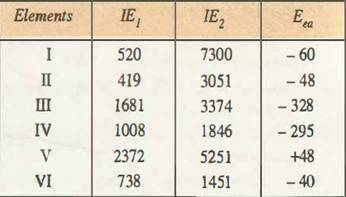
Which of the above element is likely to be:
(i) the least reactive element.
(ii) the most reactive metal.
(iii) the most reactive non-metal.
(iv) the least reactive non-metal.
(v) the metal which can form a stable binary halide of the formulae .
5A.Define the terms oxidation and reduction
5B.In the reaction Fe2O3(S)+3CO(g)-2Fe(s)+3CO2(g)
Which of the substances is
i.reduced and
ii .oxidized?
6. Name this compound H4P2O7
SS2 Civic Education Examination Questions For First Term
SENIOR TWO (2) S.S. 2
CIVIC – EDUCATION
OBJECTIVE PARTS: SECTION A
TIME: 1 HOUR 45 MINUTES
ANSWER All QUESTIONS CORRECTLY
- Citizenship means……….. (a). A person that is not recognized by law as a member of a country (b). A person recognized by law (c). A person that doesn’t enjoy any right at all (d).None of the above
- What is the subject designed to make student to be responsible and functional members of the society? (a). Civic education (b). Civil education (c). Civic mode (d). Civic law
- One of the importance of citizenship education is to ________ (a). Promote communication skills (b). Vote and be voted for (c). Ensure all citizens have political education (d). To have equality of rights
- Man’s total way of life is called…….. (a). Culture (b). Religion (c). Education (d). Destiny
- National consciousness can be defined as the……….. (a). Way of sharing common purse and common force (b). Way of sharing religion which is the opinion of the people (c). Way of sharing common ethnic. Linguistic or cultural background (d). None of the above
- National unity and integration is necessary so as to bring about (a). Chaos (b).Problems (c). Political (d). Deficiency
- …… is a true reflection of democratic government (a). Capitalism (b). Socialism (c). Authoritarianism (d). Sectionalism
- Politics can be defined a (a). Profession of running church affairs (b). Profession of running monetary affairs (c). Profession of running poverty affairs (d). Profession of running government affairs
- The kind of government practiced in Nigeria is (a). Autocratic (b). Democracy (c). Military (d). Authoritative
- Military rule is by……… (a). Constitution (b). Decree (c). Force (d). Fiat
- Corruption is … (a). A state of honesty and openness (b). A state of dishonesty and non-openness (c). A state of dishonesty and immoral behaviour (d). A state of western influences
- To alleviate poverty, government should provide……. (a). Free food for all (b). Free teaching for all (c). Free education for all (d). None of the above
- Poverty can be defined as (a). Ability to provide (b). Access to avoid basic needs (c). Inability to provide basic needs of life (d). Situation to prevent basic needs
- Nigeria mineral resources include these except…. (a). Coal (b). Tin Ore (c). Lead and Zinc (d). Key
- ……… is the role of individuals in alleviating poverty (a). Domestic selflessness (b). I don’t care attitude (c). Thuggery (d). Crime
- Development and progress are possible under the atmosphere of A. hatred B. rivalry C. peace D. intolerance.
- …….. is a person who performs specific task for an agreed amount of money at the end of a given period (a). Employed (b). Employer (c). Employee (d). Emperor.
- ……….. are factors that promote guaranteed employment except….. (a). Age (b). Experience (c). Free education (d). Irresponsible government.
- Poverty makes people to be….. (a). Homeful (b). Homeless (c). Home (d). Homely.
- …………… are group of people who use weapon to disposes people of their belongings (a). Armed coming (b). Armed reason (c). Armed robbers (d). Armed taken.
- Political apathy is……… (a). Situation where people choose not to participate in political affairs of a state (b). A state where people chose to participate in political affairs of a state (c). All of the above (d). None of the above.
- A good follower must be (a). Obey the constituted authority (b). Must be legal (c). Must be obedient (d). All of the above
- One of the reasons for political apathy is …. (a). Military (b). Truancy (c). Good Government (d). Bad governance
- ….. is a process of influencing, directing, controlling and motivating people to achieve the set goals (a). Democracy (b). Management (c). Leadership (d). None of the above
- NLC means …… (a). Nigerian Labour Congress (b). Nigerian Labour Commission (c). Nigerian Labour Corporation (d). Nation Labour Council
- ………….. is a follower who knows what to do without being told (a). Passive follower (b). Exemplary Followers (c). Dogmatic followers (d). None of the above
- A process whereby an individual chooses to favour a person who comes from his family or tribe is called ……… (a). Tribalism (b). Nepotism (c). Favouritism (d). Familiarism
- Which of these is an effect of political apathy on an individual and government (a). Bad government (b). Emergence of thuggery (c). Politics as a nation for miscreant (d). None of the above
- A good leader is one who……. (a). Gives instructions to his followers (b). Exercise authority over his followers (c). Carries his followers along with his policies (d). Delegates his duties to his subordinates
- ……… is a way of controlling leaders who fails to protect the interests of their followers (a). There should be form of checks and balances on the various committee appointed (b). The judiciary should be controlled by the leaders (c). There should be sentiment of religious beliefs (d). All of the above
- Being a ……. of political party is a form of political participation (a). Member (b). Opposition (c). Opponents (d). Legitimate
- ……….. is a written public declaration of the intentions, motives and views of a political party that designed it (a). Agenda (b). Manifesto (c). Gazette (d). Constitution
- People do not participate in politics because of….. (a). Poverty (b). Politics (c). Religion (d). InJustice
- …….. Are the obligations citizens are expected to perform for his country (a). Obligation (b). Duties (c). Rights (d). None of the above
- Citizenship education can be defined as…….. (a). Education that informs and enrich citizens with information (b). Education that limits and perfect citizens (c). Education that discharge citizens (d). None of the above
- Honorary citizenship is…….. (a). Granting award of politics to people (b). Granting award of distinction to honour somebody (c). Granting award of friends to somebody (d). None of the above
- …… is NOT an example of our culture (a). Greetings (b). Ideals (c). Satisfaction (d). Working
- One of the importance of national unity is……. (a). Internal security against external attack (b). Internal disorganization (c). Internal molestation (d). Internal discrimination
- National unity and integration can be defined as…….. (a). Living together in conflict (b). Living together peacefully (c). Living together in disharmony (d). Living together in biased
- Capitalism can be said to be a ……. system (a). Regulated market system (b). Free market system (c). Controlled market system (d). None of the above
- Advantages of capitalist democracy excludes……. (a). Instrumentalized poverty (b). Dynamism (c). Financial motivation (d). Employment opportunities
- Which of the following principles emphasizes equality before the law? A. election B. executive C. rule of law D. separation of power.
- Political party organizes ……., ……. and …….. (a). Market, appeal and assets (b). Campaign, company and leading (c). Campaign, rallies and manifesto (d). None of the above
- List three causes of poverty (a). Production, institution and association (b) Overpopulation, ignorance and refusal to use one’s talents (c). Inadequate knowledge of promotion (d). None of the above
- One of the causes of corruption on individual is …… (a). Destroying of an individual image (b). Moldering an individual image (c). Building an individual image
- Truancy is an example of ….. (a). Indiscipline (b). Contentment (c). Integrity (d). Discipline
- National consciousness will promote the following EXCEPT A. impartiality B. unity C. development D. friendliness.
- The effort made by government to reduce the pains of lack of money to live a good life is poverty …… (a). Emendation (b). Reduction (c). Alleviation (d). Purification
- The FESTAC celebration was a show of___ A. culture B. unity C. hard work D. fame.
- There are over …. ethnic groups in Nigeria. A. 469 B. 774 C. 250 D. 813
- Which of the following is NOT a major political party in Nigeria? A. APC B. LP C. KOWA D. PDP
- …… is a function of a good leader (a). Maintenance of law and order (b). Dogmatic followership (c). Arbitrary rule (d). None of the above
- List three forms of political apathy …… , …….. and ……. (a). Refusal to become citizens (b). Refusal to vote, register and belong to party (c). Acceptance to vote, register and belong to party (d). None
- Leader who allow his followers to contribute to decision making (a). Democratic leadership (b). Autocratic leadership (c). Constitutional leadership (d). None of the above
- A voter is also known as A. electorate B. aspirant C. candidate D. contester.
- An election that is conducted within a political party to select a flag bearer is called A. primary election B. flag bearer election C. general election D. secret election
- Social miscreant are found at ……… (a). Market, office and government houses (b). Schools, home and government houses (c). Streets, markets and parks (d). All of the above
- Operation Feed the Nation OFN was established by A. Tafawa Balewa B. Muhamadu Buhari C. Olusegun Obasanjo D. Ernest Sonekan
- ……… is a term used by politicians to influence the decision of the electorate during elections (a). Hobby (b). Rigging (c). Thuggery (d). None of the above
- Which of the following is NOT a political leader? A. Governor B. President C. Councilor D. Candidate
Civic Education Exam Questions Objectives (OBJ) Answers
1.B 2.A 3.D 4.A 5.C 6.C 7.A 8.D 9.B
10.C 11.C 12.D 13.C 14.D 15.A 16.C 17.B
18.A 19.B 20.C 21.A 22.D 23.D 24.C 25.A
26.A 27.A 28.B 29.C 30.A 31.A 32.B 33.D
34.B 35.A 36.B 37.C 38.A 39.B 40.B 41.A
42.C 43.C 44.B 45.A 46.A 47.A 48.C 49.A
50.C 51.C 52.A 53.B 54.B 55.A 56.A 57.C 58.C 59.C 60.D
SECTION B
ANSWER 3 QUESTIONS IN THIS SECTION. QUESTION THREE (3) IS COMPULSORY.
- Define National Consciousness
b. list and explain five (5) ways to promote National Consciousness, National Integrity and Unity
- What is citizenship Education
b. Mention and explain five duties and obligations of citizens to their communities
c. who is a citizen? (10 marks)
- Differentiate between custom and Tradition
b. Explain four skills necessary for preservation of traditions, customs and beliefs in Nigeria
- Define democracy
b. Define Capitalism?
c. Explain the two (2) forms of Democracy (5 marks)
- Define political party?
b. list five (5) ways by which political parties compete for power during elections (5 marks)
- Explain the term political Apathy
b. Mention five (5) reasons for political apathy (5 marks)
SS2 Civic Education Examination Question For First Term
OBJECTIVE PARTS: SECTION A
TIME: 1 HOUR 45 MINUTES
ANSWER All QUESTIONS CORRECTLY
- Citizenship means……….. (a). A person that is not recognized by law as a member of a country (b). A person recognized by law (c). A person that doesn’t enjoy any right at all (d).None of the above
- What is the subject designed to make student to be responsible and functional members of the society? (a). Civic education (b). Civil education (c). Civic mode (d). Civic law
- One of the importance of citizenship education is to ________ (a). Promote communication skills (b). Vote and be voted for (c). Ensure all citizens have political education (d). To have equality of rights
- Man’s total way of life is called…….. (a). Culture (b). Religion (c). Education (d). Destiny
- National consciousness can be defined as the……….. (a). Way of sharing common purse and common force (b). Way of sharing religion which is the opinion of the people (c). Way of sharing common ethnic. Linguistic or cultural background (d). None of the above
- National unity and integration is necessary so as to bring about (a). Chaos (b).Problems (c). Political (d). Deficiency
- …… is a true reflection of democratic government (a). Capitalism (b). Socialism (c). Authoritarianism (d). Sectionalism
- Politics can be defined a (a). Profession of running church affairs (b). Profession of running monetary affairs (c). Profession of running poverty affairs (d). Profession of running government affairs
- The kind of government practiced in Nigeria is (a). Autocratic (b). Democracy (c). Military (d). Authoritative
- Military rule is by……… (a). Constitution (b). Decree (c). Force (d). Fiat
- Corruption is … (a). A state of honesty and openness (b). A state of dishonesty and non-openness (c). A state of dishonesty and immoral behaviour (d). A state of western influences
- To alleviate poverty, government should provide……. (a). Free food for all (b). Free teaching for all (c). Free education for all (d). None of the above
- Poverty can be defined as (a). Ability to provide (b). Access to avoid basic needs (c). Inability to provide basic needs of life (d). Situation to prevent basic needs
- Nigeria mineral resources include these except…. (a). Coal (b). Tin Ore (c). Lead and Zinc (d). Key
- ……… is the role of individuals in alleviating poverty (a). Domestic selflessness (b). I don’t care attitude (c). Thuggery (d). Crime
- Development and progress are possible under the atmosphere of A. hatred B. rivalry C. peace D. intolerance.
- …….. is a person who performs specific task for an agreed amount of money at the end of a given period (a). Employed (b). Employer (c). Employee (d). Emperor.
- ……….. are factors that promote guaranteed employment except….. (a). Age (b). Experience (c). Free education (d). Irresponsible government.
- Poverty makes people to be….. (a). Homeful (b). Homeless (c). Home (d). Homely.
- …………… are group of people who use weapon to disposes people of their belongings (a). Armed coming (b). Armed reason (c). Armed robbers (d). Armed taken.
- Political apathy is……… (a). Situation where people choose not to participate in political affairs of a state (b). A state where people chose to participate in political affairs of a state (c). All of the above (d). None of the above.
- A good follower must be (a). Obey the constituted authority (b). Must be legal (c). Must be obedient (d). All of the above
- One of the reasons for political apathy is …. (a). Military (b). Truancy (c). Good Government (d). Bad governance
- ….. is a process of influencing, directing, controlling and motivating people to achieve the set goals (a). Democracy (b). Management (c). Leadership (d). None of the above
- NLC means …… (a). Nigerian Labour Congress (b). Nigerian Labour Commission (c). Nigerian Labour Corporation (d). Nation Labour Council
- ………….. is a follower who knows what to do without being told (a). Passive follower (b). Exemplary Followers (c). Dogmatic followers (d). None of the above
- A process whereby an individual chooses to favour a person who comes from his family or tribe is called ……… (a). Tribalism (b). Nepotism (c). Favouritism (d). Familiarism
- Which of these is an effect of political apathy on an individual and government (a). Bad government (b). Emergence of thuggery (c). Politics as a nation for miscreant (d). None of the above
- A good leader is one who……. (a). Gives instructions to his followers (b). Exercise authority over his followers (c). Carries his followers along with his policies (d). Delegates his duties to his subordinates
- ……… is a way of controlling leaders who fails to protect the interests of their followers (a). There should be form of checks and balances on the various committee appointed (b). The judiciary should be controlled by the leaders (c). There should be sentiment of religious beliefs (d). All of the above
- Being a ……. of political party is a form of political participation (a). Member (b). Opposition (c). Opponents (d). Legitimate
- ……….. is a written public declaration of the intentions, motives and views of a political party that designed it (a). Agenda (b). Manifesto (c). Gazette (d). Constitution
- People do not participate in politics because of….. (a). Poverty (b). Politics (c). Religion (d). InJustice
- …….. Are the obligations citizens are expected to perform for his country (a). Obligation (b). Duties (c). Rights (d). None of the above
- Citizenship education can be defined as…….. (a). Education that informs and enrich citizens with information (b). Education that limits and perfect citizens (c). Education that discharge citizens (d). None of the above
- Honorary citizenship is…….. (a). Granting award of politics to people (b). Granting award of distinction to honour somebody (c). Granting award of friends to somebody (d). None of the above
- …… is NOT an example of our culture (a). Greetings (b). Ideals (c). Satisfaction (d). Working
- One of the importance of national unity is……. (a). Internal security against external attack (b). Internal disorganization (c). Internal molestation (d). Internal discrimination
- National unity and integration can be defined as…….. (a). Living together in conflict (b). Living together peacefully (c). Living together in disharmony (d). Living together in biased
- Capitalism can be said to be a ……. system (a). Regulated market system (b). Free market system (c). Controlled market system (d). None of the above
- Advantages of capitalist democracy excludes……. (a). Instrumentalized poverty (b). Dynamism (c). Financial motivation (d). Employment opportunities
- Which of the following principles emphasizes equality before the law? A. election B. executive C. rule of law D. separation of power.
- Political party organizes ……., ……. and …….. (a). Market, appeal and assets (b). Campaign, company and leading (c). Campaign, rallies and manifesto (d). None of the above
- List three causes of poverty (a). Production, institution and association (b) Overpopulation, ignorance and refusal to use one’s talents (c). Inadequate knowledge of promotion (d). None of the above
- One of the causes of corruption on individual is …… (a). Destroying of an individual image (b). Moldering an individual image (c). Building an individual image
- Truancy is an example of ….. (a). Indiscipline (b). Contentment (c). Integrity (d). Discipline
- National consciousness will promote the following EXCEPT A. impartiality B. unity C. development D. friendliness.
- The effort made by government to reduce the pains of lack of money to live a good life is poverty …… (a). Emendation (b). Reduction (c). Alleviation (d). Purification
- The FESTAC celebration was a show of___ A. culture B. unity C. hard work D. fame.
- There are over …. ethnic groups in Nigeria. A. 469 B. 774 C. 250 D. 813
- Which of the following is NOT a major political party in Nigeria? A. APC B. LP C. KOWA D. PDP
- …… is a function of a good leader (a). Maintenance of law and order (b). Dogmatic followership (c). Arbitrary rule (d). None of the above
- List three forms of political apathy …… , …….. and ……. (a). Refusal to become citizens (b). Refusal to vote, register and belong to party (c). Acceptance to vote, register and belong to party (d). None
- Leader who allow his followers to contribute to decision making (a). Democratic leadership (b). Autocratic leadership (c). Constitutional leadership (d). None of the above
- A voter is also known as A. electorate B. aspirant C. candidate D. contester.
- An election that is conducted within a political party to select a flag bearer is called A. primary election B. flag bearer election C. general election D. secret election
- Social miscreant are found at ……… (a). Market, office and government houses (b). Schools, home and government houses (c). Streets, markets and parks (d). All of the above
- Operation Feed the Nation OFN was established by A. Tafawa Balewa B. Muhamadu Buhari C. Olusegun Obasanjo D. Ernest Sonekan
- ……… is a term used by politicians to influence the decision of the electorate during elections (a). Hobby (b). Rigging (c). Thuggery (d). None of the above
- Which of the following is NOT a political leader? A. Governor B. President C. Councilor D. Candidate
Civic Education Exam Questions Objectives (OBJ) Answers
1.B 2.A 3.D 4.A 5.C 6.C 7.A 8.D 9.B
10.C 11.C 12.D 13.C 14.D 15.A 16.C 17.B
18.A 19.B 20.C 21.A 22.D 23.D 24.C 25.A
26.A 27.A 28.B 29.C 30.A 31.A 32.B 33.D
34.B 35.A 36.B 37.C 38.A 39.B 40.B 41.A
42.C 43.C 44.B 45.A 46.A 47.A 48.C 49.A
50.C 51.C 52.A 53.B 54.B 55.A 56.A 57.C 58.C 59.C 60.D
SECTION B
ANSWER 3 QUESTIONS IN THIS SECTION. QUESTION THREE (3) IS COMPULSORY.
- Define National Consciousness
b. list and explain five (5) ways to promote National Consciousness, National Integrity and Unity
- What is citizenship Education
b. Mention and explain five duties and obligations of citizens to their communities
c. who is a citizen? (10 marks)
- Differentiate between custom and Tradition
b. Explain four skills necessary for preservation of traditions, customs and beliefs in Nigeria
- Define democracy
b. Define Capitalism?
c. Explain the two (2) forms of Democracy (5 marks)
- Define political party?
b. list five (5) ways by which political parties compete for power during elections (5 marks)
- Explain the term political Apathy
b. Mention five (5) reasons for political apathy (5 marks)
SS2 Commerce Examination Question For First Term
SENIOR TWO (2) S.S. 2
COMMERCE
OBJECTIVE PARTS: SECTION A
- Any powers exercised by a company in pursuance of objects not authorized by the memorandum of Association is regarded as _______ (a) Trespass (b) A nuisance (c) Ultravires (d) Uberrimaefidei
- A business is in existence primarily to _______ (a) Make profits (b) Provide goods and services (c) Provide employment (d) Compete with others in business
- The word “Ltd”. Written after the name of a company means that _______ (a) The individual members capital is limited (b) The total sum of the company’s capital is limited (c) Member’s are liable to the extent of their holding (d) Company’s location is limited
- Which of the following is a public co – operation? The _______ (a) Nigeria Breweries Limited (b) Nigerian Ports Authority (c) Lagos Chamber of Commerce (d) Nigerian Bottling Company
- Which of the following is not required in a memorandum of Association? The (a) Name of the company (b) Location of the company (c) Names of the board of directors (d) Limitation of members liability
- A memorandum of association is a document (a) Inviting the public to buy a company’s shares (b) Governing the affairs of a partnership (c) Showing the assets and liabilities of a company at a certain date (d) Defining a company’s relationship with public
- Which of the following is a feature of co – operative society (a) Dividend is based on the member of share sold (b) Limited membership (c) Owned and run by the state (d) Democratic control and management
- A private limited liability company differs from a public limited liability company because ______ (a) Of its inability to offer shares to the public (b) It has a separate entity (c) It has many shareholders
- The main source of capital for a limited liability company is _______ (a) Bank overdraft (b) Government subsidy (c) Undistributed profits (d) Share subscriptions
- A document that regulates the internal operations of a company is known as _______ (a) Memorandum of association (b) Articles of association (c) perform duties
- The Nigerian Television Authority is an example of a ________ (a) Private Limited Liability Company (b) Public Limited Liability Company (c) Multinational Corporation (d)Public Corporation
- Which of the following must be submitted to the registrar of companies before a company is incorporated? (a) Article of association and certificated of incorporation (b) Memorandum of association and certificated of incorporation (c) Article of association and certificated of incorporation (d) Memorandum of association and prospectus
- Which of the following is a features of co – operation societies? (a) Each member has a several votes during meetings (b) Profits are shared on the basis of shares held (c) All members have equal votes during meeting (d) Members are not involved in running the business
- Which of the following is not a necessary document in incorporating a company? (a) Memorandum of association (b) Articles of association (c) A statement of nominal capital (d) A statement of minimum subscription
- Details of a new share for which the public is being invited to subscribe are contained in the _________ (a) A memorandum of association (b) Certificate of trading (c) Certificate of incorporation (d) Prospectus
- The minimum member of membership for a public limited company is _________ (a)Two (b) Seven (c) Seventeen (d) Twenty
- A document used as a polite way of refusing credit is __________ (a) Advice note (b) Quotation (c) Proforma invoice (d) Invoice
- _______enterprises/corporation are businesses owned and run by the government in the public interest.? (a) Ex – works (b) Public (c) Private
- The board of directors of public corporation is appointed by the __________ (a) Government (b) Shareholders (c) Management (d) Employees
- The object clause of a limited liability company is stated in the ___________ (a) Memorandum of association (b) Article of association (c) Certificate of incorporation (d) Trading certificate
- _________ are government parastatals that provide essential services to the citizens at subsidized (a) Public Utilities (b) Political Board (c) Commercial Enterprises
- When C.I.F is quoted on an invoice, it means that the price includes the _________ (a) Cost of goods only (b) Cost of insurance only (c) Cost of carriage only (d) Cost, insurance and carriage
- _________ are autonomous establishment which execute the policies of the government within a specific area. (a) Public Utilities (b) Political Board (c) Commercial Enterprises
- An overdraft is the _________ (a) Amount permitted to be withdrawn in excess of one’s deposit (b) Excessive cash withdrawn by commercial banks from the central banks (c) Credit balance standing in the name of a customer (d) Special deposit made by commercial banks
- The co – operative society that performs a combination of the function of other types of co – operatives is called the _______ (a) Consumer co – operative (b) Multipurpose co – operative (c) Producer co – operative (d) Thrift and credit co – operative
- Unlimited liability in business implies that the _______ (a) Risk of the owner is limited only to the amount invested (b) Debts are paid with subventions (c) Property of the owners should not be used to secure loans (d) Owners private
- The main function of the of a thrift and credit co – operative society is to ________ (a) Encourage members to buy cheaply (b) Enable members get the highest profit (c) Help members get legal redress (d) Encourages members to save
- Which of the following justifies the existence of public enterprises (a)Making quick decision (b) Creating monopoly (c) Making profit for government (d) Providing essential services
- The owners of a pubic limited company are ________ (a)Board of directors (b) Management team (c) Shareholders (d) Government
- A private limited company differs from a public limited company because it _________ (a) Offers right to existing shareholders (b) Has a separate entity from the owners (c) Cannot easily transfer shares (d)Declares dividend
- Which of the following receives dividend based on patronage? (a)Preference shareholders (b) Co – operative society member (c) Cumulative preference shareholder (d) Debenture holder
- A company may be wound up when ________ (a)There is disagreement among the directors (b) There are two many shareholders (c)Many of the shareholders die (d) It’s product competes with that of the government
- The operation of a private company is guided by the _______ (a) Deed (b) Certificate of trading (c) Certificate of incorporation (d) Company act
- Contributing money to buy equipment for making and marketing a product is a feature of ________ (a) Thrift societies (b) Public limited companies (c) Consumer’s co – operative (d) Producer’s co – operative
- A document from a seller which corrects an undercharge on a buyer’s account is known as _______ (a) Proforma invoice (b) Credit note (c) Debit note (d) Statement of account
- A price quotation that covers the cost of goods and all other expenses incurred in delivery to the buyer is called ________ (a) CIF (b) FAS (c) FRANCO (d) LOCO
- The capital of a company indicated in the memorandum of association is known as _______ (a)Authorized capital (b) Capital employed (c) Working capital (d)Fixed capital
- Any action taken by a company outside it’s sated objectives is regarded as ________ (a) Caveat emptor (b) Ultra vires (c) Uberrimae fidei (d)Exemption
- Terms of trade refers to ________ (a) agreement between two trading countries (b) Conditions attached to specific trade transaction (c) The relationship between export and import price (d) The difference between the value of imports and exports
- Which of the following is used when goods are sent through a common carrier? (a) Receipt (b) Delivery note (c) Proforma invoice (d) Consignment note
- Which of this is true of a delivery note? It (a) is sent in anticipation of delivery (b) Does not show the prices of the goods (c) Gives additional information about the goods (d) Shows the pictures of goods being delivered
- The abbreviation ECOWAS stand for _________ (a) Economic Community of West African States (b) Economic Communion of West African States (c) Economic Council of West African States
- Which of the following functions is not performed by a small retailer? (a) Selling in units to consumers (b) Financing producers (c)Buying from wholesalers (d) Selling goods on credit
- Which of the following is common to both large and small firms? (a) Lower running cost (b) Personal attention to customers (c) Large capital (d)Profit making
- When payment is required for goods at the time the order is placed, the term of payment quoted is _________ (a) C.O.D (b) C.W.O (c) C.I.F (d) F.O.R
- A term embracing buying, selling and distribution of goods and services is known as _________ (a) Whole sale trade (b) Retail trade (c) Commerce (d) Marketing mix
- The most important function of the retailer is to ________ (a) Sell goods on credit (b) Operate on weekends and public holidays (c)Make goods available in units (d) Buy from wholesalers
- The record of land as a factor of production is known as ________ (a)Interest (b) Rent (c) Profit (d) Wages
- A document sent to a customer at a regular intervals to enable him know his indebtedness to hiss supplier is known as _________ (a)Debit note (b) Invoice (c)Statement (d) Receipt
- Terms of payment are quoted on the _________ (a) Order form (b) Advice note (c)Credit note (d) Invoice
- A document which a retailer sends to a wholesaler requesting him to supply certain items is called _______ (a)A letter of inquiry (b) A catalogue (c) An invoice (d) An order
- ___________ are government owned bodies set up to create competitive environment and make profit from their operation. (a) Public Utilities (b) Political Board (c) Commercial Enterprises
- Buying and selling of goods and services within the geographical areas of a country is called _________ (a)Entreport trade (b) External trade (c) Domestic trade (d) regional trade
- A clean bill of lading is so – called because (a) The colour is pure white (b) It is not stained (c) It is a document of authority (d) It has no record of damaged goods
- Which of the following converts raw materials into finished goods? (a) Extractive industry (b) Manufacturing industry (c)Commercial occupation (d) Constructive industry
- Paper money originated in form of receipt given by ___________ (a)Money lenders (b) Goldsmiths (c) Bankers (d)Traders
- The reward for entrepreneurship as a factors of production is __________ (a) Interest (b) Commission (c) Profit (d) Salary
- The two main branches of trade are __________ (a) commerce and aids to trade (b) Home and foreign trade (c) Foreign and Entreport trade (d) Wholesale and retail trade
- _________ can be defined as the reduction in the price of goods to encourage bulk purchases and prompt payment (a) Receipt (b) Discount (c)Involve (d) Proforma
- _________ shows the current prices of the various products of a firm (a) Quotation (b) Price list (c)Catalogue (d) Order
Commerce Exam Questions Objectives (OBJ) Answers
1.A 2.A 3.C 4.B 5.D 6.D 7.C 8.A 9.D
10.A 11.D 12.A 13.B 14.D 15.C 16.B 17.C
18.B 19.A 20.B 21.A 22.D 23.B 24.A 25.B
26.B 27.D 28.D 29.A 30.C 31.D 32.A 33.A
34.A 35.B 36.A 37.A 38.C 39.B 40.B 41.A
42.A 43.B 44.D 45.A 46.C 47.C 48.B 49.A
50.D 51.D 52.C 53.C 54.C 55.B 56.D 57.C 58.B 59.B 60.B
SECTION B (THEORY PART)
Answer all questions and each question carries 10 marks
- Explain the meaning of Public Enterprises?
b. Explain five (5) sources of finance (Capital) to public corporation
- Define a Company?
b. Explain three (3) kinds of companies which may be contributed under the companies Act 1965
c. Explain these words: (i) Memorandum of Association (ii)Articles of Association (iii) Prospectus
- Explain the term Commodity? b. State the requirement for trading
c. Explain these trade abbreviations and state the full meaning (i) C.O.D (II) C.I.F (iii) F.O.B (iv) E and O.E (V) F.O.R
Senior High School 2 Exam Ist term. Year 11/SS2 Examination Questions for first term all subjects objectives and theory answers-Edudelight Exam
SS2 CRS Examination Question For First Term
SENIOR TWO (2) S.S. 2
CHRISTIAN RELIGIOUS STUDIES
OBJECTIVE PARTS: SECTION A:
- In the creation story; the job of giving names to all living creatures was giving by _______ (a) God (b) Adam and Eve (c) Eve (d) Man
- Reuben advised his brothers not to kill Joseph but to cast him into a pit because he ______ (a) Did not want them shed the blood of the innocent (b) Wanted to rescue him afterwards and bring him safely to their father (c) Wanted to bury him alive in the pit (d) Wanted them to sell Joseph to the Ishmaelite
- Joseph was sold to the Ismaelites for _______ shekels of silver (a) Forty (b) Thirty – five (c) Thirty (d) Twenty
- When the children of Israel came to the wilderness of sin, they murmured against Moses and Aaron because ________ (a)Egyptians were in hot pursuit (b) They were hungry (c) There was neither dew or rain for seven years (d) They were thirsty
- At the time Deborah became a judge in Israel, she was a (a) Seer (b) Prophetess (c) Priestess (d) Medium
- Which of the following did God do on the seventh day after he had completed the work of creation? He (a) Blessed and hallowed the seventh day (b) Worshipped on the seventh day (c)Took a record of all that he had created (d) Blessed all that he had created
- According to the creation story, man became a living being because God ______ (a) Formed him out of the dust (b) Gave him tree of knowledge (c) Gave him a woman to live with him (d) Gave him the breadth of life
- Who mad you a price and a judge over us? This statement by the two Hebrews to Moses signifies the _______ (a) Recognition of Moses divine authority by the Hebrews (b) Recognition of pharaoh’s authority by the Hebrews (c) Rejection of Moses leadership by his people (d) Rejection of Moses as an Egyptians prince
- Which of the following does not portray the quality of leadership in the life of Deborah? (a)Ability to inspire others (b) Her marriage to Lapidoth (c) Her sound judgment of cases (d) Her Faith in God
- God’s creative ability was manifested by his ______ (a) Approving that a thing be done (b) Commanding word prefaced by “there be” (c) Ordering the Holy Spirit to act (d)Choosing the better of two alternative models
- After Joseph had revealed himself to his brothers, he ______ (a)Gave his brothers food (b) Fell upon Benjamin’s neck and smiled (c) Kissed Benjamin and departed (d) Kissed all his brothers and wept
- Which of the following instructions did God gave to man after he had created him? (a) Go ye into the world and exercise full authority over it (b) Be fruitful and multiply, and fill the earth and subdue it (c) Be you kind to all the creatures of the earth (d) I have given you power over all the world, make full use of it
- Which of the following leadership qualities was manifested by Joseph when he told his brothers not to be angry with themselves for selling him? (a) Wisdom (b) Good judgment (c) Maturity (d) Forgiveness
- Moses ran away from Egypt because he _______ (a) Did not like to be brought up in Egyptian circles (b) Could no longer endure the famine in the land (c) Feared that the news of his act of murder would reach the king (d) Heard a divine call
- Aaron accompanied Moses to Pharaoh because _______ (a)Aaron was a Levite (b) Aaron was bolder than Moses (c)Moses was deficient in speech (d) Aaron was appointed by the people
- The Israelites under Barak defeated the Canaanite troops led by ______ (a) Jael (b) Heber (c) Sisera (d) Abinoam
- The second account of creation was centered on the creation (a) Birds (b) The heavens (c) Man (d) Plants
- When Joseph was sent to see the welfare of his brothers, he met them pasturing at _______ (a)The wilderness of sin (b) Gilead (c) Shechem (d) Dothan
- Who among the following did God direct Moses to appoint as his successor? (a) Caleb (b) Eleazar (c) Joshua (d) Gideon
- Moses experienced the burning bush that was not consumed at _______ (a) Horeb (b) Bethel (c) Nebo (d) Midiam
- How did Moses prove his leadership quality when God threatened anyone that sinned (a) Forgave them (b) Atoned for their sin (c) Punished them himself (d) Reprimanded them
- The name of Moses means ______ (a) Baptized in water (b) Abandoned in water (c) Drawn out of water (d) Washed in water
- “Fear not, stand firm, and see the salvation of the Lord, which he will work for you today”. Moses made this statement when? (a) The Israelites were trapped between the host of Egypt and the red sea (b) Israel was suddenly attacked by the Amalekites at Rephidim (c) The Israelites faced hunger and death at the wilderness of sins (d) The people became afraid at mount Sinai as a result of the thunders and lightening.
- The land, the sea and the vegetations were created on the _________ (a)First day (b) Third day (c) Fourth day (d) Fifth day
- The miraculous crossing of the red sea by the Israelites shows ________ (a) God’s guidance and protection over his people (b) The ill – equipped army of pharaoh (c) God’s fulfillment of his promises to destroy the Egyptians (d) Moses as a reliable leader
- In the battle against Sisera, Deborah’s co – operation with Barak was based on her (a) Belief in Barak’s power (b) Absolute belief and trust in God (c) Reliance on a large army (d) Power as a prophetess
- God charge Joshua during his call to the cross the Jordan river in order to (a) Fight the people of Jericho (b) Possess the promised land (b) Appoint Eleazar to succeed Aaron (d) Circumstance all Hebrew children
- The priest of midian gave Moses, his daughter (a) Shiphrah (b) Zippo rah (c) Puah (d) Gershom
- God hardened the Egyptian’s heart because (a) Of his plan to punish pharaoh (b) Moses and Aaron deserved God’s punishment (c) God wanted to gain glory over pharaoh (d) Pharaoh was a powerful king
- Joshua was a successful leader of is people because he_______ (a) Was chosen by Moses (b) Trusted in God (c) Was a good spy (d) Was a brilliant soldier
- Joshua died at the age of a ______ (a)Hundred and forty years (b) Hundred and twelve years (c) Hundred and ten years (d) Hundred years
- The land, the sea and vegetations were created on the _______ day (a) First (b) Second (c) Third (d) Fifth
- When Moses stayed away for too long on the ,mountain, the people of Israel ______ Prayed and fasted (b) embark on farming (c) Returned to Egypt (d) Mad and worshipped idol
- What in the creation of account gave man an edge over every other creature? (a) Other creatures were made for man (b) Man alone was created in the image of God (c) Man had the rare privilege to dwell in Eden (d) Satan acknowledged his privileged position
- Deborah, a prophetess who was a judge in Israel was the wife of _____ (a) Joshua (b) Abijah (c) Lappidoth (d) Sisera
- God prepared Joshua for his leadership role in Egypt through _______ (a) The love which his father had for him (b) The trials and temptations of his earlier years (c) His disagreement with his brothers (d) His encounter with Potiphar’s wife
- By removing his sandals before the burning bush, Moses was showing a sense of _______ (a)Honour and love (b) Curiosity and adventure (c) Humility and respect (d) Reverence and submissiveness
- The twelve spies that were sent by Moses to the promised land were to confirm all the following except ________ (a) The type of people in the land (b) The fertility of the land (c) Fortification of the cities (d) Availability of grapes in the land
- The boy Moses was hidden for three months because (a) He was distinct to become a great leader (b) He was attacked by an abominable diseases (c) Pharaoh feared the growth of the Hebrew population (d) Pharaoh had decreed the murder of Hebrew male born
- Joseph was of a good behaviour because he _______ (a)Was loved and pampered by his father (b) Interacted well with his prisons inmates (c) Rejected pottiphar’s wife’s proposal
- The minority report of the twelve spies was presented by ________ (a) Caleb and Joshua (b) Palti and Gaddiel (c) Joshua and Ammiel (d) Sethur and Gaddiel
- Moses before his death served Israel as __________ (a) Prophet, Liberator and a king (b) King, Priest and warrior (c) Priest, Prophet and deliverer (d) Strategist, seer and prophet
- Besides being a true prophetess, Deborah could also be described as a woman of ______ (a) Love (b) Glory (c) Peace (d) Charity
- Pharaoh’s fear for the growth and the might of Israel made him to ______ (a)Drive the Israelites out of Egypt (b) Afflict the Israelites with heavy burden (c) Drown Israelites babies in the Nile (d) Punish the Israelites with starvation
- Joshua was a chosen successor to succeed Moses because (a) Moses was very old (b) God had now rejected Moses (c) Moses asked for a successor (d) God’s spirit was with Joshua
- Deborah was described as a judge because she _______ (a) Predicted the fall of Jabin (b) Rescued Israel by killing Sisera (c) Prophesied that a woman would kill Sisera (d) Fought to free Israel from Canaanite domination
- The fact that whatever God said during the process of creation happened as he said, indicates that God _______ (a) Loves all that he and made (b) Wanted man to have dominion over all that he had created (c) Did not want darkness to contribute upon the face of the earth (d) Had sovereignty over the universe
- Which of the following officials was charge by pharaoh to kill the Hebrew male children? (a) Egyptians physicians (b) Egyptians taskmaster (c) Hebrew midwives (d) Egyptians soldiers
- The walls of Jericho collapsed because ______ (a)The Israelites marched round it for six days (b) Joshua had decreed it (c) God had given the city to the Israelites (d) They were too fragile
- After Ehud, Israel sinned again and God sold them to _________ (a) The Edomites (b) Eigon, the king of Moab (c) The midianites (d) Jabin, the king of Canaan
- The main reason why the Israelites went to Egypt was because of _______ (a) They needed divine protection (b) The Egyptians had colonized them (c) Joseph was in charge of food (d) There was a great famine
- The ten commandments were received by Moses at _________ Mount Horeb (b) Mount Ararat (c) Mount Goboa (d) Mount Sinai
- Who made the golden calf? (a) Moses (b) Aaron (c) Nadab (d) Abihu
- By worshipping the golden, Israel contravened the ________ commandment of God (a) First (b) Third (c) Sixth (d) Eight
- “Fear not, stand firm, and see the salvation of the Lord” This statement was made Moses at ________ (a) Wilderness of sin (b) Pihahiroth (c) Meribah (d) Wilderness of Sinai
- In the creation story; the job of giving names to all living creatures was giving by _______ (a) God (b) Adam and Eve (c) Eve (d) Man
- The Hebrew midwives refused to kill the Hebrew male children because (a) The Hebrew woman prevented them from doing so (b) They feared God (c) They were of the same blood with the Hebrew woman (d) They were bribed by the Hebrew men
- According to the creation story, man became a living being because God ______ (a) Formed him out of the dust (b) Gave him tree of knowledge (c) Gave him a woman to live with him (d) Gave him the breadth of life
- Which of the following best explains the total power and control God has over the universe? (a) Divinity (b) Majesty (c) Sovereignty (d) Indestructibility
- The Sovereignty of God means the ______ of the power of God (a) Invisibility (b) Concreteness (c) Mightiness (d) Limitlessness
SECTION B (THEORY PART)
Answer all questions and note that each question carries 10 marks
- Explain the Sovereignty of God
b. Narrate the first creation story
(10 marks)
2. What is leadership?
b. Briefly narrate the story of leadership of the following leaders in the bible: (i) Moses as a leader (ii) Joseph as a leader (iii) Joshua as a leader (iv) Deborah as a leader
(10 marks)
3. Described the crossing of the red sea and God’s role in the episode (Guidance and protection,
God’s provision)
(10 marks)
CRS Exam Questions Objectives (OBJ) Answers
1.B 2.A 3.C 4.D 5.B 6.D 7.D 8.C 9.C
10.B 11.D 12.B 13.D 14.C 15.C 16.C 17.D
18.B 19.C 20.A 21.B 22.C 23.A 24.B 25.A
26.B 27.B 28.B 29.A 30.B 31.C 32.C 33.D
34.B 35.C 36.A 37.C 38.C 39.D 40.C 41.A
42.C 43.A 44.B 45.D 46.D 47.D 48.C 49.A
50.D 51.D 52.D 53.B 54.A 55.D 56.B 57.B
58.D 59.C 60.C
SS2 Data Processing Examination Question For First Term
S.S.S 2
DATA PROCESSING
OBJECTIVE PARTS: SECTION A:
ANSWER ALL QUESTIONS TIME: 1 HR 45 MIN
INSTRUCTIONS: ANSWER ALL QUESTIONS IN THESE SECTIONS CORRECTLY, AND NOTE THAT ALL QUESTIONS CARRY EQUAL MARKS
- An attributes or field that can be used to identify a record in a data base table or file is known as a ______ (a) file (b) database (c) field (d) key
- The data in the relational data base is stored in database objects called the _____ (a) rows (b) fields (c) table (d) language
- A record is also called _____ (a) row of fields (b) rows of rows (c) rows of data (d) rows of tables
- ______ are the rules enforced on data columns on table (a) data (b) constraints (c) integrity (d) relation
- ______ are used to ensure accuracy and consistency of data in a relational database (a) constraints (b) integrity constraints (c) data integrity (d) no idea
- A raw fact or unprocessed data is referred to as ________ (a) key (b) file (c) data (d) field
- Microsoft access, database iv, oracle are good example of a _______ (a) file (b) database management system (c) key (d) records
- A single piece of attributes about an entity, place or events is referred to as ________ (a) key (b) field (c) records (d) database
- ______ is a data models that describes the structure of the data within a given domain and, by implication, underlying structure of the domain itself (a) data organization (b) data (c) data structure (d) file structure
- ______ is the process of structuring and organizing data (a) data network (b) data modeling (c) data structure (d) data organization
- There are _____ approach in data modeling (a) 5 (b) 9 (c) 3 (d) 1
- _______ is referred to as a single organized collection of data for one or more purposes stored with minimum duplication of data items so as to provide a consistent and controlled pool of data (a) records (b) file (c) key (d) database
- ______ is a single collection of related records (a) file (b) database (c) model (d) data model
- In the third normal form, the rule says what?
- ________ is a formatted text document on a web (a) records (b) web master (c) webpage (d) no idea
- ________ is a special type of network used to communicate and share information with an organization protocol (a) webpage (b) internet (c) website (d) intranet
- I. S. P. means ______ (a) Intranet Sells of Phone (b) Internet Selling Pool (c) Internet Service Proof (d) Internet Service Provider
- The relational model was introduced by code in which of the following years (a) 1965 (b) 1974 (c) 1970 (d) 1999
- ______ is a table with rows and columns (a) data (b) field (c) attributes (d) relations
- _______ is the named columns of a relations (a) data (b) key (c) field (d) attributes
- Relational database is divided into _______ (a) 11 (b) 5 (c) 4 (d) 3
- _______ is an organized data using two fundamental constructs called the Records and Sets (a) data model (b) field model (c) network model (d) relational database model
- The ______ is a model that is organized into an upside down tree like structure, implying a single upward link in each records to describe the nesting and a sort field link to keep the records in a particular order in each same level list (a) network model (b) relational database model (c) database model (d) no idea
- _______ is an example of internet browser (a) crazy browser (b) Q1 browser (c) Opera 44 (d) Motorola
- _______ is a worldwide collection of public networks that are linked to each other for information (a) chat room (b) cyber café (c) E – Mail (d) Internet
- _______ is a place which provide internet access to the public, usually for free (a) chat room (b) cyber café (c) E – Mail (d) Internet
- The process of copying files from another computer on the internet to the other computer is known as ________ (a) chat room (b) cyber café (c) download (d) upland
Write the full meaning of the following words:
28. H. T. M. L.
29. H. T.T.P
30. P. O. S.
31. O.O.D.B.M.S
32. P. S. T. N.
33. H. N. F.
34. R. D. B. M. S.
35. The following are the features of word processor except _________ (a) font alignment (b) thesaurus (c) grammar checking (d) spell checking
36. ________ is the components of a window desktop (a) test board (b) task bar (c) Icons (d) B and C
37. In the second normal form, the rule says what?
38. ________ is a collection of similar records on a computer (a) field (b) computer files (c) records (d) data items
39. _______ is a way where file can be secured from harm (a) the use of password (b) the use of virus (c) the use of antivirus (d) A and C
40. _______ is venerable to unwanted things like virus, hackers, or unauthorized users (a) file security (b) file insecurity (c) data backup (d) firewall
41. Give example of an E –Mail address
42. In the first normal form, the rule says what?
Say True or False to the following words:
43. Internet is used for E – commerce
44. It helps in running away from home
45. Sending and receiving mail is one of the services available on E – Mail
46. _______ is the most commonly used programs used to create, edit and save a document and also change the appearance or positions of a text or pictures. (a) work banking (b) word laughing (c) word program (d) word processing
47. Give one characteristics of a suitable set relations in normal form
48. ________ is an application area of a word processor (a) Journalism (b) education (c) school (d) booking office (e) A and B
49. There are _____ basic components of the entity relationship (a) 2 (b) 4 (c) 3 (d) 9
50 ______ key is a field in a relational table that matches a candidates key of another table (a) data (b) foreign (c) normal (d) old
(25 MARKS)
THEORY SECTION B
ANSWER ALL QUESTIONS CORRECTLY
- Explain the following terms:
- Attributes
- Internet
- Normalization
- Database
- Flat model
- Network model
- Relational model
- Foreign key
- Data modeling
- Database management system
- )
1b. Explain the following terms:
- Data structure
- Data organization
- Conceptual data modeling
- Logical data modeling
- Physical data modeling
(5 MARKS)
- Draw and label the network model
ii. Draw and label the Hierarchical model
2b. What is database model?
ii. What is Normal form
- List three (3) benefits of the internet
3. Write the short cut for the following words:
i. Ctrl + V ii. Ctrl + B iii. Ctrl + C iv. Ctrl + A v. Ctrl + J
vi. Ctrl + D vii. Ctrl + F viii. Ctrl + S ix. Ctrl + O x. Ctrl + P
(35 MARKS)
SS2 Data Processing Examination Question For First Term
SENIOR TWO (2) S.S. 2
DATA PROCESSING
SECTION A
Instruction: Choose the correct option from the ones lettered A to D
- In the approach of data modeling ____ data modeling illustrate the specific entities, attribute and relationship involved in business function. (a) Conceptual Data Modeling (b) Logical Data Modeling (c) Flat data Modeling (d) Physical Data Modeling
- The processing of structuring and organizing data is referred to as ______ (a)Data Structure (b) Data Organization (c) Data Manipulation (d) Data Modeling
- The major concept for data modeling is to ________(a) Translate simple system design to complex representation of data (b) Translate complex system design to simple representation of data (c) Translate simple system design to simple representation of data (d) Translate complex system design to complex representation of data
- The term “Data Model” refers to two different things- data organization and ________ (a) Data Model (b) Data Processing (c) Data Structure (d) Data Organization
- The following are unstructured data Except_______(a) Video (b) email message (c) Picture (d) Database
- One of the following is an example of a DBMS package. (a) Ms Word (b) Ms Power-point (c) Ms access (d) Ms Outlook
- In the approach of data modeling ____ data modeling identifies the highest level relationship between different entities. (a) Conceptual Data Modeling (b) Logical Data Modeling (c) Flat data Modeling (d) Physical Data Modeling
- ____ model organizes data using two fundamental construct called record and set. (a) Network (b) Relational (c) Object Oriented (d) Star Schema
- ____model consists of a single, two-dimensional array of data elements. (a) Network (b) Relational (c) Object Oriented (d) Flat model
- ____database model is organized into an upside-down tree-like structure (a) Network (b) Relational (c) Object Oriented (d) Hierarchical
- Another name for field type is known as ____ (a) File type (b) Name type (c) Record type (d) Data type
- Another name for unique identifier is known as ____ (a) Key (b) Data (c) Field (d) Record
- ____ is an attribute or field that can be used to identify a record in a database table or file. (a) Data (b) Field (c) Key (d) Table
- ____ is used to design a database in a computer. (a) Database package (b) Graphics package (c) Spreadsheet package (d) Word Processing package
- ____model organizes data using two fundamental constructs, called records and sets. (a) Hierarchical (b) Relational (c) Network (d) Optical
- Standard Data model can also be called ____.
- Manufacture Standard data Model (b) Industry Standard data Model (c) Structured Standard data Mode (d) Enhanced Standard data Model
- ____ are great communication tool because it allows interaction and communication between designers, programmers and end users. (a) Data Model (b) Normal Form (c) Database (d) Attribute
- What is the full meaning of ISDM? (a) Industry Significant Data model (b) International Standard Data Model (c) International Significant Data Model (d) Industry Standard Data Model
- ____ is the international defense enterprise architecture specification for exchange group. (a) Ideas Group (b) Standard Group (c) Best Group (d) Normal Group
- The following are significance of data model except
- It can foster improved understanding of the organization for which the database design is developed (b) It also imposes constraints or limitations on the data placed within the structure (c) It helps in structuring and organizing data (d) It creates database management system for organization
- ____ is a collection of computer software that enables users to define, create and maintain a database. (a) Database Management System (b) Normalization(c) Data Model (d) Normal Form
- ____ is the logical design method which minimizes duplicate or redundant data and design flaws. (a) Database (b) Normalization (c) Form (d) Data Model
- One of the goals of normalization process is ____ (a)Eliminate redundant data (b) Ensure data independencies (c) Allow Update, insertion and deletion(d) Create tables
- The primary purpose of normalization is to ____ (a) Eliminate redundant data (b) Ensure data dependencies (c) Allow Update, insertion and deletion (d) Create tables
- ____ is the process of efficiently organizing data in a database. (a) Database(b) Normalization (c) Form (d) Model
- ____ normal form says that all column values must be atomic. (a) 1NF (b)2NF (c) 3NF (d) 4NF
- ____ normal form must meet the requirement of first and second. (a) 1NF (b) 2NF (c) 3NF (d) 4NF
- ____ normal form are beyond the scope for the syllabus. (a) 1NF and 2NF (b) 2NF and 3NF (c) 3NF and 4NF (d) 4NF and 5NF
- ____ is an attribute or field that can be used to identify a record in a database table or file. (a) Key (b) Attribute (c) Entity (d) Relationship
- How many generation of computer do we have? (a) five (b) three (c) two (c) six (d) four
Data Processing Exam Questions Objectives (OBJ) Answers
1.B 2.A 3.B 4.C 5.C 6.B 7.A 8.A 9.D
10.D 11.D 12.A 13.C 14.A 15.C 16.B 17.A
18.D 19.B 20.B 21.A 22.A 23.C 24.B 25.B
26.A 27.C 28.D 29.A 30.A
SECTION B:
THEORY ( 5) QUESTIONS
1. List the generation of computers and their invention
2. List the classification of computers
3. List 3 Uses of ICT and the Impact on the society
4. Mention 3 types of operating system and 2 functions
5. List 4 steps on how to carry out Microsoft word
6. Define DBMS and list 4 examples
7. Define spreadsheet ,3 uses
8. Define Data modeling , 2 concept
SS2 Economics Examination Question For First Term
SENIOR TWO (2) S.S. 2
ECONOMICS
OBJECTIVE PARTS: SECTION A:
- Change in …… are caused by the same factors that causes changes in demand and supply (a). graph (b) line (c).equilibrium (d). all of the above
- The normal demand curve shapes downward from left to right (a) True (b) False
- The degree of spread of the numerical value in a distribution is …(a).central tendency (b). arithmetic mean (c). mean deviation (d). measure of dispersion
- ……… is the average of a series of figures or value (a). median (b). range (c). mode (d). mean
- ………… is the satisfaction that a consumer derives from consuming a commodity at any given time (a). total utility (b). marginal utility (c). utility (d). none of the above
- ……….. measures how change in income of consumers will affect the quantity of commodities demanded (a). employment (b). income elasticity of demand (c). income elasticity of supply (d). out of market price
- There are …………. Measures of central tendency (a). 3 (b). 5 (c). 2 (d). 4
- Arithmetic mean can also be prepared for … data (a). ungroup (b). grouped (c). single (d). all of the above
- ………. Is a small change in price leading to a greater change in commodity of goods supplied (a). Perfectly inelastic supplied (b). elasticity supply (c). inelastic supply (d). unity supply
- ………. Refers to the satisfaction which a consumer derives per unit of a commodity consumed (a). total utility (b). average utility (c). marginal utility (d). utility
- A change in ………….. is when the curve shifts to an entirely new position (a). demand (b). price (c). commodity (d). curve
Use these formula to answer No 14
MUA /PA = MUB/PB = MUC/P
12. Which of the following is not a set of measure of central tendency? (a) mode and mean (b) mean and median (c) mean and percentile (d) mode and median
13. The formation of cumulative frequency is necessary for the calculation of………… (a) mean (b) range (c) median (d) mode
14. MU is …………. (a). maximized utility (b). Management union (c). marginal unity (d). marginal utility
15. The formula (n+1)th/2 is for calculating
(a ) median (b ) mode (c ) mean (d) range.
16. ………. Refers to how the government or its agency fixes price of essential commodities (a). legislators (b). price control (c). price policy (d). government policy
17. The difference between the maximum and the minimum values in a set of data is known as
(a). quadratic mean (b). variance (c).mean (d).range
18. The equilibrium price of oranges is 50k if for some reasons, the price rises to 60k, there will be …………… (a). excess demand (b). excess supply (c). shortage in the market (d). no buyer in the market
19. An increase change in supply implies a ………… (a). movement along the demand curves (b). decrease in price (c). shift in the supply curve to the right (d). shift in supply curve to the left
20. The force of demand and supply is called …………….. (a). technology development (b). price (c). market force (d). commodities
21. ………….. is done to ensure the proper distribution of resources without any unwanted waste (a). production policy (b). hoarding (c). rationing (d). none of the above
22. Supply moves in the same direction with price True / False
23. Which of the following is not a measure of central tendency (a). mode and median (b). mean and geometric mean (c). harmonic mean (d). medium and percentage
24. A change in supply implies (a). movement along the supply curve (b). decrease in price and quantity supplied (c). shift in the supply curve to the left or to the right (d). shift in supply curve to the left only
25. Elasticity of demand can be measured or calculated by using the co-efficient of …………… (a). price (b). time (c). supply (d). demand
26. The formula for calculating marginal utility are (a). total utility / quantity consumed (b). TU = AU X Qty consumed (c). Change in total utility / change in consumption (d). none of the above
27. Additional commodities consumed give the consumer less satisfaction True / False
USE THE TABLE BELOW TO ANSWER QUESTIONS 28 – 30 UNDER RANGE
| MARKS | 21 – 30 | 31 – 40 | 41 – 50 | 51 – 60 | 61 – 70 |
| FREQUENCY | 10 | 2 | 6 | 5 | 2 |
28. The minimum score is (a). 10 (b). 21 (c). 41 (d). 30
29. The range is (a). 49 (b). 60 (c). 10 (d). 40
30. The maximum score is (a). 80 (b). 30 (c). 70 (d). 60
31. ……….. market is where goods and services are sold in a way that is illegal (a). financial (b). commodity (c). black (d). white
32. When the price of a commodity is fixed by law either below or above the equilibrium, the mechanism is known as (a). price discrimination (b). perfect market (c). price control (d). perfect commodity
33. …………. Is the responsiveness of quantity demanded to small change in the price of commodity (a) elastic of demand (b). supply (c). elasticity of supply (d). all of the above
34. The full meaning of ΔTU is (a). change in total utility (b). change in supply (c). change in demand (d). all of the above
35. The law of diminishing marginal utility can be demonstrated with the aid of ……… (a). charts (b). table (c). curves (d) none of the above
36. …………… is used when items or value are large and arranging them in ascending order may not work (a). ungrouped data (b). arithmetic mean (d). group data (d). cumulative frequency
37. Land is often different from other factors of production because it (a). is a free gift of nature (b). has different grades (c). is owned by the individuals (d) is owned by the government
38. ……….. is the quantity of goods and services that consumers are willing and able to buy at a given price (a). supply (b). elastic (c). demand (d). inelastic
39. …….…….. is also called measure of location (a). measure of quantity (b). measure of central tendency (c). measure of dispersion (d). none of the above
40. Find the median of the following set of numbers 2, 8, 11, 13, 15, 6, 9, 20 and 7. (a). 7 (b). 8 (c). 9 (d). 11
41. Demand is said to be ……………… if small change in price leads to a greater change in quantity demanded (a). perfectly inelastic (b). inelastic (c). elastic (d). unity elastic demand
42. When there is decrease in supply the supply curve will shift to the (a). right (b). side (c). left (c). all of the above
43. ………….. refers to private individuals keeping unusually high stocks of goods for their own use, rather than relying on the market (a). rationing (b). Stocking (c). hoarding (d). all of the above
44. A change in the quantity demanded is of ……….. parts (a). 4 (b). 7 (c). 2 (d). 3
45. ……………. Is the degree of responsiveness of demand to change in income of consumers (a). elasticity of demand (b). income elasticity of demand (c). cross elasticity of demand (d). none of the above
46. In economics the reward for labour is in the form of (a) wages (b). profit (c). rents (d). interest
47. Which of the following pairs can be referred to as the middlemen (a). wholesalers and agents (b). retailers and consumers (c). wholesalers and retailers (d). wholesalers and consumers
48. When there is an increase in demand, the demand curves shifts to the ………….. (a). right (b). left (c). side (d). up
49. The quantity of a commodity supplied changes with …………….. (a). market (b). time (c). increase (d). price
50. Which of the following is a measure of central tendency (a). variance (b). median (c). graph (d). percentage
51. TU means (a). total units (b). total utility (c). transaction unit (d). total unity
52. ………… is the absolute mean of the deviation of the individual values (a). mean (b). mean standard (c). arithmetic mean (d). mean deviation
53. …………….. is the most frequently occurring number in a set of numbers or data (a). mean (b). mode (c). median (d). frequency
54. Price legislation is also known as (a). market price (b). commodity (c). price control policy (d). price policy
55. The following are the types of elasticity of supply except (a). perfectly (b). unity (c). elastic (d). none of the above
56. Find the mode of the following numbers 25, 25, 30, 60, 51, 20, 25, 30 and 40 (a). 30 (b). 20 (c). 40 (d). 25
57. Find the mean of the following numbers: 2, 8, 10, 13, 8 and 20 (a) 5 (b) 20 (c) 8 (d) 10
58. …………. Can be defined as the quantity of a commodity which a producer is willing and able to offer for sale at a given time (a). income (b). elasticity (c). supply (d). demand
59. There are also black market for things that are legal to own (a) True (b) False
60. Scarcity in economics means (a). shortage of a commodity (b). High cost of a commodity (c). Limited supply of goods and services (d). unlimited demand for consumer goods
Economics Exam Questions Objectives (OBJ) Answers
1.C 2.B 3.B 4.D 5.C 6.B 7.B 8.A 9.B
10.D 11.B 12.C 13.C 14.C 15.A 16.B 17.B
18.C 19.B 20.C 21.A 22.A 23.D 24.C 25.A
26.A 27.A 28.B 29.B 30.C 31.C 32.B 33.A
34.A 35.C 36.B 37.A 38.C 39.B 40.C 41.A
42.C 43.C 44.D 45.B 46.A 47.C 48.A 49.D
50.B 51.B 52.D 53.B 54.C 55.B 56.D 57.D 58.D 59.A 60.C
THEORY
Answer three questions
- The price of bread in 2003 was increased from 40 to 50 and the quantity bought per week by a consumer decreases from 160 loaves to 80 (a) present the above in a table (b) calculate the co-efficient of price elasticity of demand (c) what type of elasticity is this and how did you arrive at your conclusion.
- Differentiate between income elasticity of demand and price control
b. State their types
3. Define measure of dispersion
b. Find the range in the following data:
12, 6, 19, 8, 24, 16, 36, 9, 40, 6, 50, 48, 12 and 10
4. Explain the following with curve
- Total Utility
- Marginal utility
- Black market
- Inelastic demand
- Elastic demand
SS2 Yoruba Examination Question For First Term
SENIOR TWO (2) S.S. 2
EDE YORUBA
OBJECTIVE PARTS: SECTION A:
IBEERE IDANWO SAA KINNI
Ka akaye yi daradara, ki o si dahun awon I beeere abe re
AKAYE ITAN OPOLO ATI AKUKO
Ni aye atijo awon ore meji kan wa oruka okan ni opolo oruko keji ni akuko. Akuko se fun ore re wi pe ki o tele ohun lo si ile ana oun. Bi won ti de oju ona ni opolo daba wipe ki awon se ayipada aso awon. Bayi ni opolo gba aso akuko wo ti Akuko si gba aso opolo. bi won ti de ibe ni won bere si n pon won le ti won sin je won. Leyin ti won ti jeun ekeji tan ni won pe opolo ti won robi akuko ni, ti worfa iyawo lee lowo. Inu akuko to wa ninu aso opolo ko dun rara, fun idi eyi, o fi orin bonu o bere sii wi pe
Opolo gbawo mi wo…………..saworo
O gbawo mi wo…………..saworo
Kunbete kunbete……….saworo
Kunbete kunbete….saworo
Bayi ni awon oniyan teti si orin ti akuko to ti wa aso opolo nko ti wobo aso kuro lorun re ti won si da awo re pada ojukokoro ko dara rara
IBEERE
1. Awon melo lo n se ore ninu itan yii (a)mefa (b)meji (c)merin (d)mejila
2. Iru aba wo ni opolo da fun ore re (a)pe ki won maa fo soke (b)pe ki won maa korin aro (C)pe ki won paaro aso (d)pe ki won maa jo
3. Ta ni eni ti o be enikeji re lati lo sile anan? (a)opolo (b)kunbete (cakuko (d)saworo
4. Ta lo bere si nkorin ninu itan yii? (a)akuko (b)opolo (c)iyawo (d)djogbo
5. Eko wo ni itan yi kowa? (a)ki a maa ya aso‘alaso (b)ki ama se ojukpkoro (c)ojukokoro ko dara. (d)ki a maa sa fun ore
AKAYE 2
Orisirisi ise owo ni o wa ni ile Yoruba bii ise aro dida ,irun didi, ile mimo, bko riro, aga kikan ati beebee lo Ise owo ni ko ba je ise ti o dara julo ni orilede yii, sugbon iwa aisooto awon onise owo lo ba iyi ati eye ise naa je, bii iro pipa,ole jija jibiti lilu lara eni ti o ni nnkan,
Lara iro pipa won ni ise ti won mo wipe awon ko le e se ni ola, won a so wipe yoo pari lonii Bakan naa lara awon ohun elo ile ti onile ni, won yoo ji die nibe ta oja ti won ra ni naira meji, won a gba naira mewa lowo oluwa re won ko mo wipe iru wa yii lo n di ire aye ti awon nda lowo
6. Ewo ni ko si ninu ise owo ti a daruko?(a)aga kikan (b)ile mimo (c) run didi (d)okuta wiwa
7. Orisi ise owo ti o wanile yoruba je (a)mewa (b)pupo (C)kekere (d)mefa
8. Abuku awon onise owo ni _ _(a)iro pipa (b)lilu omose (c)otilmimu (d)owo ninan
9. iwa aisooto awon onise owo nje ki _ (a)aye won baje (b)won gbajumo (C)won ni owo sii (d)ire aye won ni idaduro
10. Ara iwa aisooto awon onise owo (a)gbigba owo ounje (b)gbigba owo ise (c)ibiti lilu (d)omose lilu
11. Kiki ti omo ba n ki obi re laaro je afihan asa____ (a)ikomojado (b)ikini (c)isomoloruko (d)eko
12. Awon wo ni a nki bayi “aroko bodun de” (a)oluko (b)akeeko (c)abe (d)awako
13. lye amin ohun inu ede yoruba je? (a)eyokan (b)meji (c)meta (d) merin
14. Ewo ni oro-oruko ninu iwonyi? (a)iwe (b)sun (c) hokoo (d) awon
15. Toka si oro-ise ninu gbolohun yil. “moje eba” (aleba (b)je (c)mo id)moje
16. Ewo ni oro asopo ninu gbolohun yil.”tope wa sugbon kop e”(a)tope (b)sugbon (c)ko pe (d) wa
17. Eniyan melo ni o ma anta ayo olopon? (a)meji (b)merin (c)meta (d)mefa
18. “papoda” tumo si (a)ku (b)sun (C)sare (d)kuro ni aye eni
19. Ere idareya ni awon wonyi ayafi (a)okoto (b)awebi (c)eke (d)boluboju
20. ___ __kii se ere osupa (a) o uboju (b)tente (c)ta lo wa nini ogb. naa (d)aalo apagbe
21. Okan ninu ere osupa ni. (a)ayo tita (b)ludo tita (c)ogun pipe (d) Hojuboju
22. Bawo ni a se seda orooruko yi “idajo”. (a)idajo (b)ida+jo (c)i+dajb (d)id+ajo
23. Oruko ti yoruba npe abiku ni_ (a)malomo (b)funmilayo (c)dgunremi (d)ogundelee
24. Pari owe yi ajeji owo kan”_ (a)la fin se ounje (b)la fi ngbe dmo (c)ko gberi dori (d)ko le fo aso mo
25. Oro ti a va lati inu ede kan si omiran ni a npe ni_ (a)oro ayalo (b)oro aropo (C)oro eyan (d)oro atokun
26. travel to lagos tomorrow”tumo si (a)mo lo si eko (b)nlo ti fe lo si eko (c)mo n lo si eko ni ola (d)mo lo eko
27. “kemi loves her parent” turno si (a)kemi mo obi re (b)kemi ati obire (Okemi feran won obire (d)kemi n bu awon obi re
28. Baba re n ko? Irufe gbolohun wo ni yii (a)gbolohun asa (b)gbolohun alaye (C)gbolohun ayisodi (d)gbolohun ibeere 29. Gbolohun ti o ni ju eyo oro-ise kan lo ni a npeni___(a)gbolohun abobe (bigbolohun kufuru
(c)gbolohun eleyo oro-ise (d)gbolohun olopo oro-ise
30. Omo ayo___ ni o maa wa nini iho kan. (a)meji (b)merin (C)eyo kan (d)meje
THEORY ( Dahun Ibeere meta pere)
1. Ko akanlo ede marun-un ati itumo won
2. Daruko eya gbolohun marur-un
3. Ko ere idaraya marun-un
4. Seda oro oruko marun-un nipa lilo apetunpe
5. Daruko awon orisa ile yoruba marun-un.
SS2 English Language Examination Question For First Term
SENIOR TWO (2) S.S.S. 2
ENGLISH – STUDIES
OBJECTIVE PARTS: SECTION A: SPEECH WORK
- _____begins strongly at the beginning of the stress and dies down at the end of the syllable. (a) word stress (b) speech (c) world stress
- There are _____ degrees of stress (a) 1 (b) 3 (c) 2
- /^/ (a) palm (b) such (c) crawl (d) last
- /u:/ (a) suit (b) buck (c) book (d) cold
- /e/ (a) said (b) bred (c) bird (d) cried
From the word lettered A to D, choose the word that has the correct stress
6.(a) mechanSAtion (b) mechaNIsation (c) meCHAnisation (d) mechanisaTION
7. Examination (b) eXAmination (c) exaMInation (d) examiNAtion
8. (a) glorificaTION (b) gloriFIcation (c) glorifiCAtion (d) gloRIfication
9. investiGAtion (b) INverstigation (c) invesTIgation (d) inVEStigation
10. maniFEStation (b) manifesTAtion (c) maNIfestation (d) MAnifestation
SECTION B: GRAMMA ( LEXIS AND STRUCTURE
From the list of words lettered A to D, choose the one that is most nearly opposite in meaning to the underlined word and that will, at the same time, correctly fill the gap in the sentences
11. The man refused to accept the offer of a job in the Rural areas; he preferred one in the _____ area (a) local (b) urban (c) township (d) municipal
12. He Intentionally hid the document but his secretary ______ burnt them (a) carelessly (b) willingly (c) accidentally (d) foolishly
13. The crops the farmer Planted will be _____ in three months’ time (a) sold (b) weeded (c) uprooted (d) harvested
14. It is curious how Bayo can be so Carefree in his ways while his younger brother is so ______ (a) meticulous (b) eccentric (c) indifferent (d) active
15. Personally, I Give In rather easily when it comes to arguments, but Emeka will always _____ to his opinion (a) hold in (b) hold on (c) hold up (d) hold back
16. He didn’t lose the fight because of his Bravery but for his ______ (a) ignorant (b) strength (c) cowardice (d) rashness
17. If you do not drive with Care you may be changed for _______ (a)recklessness (b) drunkenness (c) overspreading (d) ignorance
18. Some people live in object Poverty, while others live in ______ (a)affluence (b) greatness (c)fame (d)peace
From the words lettered A to D, choose the word that best complete each of the following sentences.
19. Matters that are confidential must not be made _______ (a) public (b) popular (c) unreasonable (d)uncertain
20. One should ______ the land very well if one expects a bumper harvest. (a) water (b) dig (c) cultivate (d) clear
21. The friendly match will kick ______ at 4:00p.m today as scheduled (a) up (b) on (c) of (d) off
22. Our teacher is ______ to make such a mistake (a) too much intelligent (b) intelligent too much (c) much too intelligent (d) too intelligent much
23. The little boy found it difficult to keep pace ______ his father (a) against (b) by (c) with (d)over
24. No sooner had they arrived _______ we left the hall (a) than (b) when (c) so (d) therefore
25. Anyone who wants to succeed in any Endeavour should ______ his lazy habits (a) shake off (b) shake down (c) shake at (d) shake in
From the words lettered A to D below each of the following sentences, choose the word or group of words that is nearest in meaning to the underlined word as it used in the sentence.
26. Sir Focus has a Conspicuous nose (a) prominent (b) flat (c) battered (d) pointed
27. Their father is so Vigilant that it is not possible for his children to play truant (a) intelligent (b) watchful (b) rigid (d) concerned
28. The principal Endorsed my travelling documents without delay (a) corrected (b) checked (c) reviewed (d) approved
29. John bled Profusely as a result of his accident (a) slowly (b) excessively (c) extremely (d)abundantly
30. Maxwell usually makes Obnoxious remarks (a) prudent (b) offensive (c) persuade (d) queer
After each of the following sentences, a list of possible interpretations is given. Choose the interpretation that you consider most appropriate for each sentence.
31. The boy went scot free even though he insulted his teacher. This means that the boy was ______ (a) not punished (b) free to move about (c)expelled from the school (d) cautioned seriously
32. I am given a free hand to run this business. This means that I ______ (a) am allowed to make my own decision (b) make my own appointments (c) assist the workers willingly (d) alone can choose my executives
33. They vowed to win the race by hook or crook. This means that they vowed to win by ______ (a)peaceful negotiations (b)any possible means (c)bring the other competitors (d) being honest
34. Although the men were foreigners, they were given preferential treatment. This means that the men were treated _______ (a) better than others (b) with cautions (c) with respect (d) very quickly
35. Our teachers, Sir Focus advised us not to go with the crowd. This means that he advised us not to ______ (a) stay too much in the crowd (b) travel with the crowd (d)have many friends (d) unduly influenced by others
From each of the words or figures of speech lettered A to D, choose the one that best suits the underlined phrase or clause.
36. The gate keeper’s monthly earning always Live from hand to mouth (a) Irony (b) Metaphor (c) Hyperbole (d) Alliteration
37. Time waits for no one. (a) personification (b) assonance (c) paradox (d)synecdoche
38. Mu guest was attacked by a Mosquito in the size of a venture. (a) Hyperbole (b) Onomatopoeia (c)Simile (d) Personification
39. The chief priest passed away last night. (a)Pun (b)Paradox (c)Alliteration (d) Euphemism
40. Sola whispered some words into my ears. (a) Personification (b) Simile (c) Metaphor (d) Onomatopoeia
COMPREHENSION PASSAGE
THE TREASURE
The next morning we began work early because moving this great mass of gold nearly a mile by land to the beach, and three miles by boat to the Hispaniola, was a huge task for a small a number of workmen. The three fellows for so many a numbers of workmen. The three fellows still wandering about on the inland did not greatly trouble us; a single watcher on the hill was enough to guard against any sudden attack.
Gray and Ben Gunn rowed the boat to and from the ship, while the rest carried the treasure to the beach. As I was not big enough to carry heavy loads, I was kept busy all days in the cave, packing the money into bread bags.
It was a strange collection of money – English, French, Spanish, and Portuguese – and on the pieces were all the kings of Europe for the last hundred years. There were strange pieces from East, round pieces, square pieces, and pieces with holes through them as if to wear round your neck. Every kind of money in the world must, I have found a place. And in number they were like autumn leaves, so that my back was weary of bending and my fingers with picking them up. Day after day, this work went on. At last – I think it was on the third night – the doctor and I were walking on the hill, when the wind brought us a noise of singing. Then there was silence. ‘Heaven forgive them’ said the doctor, ‘it’s the pirates!’ All drunk, Sir, came the voice of silver from behind us. That evening we discussed what we should do with them, and decided that we must leave them on the island. We left a good supply of powder and shot, food and clothes. After seeing to this, we went on board and set sail. We had so few men that everyone on the board had to help. The captain lay on a bed giving his orders. We sailed to the nearest port in South America because we could not risk the voyage home without more men. It was sundown when we sailed into the harbour. The doctor and Mr. Trelawney took me on shore with them. When we came back to the Hispaniola, we found Ben Gunn on board alone. Silver had gone. But that was not all. The sea cook had not gone empty – handed. He had cut through into the place where the treasure lay and had removed one of the bags of money worth, perhaps, three or four hundred pounds, to help him on his further wanderings. I think we were all placed to get rid of him at the price. Well, to make a long story short, we got some men on board and made a good voyage home. Only five men of those who had sailed return with her. ‘Drink and the devil had done for the rest’. All of us had a good share of the treasure and used it wisely or foolishly, according to our natures. Captain Smollett is now retired from the sea. Gray is now captained part – owner of a fine ship. Ben Gunn got a thousand pounds, which he spent or lost in three weeks or, to be more exact, in nineteen days – he was back, begging, on the twentieth. Then Mr. Trelawney made him a gatekeeper – just as he had feared on the island. He is also a great singer in the village church.
Of Long John Silver we have heard no more. Nothing would make me go back again to that cursed island, and the worst dreams that I ever have are when I hear the waves beating on its coasts, or leap up in bed, with the sharp voice of Captain Flint still ringing in my ears: ‘Pieces of eight! Pieces of eight!’
COMPREHENSION QUESTIONS
- Why was it difficult to move the gold?
- What did the writer mean by ‘a strange collection of money’?
- ‘…… who had sailed return with her.’ Who or what is referred to as her in the passage?
- ‘Heaven forgive them.’ Who were prayed for here?
- What reason did Silver cite for the singing?
- ‘……… they were like autumn leaves,…….’ i. What figure of speech is contained in the expression above? ii. Why do you think so?
- ‘When we came back to the Hispaniola,……’ i. What grammatical name is given to this expression as it is used in the passage? ii. What is its function?
- For each of the following words, find another words or phrase that means the same and can replace it as it is used in the passage.
i. Task
ii. Attack
iii. Weary
iv. Orders
v. Shore
vi. Wanderings
vii. Natures
ESSAY
- Write a letter to your Uncle / Aunt in another state telling him / her about your new school. (10 marks).
- Write an argumentative essay “Debate” on the topic: “Military rule is better than Civilian rule”
SS2 Financial Account Examination Question For First Term
SENIOR TWO (2) S.S. 2
FINANCIAL – ACCOUNTING
OBJECTIVE PARTS: SECTION A:
- …………. Account are accounts prepared to ascertain the cost of goods manufactured during the financial year (a). protection (b). trading (c). manufacturing (d). profit and loss
- Cost of production is the total expenditure incurred in the production of output (a) True (b) False
- The following are errors the trial balance cannot disclose except (a). errors of principle (b). errors of omission (c). errors of control (d). compensating errors
- Control account is divided into ……………. (a). 4 (b). 2 (c). 3 (d). 10
- …………….. are cost that can be traced to a particular production unit (a). direct labour (b). factory overheads (c). prime cost (d). cost of production
- Sales account must have credit balance (a) True (b) False
- Trial balance must be balanced (a) True (b) False
- ____ type of partner does not take any active part in the management of the partnership business. (a) active (b) sleeping or dormant (c) nominal
- ……………… is an account used to record the difference on a trial balance temporarily until the errors are deleted and corrected (a). accounting errors (b). control account (c). suspense account (d). manufacturing account
- One of these is not a type of partner (a). active (b). sleeping (c). nominal (d). working
- The following are reasons for central account except (a). they save time (b). they are used to detect missing figures (c). to ascertain the cost of production (d). fraud becomes difficult
- One of these is NOT accounting requirement under partnership agreement (a). rate of interest on capital (b). no interest on capital (c). division of profits and losses (d). the rate of interest on drawings
- …………. Is simply a mistake made in the preparation of accounts (a). trial balance (b). wrong entry (c). errors (d). all of the above
- ………….. must be signed by the partners in the presence of a lawyer unit partnership (a). papers (b). will (c). agreement (d). document
- When errors affect the trial balance, it must not pass through the suspense account (a) True (b) False
- ………… partner only contributes his name to the formation of the business and nothing more (a). sleeping ((b). limited (c). active (d). normal
- …………. Errors is when the Dr and Cr sides may be overcast or under cast by the same amount (a). commission (b). original entry (c). omission (d). compensating
- ……………. Control account is referred to as total debtors control account (a). purchase ledger (b). trading (c). profit and loss (d). sales ledger
- Experience has shown that the best possible way to correct mistakes is to ignore the mistakes True or false
- ……………. Is where a wrong amount is entered on the debit and credit sides (a). errors of omission (b) errors of original entry (c). errors of commission (d). transposition errors
- …………….. is the expenditure incurred on raw materials which can be traced to a particular production unit (a). factory overhead (b). direct materials (c) prime cost (d). direct labour
- The following must be followed closely when there are errors in the account except (a). identify the type of error (b). interprets the errors in the ledger (c). identify sales of goods (d). identify the two account
- The following accounts must be prepared in partnership accounting except (a). current and capital (b). balance sheet (c). appropriation account (d). accounting entries
- ………….. is an extension of the trading account (a). work in progress (b). non-manufacturing cost (c). manufacturing account (d). accounting entries
- The following are errors the trial balance can disclose except (a) the trial balance is incorrectly totaled (b). errors of principle (c). items can be mis posted to the account (d). an item can be omitted from the trial balance
- Partnership can be formed by two to twenty persons (a) True (b) False
- One of these is not a reason for control account (a). they save time (b). used to detect messing figures (c). It helps in locating errors (d). none of the above
- _______ is a document drawn up by the partners which will clarify the respective positions and duties of the partners in a business. (a) partnership (b) deed of partnership (c) proprietorship
- ……….. is referred to as the total creditors controlling account (a). self balancing ledger (b). sales ledger (c). purchase ledger (d). all of the above
- …………. Is the relationship which subsists between persons carrying on a business in common with a view of profit (a). organization (b). co-operation (c). partnership (d). relationship
- ………….. is the partly finished goods or incomplete work (a). cost of raw materials (b). work in progress (c). direct labour (d). factory overhead
- The guiding rules under partnership agreement will be contained in a written agreement known as (a). partnership will (b). partnership deeds (c). partnership document (d). partnership agreement
- Persons cannot enter into partnership without any written form of agreement (a) True (b) False
- ………….. errors is when an item is posted to the wrong side of the account (a). complete reversal of entity (b). omission (c). transposition (d). compensating
- Section 24 of the partnership act lays down the following except (a). no remuneration or safety (b). equal share of profit and losses (c). No interest on capital (d). sharing of capital
- Trial balance is a test of arithmetical accuracy of the ledger (a) True (b) False
- ………… partner are not allowed to take part in the management of the partnership business (a). limited (b). dormant (c). active (d). nominal
- For a partnership to be effective and efficient, there must be some guiding rules and regulations (a) True (b) False
- ……. agreement must be signed by the partners in the presence of a lawyer (a). manufacturing (b). Trading (c). partnership (d). business
- There are ………….. reasons for manufacturing account (a). 2 (b). 4 (c). 6 (d). 3
- ____ account is an account which records in total what has been entered in detail in the ledger account to which it relates. (a) fixed (b) control (c) saving
- _____ error when there is a complete omission of a transaction from the ledger. (a) commission (b) omission (c) original entry
- ______ error occurs when a transaction is entered in the wrong account within the correct class of accounts. (a) commission (b) omission (c) original entry
- _____ error occurs whenever the double entry of a transaction is correctly made, but the original account amount of the transaction is wrongly recorded (a) commission (b) omission (c) original entry
- ____ error occurs when entry for a transaction resulting in situation where an account that should have been debited is credited and another account that should have been credited is debited (a) commission (b) reversal entry (c) original entry
- _____ error occurs when an error of error occurs when an error in one account is cancelled out by another error in another account (a) commission (b) compensating (c) original entry
- There are ____ approaches available to correct errors in the accounts. (a) two (b) three (c) four
- Errors not affecting the agreement of the trial balance are usually detected through complaints from affected _____ parties such as customers (a) fourth (b) third (c) first
- The sales ledger control account is sometimes called total ___ control account (a) creditor (b) debtors (c) fixed
- Which of the following is NOT uses of control account? (a) location of errors (b) prevention of fraud (c) delay time
- ___ account is an account that is prepared so as to identity all the manufacturing costs incurred in bringing the product to a marketable state (a) manufacturing (b) profit and loss (c) marketing
- Manufacturing is the process of making goods by hand or by____ (a) machine (b) car (c) food
- The costs involved in manufacturing process are principally in ___ main divisions (a) two (b) three (c) four
- ____ materials are basic substances or raw materials form which a product is made (a) direct (b) indirect (c) labour
- ___ are expenses other than direct materials cost and direct labour cost that are incurred solely in producing the goods. (a) direct (b) indirect (c) labour
- ____ are costs which cannot be traced directly to the product but which all the same are part of the cost of the product. (a) direct (b) indirect (c) labour
- _____ are administrative and marketing costs and are not included in the cost of manufacturing the product (a) manufacturing cost (b) Non-manufacturing cost (c) cost
- ____ is the total cost of direct materials direct wages and direct expenses. (a) prime (b) total (c) inventory
- ____ type of partner participates actively in management of the partnership’s business (a) dominant (b) active (c) nominal
- ___ This is a partner that has not capital contribution into the business but partners in the share of the profit. (a) dominant (b) active (c) nominal
Financial Accounting Exam Questions Objectives (OBJ) Answers
1.D 2.A 3.C 4.B 5.C 6.A 7.A 8.B 9.B
10.D 11.C 12.B 13.C 14.C 15.B 16.A 17.D
18.D 19.B 20.B 21.C 22.C 23.D 24.C 25.A
26.A 27.D 28.B 29.C 30.C 31.B 32.B 33.A
34.A 35.A 36.A 37.B 38.A 39.C 40.D 41.B
42.B 43.A 44.C 45.B 46.B 47.A 48.B 49.B
50.C 51.A 52.A 53.A 54.A 55.A 56.B 57.B 58.A 59.B 60.C
THEORY Answer four questions No One Is Compulsory
- Purchase of goods from Ayo N76 was entered in the account as
N67. Correct this account - Differentiate between accounting errors and suspense account
ii. State five errors the trial balance cannot disclose
3. What is manufacturing account
ii. State and explain five terminologies in manufacturing account
4. Define partnership agreement
ii. State five of its accounting requirements
5. What is control account
State and explain types of partner
SS2 Food and Nutrition Examination Question For First Term
S.S.S 2 (TWO)
FOOD – NUTRITION
OBJECTIVE PARTS: SECTION A:
ANSWER ALL QUESTIONS TIME: 1 HR 45 MIN
- Fruits and vegetables are rich sources of _____ (a) saturated fat (b) dietary fibre (c)protein (d)sugar
- Which of the following deficiencies is due to lack of iron in the diet? (a) anaemia(b)bleeding gum(c) rickets(d) night blindness
- A major advantage of using stainless steel knives in the kitchen is that, it ____(a) does not rust (b)is beautiful (c) is hard (d)is easy to sharpen
- The beneficial chemical substances present in foods are known as _____ (a) diets (b)enzymes (c)nutrients (d)meals
- Kitchen equipment are classified as large when they are _____ (a) permanently fixed (b)used to store food items (c)difficult to move about (d)used to store utensils
- To prevent contamination of food by flies, an important immediate action is to_____ (a) sweep the surroundings (b)cover the food (c)empty waste bins (d) eliminate breeding places
- Fat soluble vitamins includes _____ (a) vitamins A,B&C (b)vitamins A,D,E&K (c)vitamins B,D&E (d)vitamins C,D,E&K
- Deficiency of protein in children results to _____ (a)jaundice (b)marasmus (c)kwashiorkor (d)scurvy
- ________ is the whole breast cut in half parallel to breast bone to create approximately two equal halves. One or both halves may be displayed with or without ribs. (a) gizzard (b) split breast (c) kidney (d) liver
- Recommended dietary allowance is affected by ____and body size (a) age (b) cultural value (c) likes and dislikes (d) economic status
- One of the major functions of NAFDAC is to ensure (a) effective marketing strategies for food products (b) good quality and safe food products (c) maximization of profit by manufacturers (d) regulation of price of food products
- On a laid table, the fancifully folded napkin should be placed______ (a) inside the tumbler (b)under the cruet set (c)under the cutlery(d)inside the Pyrex dish
- When an homemaker compares prices and quality of food items before purchase, he/she is a/an _____ (a) wise consumer(b) stingy consumer(c)spendthrift (d)impulsive consumer
- Lumps in dry food items can be removed by the use of a (a) colander (b) knife (c) sieve (d) whisking and sifting
- The right that enables a consumer to return an article with complaints within a stated period of time is known as (a) guarantee (b) opportunity (c) warranty (d) privilege
- Vegetables are blanched in order to _____ (a) increase nutritive value(b) increase enzyme action (c) improve colour (d) improve flavour
- Fat soluble vitamin include (a) vitamin A, B and C (b) vitamins A, D E and K (c) vitamins B,D and E (d) vitamins C, D, E and K
- Which of the following deficiencies is due to lack of iron in the diet (a) anemia (b) bleeding gum (c) rickets (d) night blindness
- Which of the following dishes requires a combination of two methods of cooking? (a) baked custard (b)braised beef (c) grilled fish(d)fried potatoes
- Poor teeth formation can be prevented by eating foods rich in (a) protein (b) iodine (c) calcium (d) iron
- An example of a method of cooking with radiant heat (a) roasting (b) boiling (c) grilling (d) baking
- Sweet sauce is usually served with _____ (a) meat pie (b) jollof rice(c) canary pudding(d)pineapple upside-down
- An appropriate method of cooking meat to make it tender and tasty is_____ (a)grilling(b)roasting(c)boiling(d)stewing
- Leftover bread kept in a polythene bag and stored in a warm place for a week will _____ (a)change colour(b)turn mould (c)become softer(d)becomes harder
- Steaming is a suitable method for the aged because it____ (a)reduces fibre content of food(b)enhances flavor of food(c)improves quality of food(d)retains nutrients in food
- The cloths used in table settings are referred to as _____ (a)table linen(b)table runner(c)table appointment(d)tableware
- An organism responsible for infecting canned foods is_____ (a)staphylococcus aureus(b)clostridium botulinum(c)Escherichia coli(d)salmonella species
- Which of the following vegetables belongs to the bulb class?_____ (a)carrot(b)pumpkin(c)garlic(d)tomato
- Cream is a product of _____ (a)egg(b)cheese(c)oil(d)milk
- The contents of a cruet set includes_____ (a)marmalade and butter(b)sugar and salt(c)sugar and pepper(d)pepper and salt
- Which of the following pests infest cereals (a)weevils(b)mice (c)beetles (d)cockroaches
- Which of the following vegetables belongs to the bulb class (a) carrot (b) pumpkin (c) garlic (d) tomato
- The main mineral elements in meat are_____ (a)iron and calcium(b)iron and phosphorus (c)potassium and zinc(d)phosphorus and iodine
- One of the characteristics of fresh egg is that, it____(a)has large air space (b)floats in brine(c)has firm yolk and watery white when broken(d)has firm yolk and thick gel white when broken
- Lettuce loses its crispness when(a)frozen(b)washed in brine(c)washed under running water(d)refrigerated
- A cut of beef that is suitable for grilling is _____ (a)shin(b)neck(c)fillet(d)flank
- Which of the following fuel is the cleanest?(a)charcoal (b)electricity (c)gas (d)kerosene
- Ground egg shell is most suitable as a/an_____ (a)alkaline(b)soap(c)abrasive(d)detergent
- In which of the following parts of the refrigerator are fruits and vegetables best stored(a)freezer compartment (b)crisper (c)middle shelf (d)door
- Which of the following dishes will supply the most energy to an individual? 100g (a)boiled yam(b)grilled plantain(c)poached egg (d)stewed pork
- The most essential nutrient to consider when planning meals for the aged is _____ (a)fats and oil(b)protein(c)mineral(d)carbohydrate
- Chocolate and cocoa drinks are often recommended for children because they_____ (a) contain stimulants that makes children active(b)supply essential nutrients needed by children (c)taste sweet (d)supply water
- Which of the following sugars is found in milk? (a)galactose (b)maltose(c)lactose(d)fructose
- Protein-energy deficiency in children results in_____ (a)jaundice (b)marasmus (c)rickets(d)scurvy
- The role of hydrochloric acid in the process of digestion is to_____ (a)breakdown large carbohydrates molecules (b)convert starch to maltose(c)lubricate food for easy swallowing(d)provide acidic medium for the action enzymes in the stomach
- A laboratory tool commonly used to perform the million’s test is the _____ (a)incubator(b)microscope(c)test-tube (d)spoon
- The ratio of hydrogen to oxygen in the chemical structure of carbohydrates is_____ (a)2:1(b)4:2(c)3:1 (d)1:1
- Which of these nutrients spares for energy in the body when carbohydrate and fat are inadequate?(a)minerals(b)protein(c)vitamins(d)water
- Increase in the consumption of food rich in fibre is recommendable for someone suffering from_____ (a)digestive disorder(b)loss of appetite(c)poor eyesight (d)skin disorder
- Which of the following fresh foods has the lowest shelf-life? (a)egg(b)fish(c)pineapple(d)spinach
- The following are forms in which fruits can be served except as_____ (a)broth (b)dessert (c)drink(d)juices
- A U-shaped kitchen is described as that which has its heavy equipment arranged____(a)along three adjoining walls(b)along two walls(c)on one wall(d)on two parallel partitions of the wall
- A whole grain flour contains _____finely ground together. (a)bran, germ and endosperm(b)endosperm, fossil and sprout(c)exoderm, bran and skin(d)fossil, bran and skin
- What is the equivalent of two teaspoons syrup in milligrams? (a)5(b)10(c)15(d)20
- The organization responsible for penalizing food manufacturers involved in misbranding and adulteration is_____ (a)FAO(b)ICPC(c)WHO(d)NAFDAC
- The purpose of soaking root vegetables in salted water after peeling is to____(a)improve texture(b)increase water content(c)prevent discoloration(d)prevent disintegration
- Which of the following has the largest gluten content? (a)rice(b)millet(c)oat(d)wheat
- Dysentery is easily spread by(a)flies(b)ants(c)mosquitoes(d)cockroaches
- An example of a method of cooking with radiant heat is_____(a)roasting(b)boiling(c)grilling(d)baking
- Poor teeth formation can be prevented by eating foods rich in____(a)protein(b)iodine(c)calcium(d)iron
Food and Nutrition Exam Questions Objectives (OBJ) Answers
1.C 2.A 3.D 4.C 5.B 6.B 7.B 8.C 9.B
10.A 11.B 12.C 13.A 14.D 15.C 16.A 17.B
18.A 19.B 20.C 21.B 22.B 23.A 24.A 25.D
26.A 27.A 28.C 29.D 30.C 31.C 32.C 33.B
34.D 35.D 36.D 37.C 38.D 39.A 40.A 41.D
42.A 43.C 44.B 45.A 46.B 47.A 48.C 49.A
50.D 51.C 52.A 53.A 54.B 55.D 56.C 57.D 58.D 59.B 60.C
Theory: Answer three questions from this section
- State five (5) types of meat and their origin in tabular form.
b. State the nutritive value of meat
c. Differentiate between white meat and red meat.
- State five (5) uses of egg in cookery with suitable examples
b. Enumerate five (5) factors that determine the freshness of egg.
- Write short notes on the following as related to milk preservation: (i)dehydration(ii)pasteurization(iii)sterilization
b. Mention five (5) types of milk and two (2) types of milk product.
c. State three (3) factors to consider when choosing sea foods.
- State five (5) important points to bear in mind when choosing a refrigerator.
(b) Explain three (3) things to avoid when using a refrigerator.
(c) What are mechanical equipment? Give four (4) examples.
SS2 Further Mathematics Examination Question For First Term
SSS 2 FURTHER – MATHEMATICS
ANSWER ALL QUESTIONS TIME: 2 HRS 30 MIN
SECTION A: OBJECTIVES
- ____is the formular for quadratic equation. (a) abx2 + bx + c = 0 (b) ax2 + bx + c = 0 (c) ax2 + bx + c =1
- The sum and product of the roots of this quadratic equation ½ x2 – 3x – 1 = 0 is ____(a) -2 (b) 2 (c) +2
- The quadratic equation whose root -1 and 8 is _____(a) x2 – 7x – 8 = 0 (b) x2 – 7x – 8 = 1
- Which of the following is not true about the symmetric properties of root? (a) Certain relations involving α and β cannot be determined (b) Certain relations involving α and β can also be determined (c) They are symmetric in the sense that if α and β are interchanged
- If α≠ β, determine whether or not α + β is symmetric (a) true (b) false
- If α≠ β, determine whether or not 3α +2β is symmetric (a) True (b) false
- Find the equation of the tangent and the normal to the curve y = 2x3 – x2 + 3x + 1 at the point x = 1. ____(a) 13y + 15x – 14 = 0 (b) 13y + 15x – 41 = 0
- A curved is defined by the gradient function at any point on the curve _____(a) false (b) maybe (c) true
- The straight line, perpendicular to the tangent at the point of contact of the tangent to the curve is called the ____to the curve. (a) Normal (b) Abnormal (c) Exceptional
- Consider the expressions formed from the sum of integral non negative powers of a variable x taken together with some numerical constants. Such expressions are called______(a) tangent (b) numerical constant (c) Polynomials
- Given that P1(x) = 7x3 – 4x2 + 3x + 4; P2(x) = 5x2 + 6x + 1 and P3(x) = 4x3 + 2x – 3. What is the addition of this polynomials P1(x) + P2(x)?___(a) 7x3 + x2 + 9x + 3 (b) 7x3 + x2 + 9x + 5
- Given that P1(x) = 7x3 – 4x2 + 3x + 4; P2(x) = 5x2 + 6x + 1 and P3(x) = 4x3 + 2x – 3. What is the addition of this polynomials P1(x) – P2(x)? ____(a) 7x3 – 9x2 – 3x + 3 (b) 7x3 – 9x2 – 3x
- The product of two polynomials of degrees m and n is another polynomial of degree _______(a) m + n 1(b) mm + mn (c) m + n
- The polynomial f(x) = 2x3 – 3x2 + 4x – 1 and find the remainders when f(x) is divided by (c) x – 3. the remainder is ______(a) 37 (b) 38 (c) 33
- In a complete factorised form, f(x) can be written in the form of ____(a) f(x) = (x ± p)(x ± r) (b) f(x) = (x ± p)(x ± rs)
- A cubical parabola has____ shapes depending on whether a > 0 or a < 0. (a) 3 (b) 1 (c) 2
- A true statement is said to have a truth value T, while a false statement is said to have a truth value F. (a) maybe (b) Yes (c) No
- Use tables to evaluate the sin 143◦ in the second quadrant __ (a) 0.6018 (b) 0.60118 (c) 0.60181
- Use tables to evaluate the cos 115 in the second quadrant ___(a) -0.42226 (b) -0.4222 (c) -0.4226
- Use tables to evaluate the tan 125 in the second quadrant ___(a) -1.429 (b) -1.428 (c) -1.482
Further Mathematics Exam Questions Objectives (OBJ) Answers
1.B 2.A 3.A 4.A 5.A
6. B 7. B 8.C 9.A 10.C
11.B 12.A 13.C 14.B 15.A
16.C 17.B 18.A 19.C 20.B
SECTION B: THEORY
1a. The general quadratic equation ax2 + bx + c = 0 can also be written as____________
Solution
x = or x =
or x2 +
1b. Find the sum and product of the roots of each of the following quadratic equations:
(a) 2x2 + 3x – 1 = 0
(b) 3x2 – 5x – 2 = 0
(c) x2 – 4x – 3 = 0
Solution
Solution
(a) 2x2 + 3x – 1 = 0
a = 2; b = 3; c = -1
Let α and β be the roots of the equation, then
α + β=
α β =
(b) 3x2 – 5x – 2 = 0
a = 3; b = -5; c = -2
Let α and β be the root of the equation, then
α + β =
α β =
(c) x2 – 4x – 3 = 0
a = 1; b = 4; c = -3
Let α and β be the root of the equation, then
α + β =
α β =
2. Find the quadratic equation whose roots are:
(a) 3 and -2 (b) ½ and 5
Solution
The quadratic equation whose roots are α and β is x2 – (α + β) x +α β = 0.
(a) α + β = 3 – 2 = 1, α β = 3 (-2) = -6
: The quadratic equation whose roots are 3 and -2 is x2 – x – 6 = 0.
(b) α β = α β =
:The quadratic equation whose roots are
x2–
or 2x2 – 11x + 5 = 0
3. If α≠ β, determine whether or not each of the following is symmetric: Write it its symmetric or Not symmetric.
(a) αβ (b) α2 β2 (c) α2– β2 (d) α2 β2
Solution
(a). symmetric (b). symmetric (c) is symmetric (d) is symmetric
4. Given that P1(x) = 7x3 – 4x2 + 3x + 4;
P2(x) = 5x2 + 6x + 1 and P3(x) = 4x3 + 2x – 3.
Find:
(a) P1(x) + P3(x)
(b) P3 (x) – P2(x)
(c) P1(x) + P2(x) + P3(x)
Solution
(a). P1 (x) + P3(x)
(7x3 – 4x2 + 3x + 4) + (4x3 + 2x – 3)
= (7x3 + 4x3) + (-4x2( + (3x + 2x) + (4-3)
= 11x3 – 4x2 + 5x + 1
(b). P3 (x) – P2 (x)
= (4x3 + 2x – 3) – (5x2 + 6x + 1)
= (4x3 – 5x2 + (2x – 6x) + (-3 – 1)
= 4x3 – 5x2 – 4x – 4
(c). P1 (x) + P2 (x) + P3(x)
= (7x3 – 4x2 + 3x + 4) + (5x2 + 6x + 1) + (4x3 + 2x – 3)
=(7x3 + 4x3) + (-4x2 + 5x2) + (3x + 6x + 2x) + (4 + 1 – 3)
= 11x3 + x2 + 11x + 2
5. Find the polynomial f(x) = 2x3 – 3x2 + 4x – 1 and we wish to find the remainders when f(x) is divided by:
(a) x – 1 (b) (b) x – 2
Solution
By using the long division method we have:
2x2 – x + 3
x– 1 2x2 – 3x2+ 4x – 1
2x2 – 2x2
-x2 + 4x
-x2 + x
3x – 1
3x – 3
2
So when f(x) is divided by x – 1, the remainder is 2.
2x2 – x + 6
x – 2 2x3 – 3x2 + 4x – 1
2x3 – 4x2
-x2 + 4x
-x2 + 2x
6x – 1
6x – 12
11
So when f(x) is divided by x – 2, the remainder is 11.
5. State which of the statements are True statement, false or logical statement
(a) If I run I shall not late.
(b) Japanese are hardworking people.
(c) Who is he?
(d) If I think of my family.
(e) The sky is blue.
(f) If 6 is an odd number, then 3 + 5 = 10.
Solution
(a) True statement
(b) True statement
(c) Logical statement
(d) Logical statement
(e) True statement
(f) False statement
6. The truth table for p ᴧ q is illustrated in Table 5
Table 5
| P | q | P ᴧ q |
| T T F F | T F T F | T F F F |
The statementp ᴧ q is true when the sub statements p and q are both true, otherwise p ᴧ q is false.
Consider the following statements:
(a) Cairo is in Africa and 8 is an even number.
(b) Cairo is in Africa and 8 is an odd number.
(c) Cairo is in Asia and 8 is an even number.
(d) Cairo is in Asia and 8 is an odd number.
Solution
The statements (a) (b) and (c) are all true since at least one of the substatements is true. The statement (d) is false since the two substatements are false, Of the four given statements, only (a) is true. The statements (b), (c) and (d) are since at least one if their substatement is false.
Use tables to evaluate each of the following, all in the third quadrant
(a) sin230◦ (b) cos236◦
(c) tan 242◦
Solution
220◦, 236◦ and 242◦ are all in the third quadrant, hence;
(a) sin220◦ = sin(180◦ + 40◦)
= -sin40◦
= -0.6428
(b) cos236◦ = cos(180◦ + 56◦)
= -cos56◦
= -0.5992
(c) tan242◦ = tan(180◦ + 62◦)
= tan62◦
= 1.881
SS2 Geography Examination Question For First Term
SENIOR TWO (2) S.S. 2
GEOGRAPHY
SECTION A
- The point where a river enters into the sea, ocean or lake is known as (a) Course of a river (b) mouth of a river (c) source of a river (d) end of a river
- Which of these is NOT a feature of the middle course of a river? (a) gorge (b) meander (c) river cliff (d) interlocking spurs
- The following conditions are favourable for the formation of delta except (a) Strong current running at right angle to the river mouth (b) active vertical erosion in the upper course of the river (c) sheltered and almost tireless coast (d) absence of large lakes in the course
- The processes of river transportation include the following except (a) saltation (b) hydration (c) solution (d) traction
- Which of these is NOT a feature of the lower course of a river? (a) ox-bow lakes (b) delta (c) rapids and cataract (d) leaves
- The largest desert is (a) Kalahari desert (b) Sahara desert (c) Atacama desert (d) Namib desert
- Which of these deserts is sandy (a) Erg (b) Reg (c) Hamada (d) Mountain desert
- The process of wind erosion which involves the lifting and blowing away of loose sand is (a) Abrasion (b) Deflation (c) Attrition (d) Saltation
- Which of these is formed by the deposition action of wind? (a) Dunes (b) Yardang (c) Zeugen (d) Rock pedestals
- An Isolated rocky outcrop of granite is (a) Dunes (b) Inselberg (c) Seifs (d) Yardang
- The action of glacier is more dominant in (a) humid region (b) tropical region (c) temperate region (d) desert region
- All are processes of glacier erosion except (a) Plucking (b) Hydration (c) Sapping (d) Abrasion
- The breaking down of rocks through the collision of the different rock fragments is called (a) Attrition (b) Abrasion (c) Traction (d) Sapping
- All are features of glacier erosion in highland areas except (a) Arete (b) Striations (c) Corries (d) Bay
- Which of the following is a feature of glacier deposition? (a) Beach (b) Seifs (c) Boulder clay (d) Delta
- The water thrown up the beach by wave is known as (a) Swash (b) Backwash (c) Current (d) Tide
- Which of these is NOT a mechanism of wave erosion? (a) Solvent action (b) Attrition (c) Traction (d) Corrosion
18. Steep rocks adjoining the coast are_____ (a) Capes (b) Cliffs (c) Bays (d) Stack
19. When two caves meet and unite, they form (a) Stack (b) Stump (c) Arch (d) Bays
20. Which of these is NOT a feature of coastal deposition? (a) Beaches (b) Dunes (c) Spits (d) Bars
21. The height of a place above the sea level is known as__ (a) Latitude (b) Altitude (c) Lapse rate (d) Spot height
22. Which of these factors does not affect weather and
climate (a) Cloud cover (b) Humidity (c) Latitude (d)
Natural Vegetation
23. The instrument used for measuring wind direction is
____(a) Wind vane (b) Thermometer (c) Anemometer (d) Rain guage
24. Wet and dry bulb thermometer could be used for__
measuring (a) Rainfall (b) Relative humidity (c)
Temperature (d) Wind speed
25. Which of the following weather elements is paired with the wrong instrument? (a) Wind direction and wind vane (b) Humidity and anemometer (c) Rainfall and rain guage (d) Atmospheric pressure and barometer
26. The liquid portion of the earth is called ________
(a) Hydrosphere (b) Biosphere (c) Atmosphere
27. Animals, man and parasites are grouped as ______
(a) Decomposers (b) Heterotrophs (c) Autotrophs
28. The relationship between organisms and its physical environment is called __________(a) Environment (b) Ecosystem (c) Community
29. The best example of autotroph are ________ (a) Animals (b) Man (c) plants
30. One of these is not a way an environmental balance is achieved__(a) Food chain (b) Water cycle (c) Sand cycle
Objectives ( 30 marks)
Geography Exam Questions Objectives (OBJ) Answers
1.B 2.A 3.D 4.B 5.C 6.B 7.A 8.B 9.A
10.B 11.C 12.B 13.D 14.D 15.A 16.A 17.C
18.B 19.C 20.B 21.B 22.D 23.A 24.B 25.B
26.A 27.C 28.B 29.C 30.C
SECTION B: THEORY
( Answer 6 questions out of all)
(30 marks)
1. What is Environmental Intervention.
2. Name the two types of Environmental intervention and give two examples of each.
3. What is an Ecosystem?
4. Mention the components of Ecosystem and briefly explain each of them.
5. What is weather?
6. Highlight five importance of weather and climate to man.
7. List any three features of coastal deposition.
8. State the processes of glacier erosion.
9. Describe plucking.
10. Explain abrasion.
11. Explain at least three features of glacier deposition in lowland areas.
12. What is Time Zone?
SS2 Government Examination Question For First Term
SENIOR TWO (2) S.S. 2
GOVERNMENT
SECTION A
- An electoral commission is headed by a (a) Director (b) Chairman (c) Secretary.
- A resident commissioner is an electoral officer in a (a) Local Government (b) State (c) District
- A form of rigging in electoral districts is (a) lobbying (b) gerrymandering (c) ramping
- In a plurality system of votes, the highest number of vote (a) wins (b) has a second ballot (c)none
- Absolute majority requires_____ percent (a)50 (b)40 (c)10
- ______ is a permanent body created by the constitution to organize Federal, state and Local Government council elections in Nigeria. (a) SEC (b) NCDC (c) INEC
- The ____has its own chairman and seven other persons that are normally appointed by INEC (a) SIEC (b) SICE (c) SIENC
- _____opinion can be defined as the belief, values and attitudes, which are commonly held and expressed by the majority of the people on a given public issue. (a) government (b) people’s (c) Public
- Which one of the following is NOT a formation of public opinion? (a) mass media (b) riot (c) lectures
- Public opinion is very important because it (a) guarantees a free press (b) lets the government know what the people want (c) protects minority (d) incites violence
- Public opinion is defined as the______ (a) expressed views of the active and conscious citizens (b) opinion of the entire citizenry (c) education of the uneducated public (d) Views of the government
- Public opinion can be formed through the following ways except (a) elections (b) rumour and gossip (c) mass media (d) coup
- The following are the functions of public opinion except (a) it helps the government to meet the needs of the people (b) it helps the government to formulate policies (c) it is difficult to ascertain (d) it wakes the government from its slumber
- Public opinion can be expressed through (a) general strike (b) socialization (c) compromise (d) coup
- Who among the following is a civil servant? (a) Bank manager (b) Medical Doctor (c) Commissioner of Police.
- Neutrality of civil servants means that they (a) do what they like (b) cannot accept government appointment (c) should not take part in politics.
- In a civil service commission, the boss is usually the (a) Minister (b) Chairman (c) Permanent Secretary.
- Red-tapism in the civil service simply means (a) too much emphasis on protocol (b) delegated power (c) using red tape to measure objects
- Those who work under the civil service are called (a) public servants (b) civil servants (c) political leaders.
- A public corporation is headed by a —- (a) minister (b) permanent secretary (c) chairman.
- Those who work in public corporation are called — (a) civil servants (b) public servants (c) political head.
- Public corporation is set up by —- (a) the minister (b) act of parliament (c) chairman.
- Public corporations are owned by the (a) director (b) government (c) minister.
- All but one of the following are examples of public corporation (a) NIPOST (b) NITEL (c) Ray Power
- All the following are sources of revenue of local government except (a) rate (b) motor parks and market fees (c) duties on exportation of local products.
- An electoral district for local government election is—- (a) senatorial district (b) ward (C) constituency.
- One of the problems facing local government in Nigeria is the (a) withdrawal of grants by the central government (b) lack of qualified personnel (c) collection of taxes.
- Local government imposes rates because (a) the government wants the rich to become richer (b) the people are expected to finance political parties (c) of the need to provide fund for public corporation.
- Representatives of the people in the local government areas are called (a) parliamentarians (b) congressmen (c) councilors.
- There are ____ arms of government (a) 2 (b) 3 (c) 4
SECTION B: THEORY
( Answer 6 questions)
1. Explain the sources of revenue of local government
2. Explain the problems confronting local government.
3. Mention 5 problems of local government.
4. List five suggested solutions to the problems of local government.
5. Discuss 5 features of capitalism.
6. State 5 characteristics of socialism
7. Mention six(6) examples of public corporation.
8. State 5 features of communism.
9. Highlight 5 features of feudalism.
10. Differentiate between public and civil service.
11. What is public corporation?
12. List 5 functions of public corporation.
13. A. Define public opinion
14. List 5 ways public opinion can be formed
15. Define Election and List 3 functions of an Electoral commission
Goverment Exam Questions Objectives (OBJ) Answers
1.B 2.B 3.A 4.A 5.A 6.C 7.A 8.C 9.B
10.D 11.A 12.D 13.C 14.B 15.C 16.C 17.B
18.A 19.B 20.C 21.B 22.B 23.B 24.C 25.A
26.C 27.B 28.B 29.C 30.B
SS2 ICT Examination Question For First Term
SENIOR TWO (2) S.S. 2
INFORMATION COMMUNICATION TECHNOLOGY (I.C.T)
SECTION A
Instruction: Answer all question in this section
ATTEMPT ALL THE QUESTIONS
PART A OBJECTIVES
1. All are functions of the ALU except _______ (a) loads data (b) performs logic operations (c) rejects data (d) performs bit shifting
2. The unit of the computer that coordinates the system unit is _______ (a) ALU (b) CU (c) UPS (d) logic unit
3. The interconnection of two or more computers to the same resources is known as _______ (a) word processing (b) computer processing (c) computer architecture (d) computer network
4. _______ is a volatile memory (a) ROM (b) CDROM (c) RAM (d) hard disk
5. The computer component where arithmetic operations are performed is _______ (a) keyboard (b) CPU (c) input (d) memory
6. The worldwide connectivity of computers is called _______ (a) fax (b) WAN (c) LAN (d) internet
7. The brain of the computer is _______ (a) printer (b) keyboard (c) system unit (d) monitor
8. The acronym SRAM stands for _______ (a) static RAM (b) standard RAM (c) solid RAM (d) soft RAM
9. The type of ROM that can be erased by exposure to electrical charge is _______ (a) PROM (b) EEPROM (c) ROM (d) EPROM
10. The physical device for storing programs or data is _______ (a) software (b) memory (c) computer (d) hardware
11. The acronym SD card stands for _______ (a) secure digital card (b) system device card (c) Security Digital card (d) Secure device card
12. DVD means (a) Digital Versatile Disk (b) Digit Verse Data (c) Data vast disk (d) digital verbal disc
13. The smallest type of computer is _______ (a) laptop (b) mainframe (c) minicomputer (d) microcomputer
14. All are types of the logic gates except _______ (a) AND (b) NOR (c) NOT (d) ADD
15. 2 nibble is equivalent to _______ (a) 1 bit (b) 1 byte (c) 2 kilobyte (d) 3 nibble
16. Secondary memory is also known as _______ (a) primary memory (b) Backup memory (c) additional memory (d) maximum memory
17. 8 bit is equivalent to _______ (a) 1 byte (b) 1 nibble (c) 2 byte (d) 10 nibble
18. The full meaning of DOS is _______ (a) Data Operi Save (b) Data of service (c) Disk Option Save (d) Disk Operating System
19. There are _______ function keys on the keyboard (a) 10 (b) 12 (c) 15 (d) 17
20. 3 byte is equivalent to _ (a) 12 (b) 18 (c) 24 (d) 36
21. In a spreadsheet, the intersection between row and column is called _______ (a) cell (b) range (c) worksheet (d) cursor
22. The ENTER key on the keyboard of a computer is called _______ (a) return (b) arrow (c) accept (d) send
23. A single symbol used in data processing is _______ (a) file (b) character (c) field (d) record
24. A computer program that constructs, organizes and maintain a database is _______ (a) SQL package (b) software engineering (c) DBMS (d) application software
25. All are characteristics of a computer except _______ (a) reliability (b) automatic (c) versatility (d) inconvenience
26. The physical part of a computer that can be seen, touched, and moved around is _______ (a) software (b) ROM (c) flash drive (d) hardware
27. All are example of search engine except _______ (a) Google (b) yahoo (c) desktop (d) Ask
28. One (1) megabyte is equivalent to _______ (a) 1021KB (b) 1024KB (c) 1023KB (d) 1026KB
29. The basic unit of computer data storage is the _______ (a) bit (b) byte (c) nibble (d) kilobyte
30. The full meaning of EPROM is _______ (a) Erasable Programmable Read-Only Memory. (b) programmable read-only memory
ICT Exam Questions Objectives (OBJ) Answers
1.C 2.B 3.D 4.C 5.B 6.D 7.C 8.A 9.B
10.C 11.A 12.A 13.D 14.D 15.B 16.B 17.A
18.D 19.B 20.C 21.A 22.D 23.B 24.A 25.D
26.D 27.C 28.B 29.A 30.A
SECTION B: THEORY
1. Define the central processing unit CPU
(a) List five (5) functions of ALU
(b) State three (3) functions of the control unit
2. Give five (5) differences between primary and secondary memory
3. Explain RAM
(a) Explain the following terms
(i) Compact Disk (ii) Hard Disk (iii) Memory Card (iv) Flash drive
4. Define a logic gate
Give the diagram of the logic gate
SS2 Marketing Examination Question For First Term
SENIOR TWO (2) S.S. 2
MARKETING
SECTION A
- An advantage of road transportation over air transportation is that____(a) fares are not fixed but negotiable (b) it is suitable for carrying bulky goods (c) movements are on special routes (d) it is a faster means of moving goods
- The route through which products flow from the producer to the ultimate consumer is_____ (a) marketing intermediary (b) distribution channel (c) merchandizing (d) transportation
- The channel member that sells in small quantities to consumers is____ (a) an agent (b) a broker (c) a retailer (d) a wholesaler
- Which of the following term is not an alternative name of middlemen? (a) channel members (b) marketing intermediaries (c) resellers (d) merchandisers
- Speed is an important consideration in choosing a means of transportation where the goods are _____ (a) bulky (b) durable (c) fragile (d) perishable
- Which of the following factors would influence the type of channel of distribution to be use by a company? (a) nature of products (b) competition (c) negotiation (d) government policies
- Perishable products are better than transported by____ (a) rail (b) sea (c) air (d) road
- The exchange of goods and services in international marketing is______ (a) counter trade (b) foreign trade (c) entreport (d) domestic trade
- The closest channel member to the consumer is ____ (a) retailer (b) wholesaler (c) agent (d) producer
- An importance of transportation to a marketer is that it_____ (a) reduces cost of production (b) increases the price of goods (c) increase the efficiency distribution (d) reduces the distribution cost
- Which channel of distribution would a producer of tomato paste in Kano use to reach a target market in Asaba (a) producer – agent- consumer (b) producer – wholesaler – consumer (c) producer – retailer – consumer producer – wholesaler – retailer – consumer
- The cheapest mode of transporting imported cars from America to Nigeria is by ______ (a) air (b) road (c) water (d) rail
- The middlemen that buys in bulk and sells in bit is ______ (a) a retailer (b) an agent (c) a wholesaler (d) a broker
- Which of the following channels of distribution would a producer who wants to control its unit price use? (a) producer – consumer (b) producer – retailer – consumer (c) producer – wholesaler – retailer – consumer (d) producer – agent – retailer – consumer
- All individuals and units that buy goods for personal use constitute the _____ (a) industrial market (b) consumer market (c) government market (d) re-seller market
- A company that sells its goods directly in foreign countries is engaging in______ (a) exportation (b) importation (c) franchising (d) licensing
- Which of these transportation modes is appropriate for transporting gas from Nigeria to Ghana? (a) pipeline (b) air (c) rail (d) truck
- A facility that would be used by a producer that wants to reduce fluctuations in product supply is______(a) wholesaling (b) retailing (c) warehousing (d) merchandizing
- Which of these transportation modes is appropriate for transporting gas from Nigeria to Ghana? (a) pipeline (b) air (c) rail (d) truck
- Which of the following is an advantage of road transport? (a) provides employment (b) facilitates movement of goods (c) enchances trade and development (d) provides regular stopover
- The essence of distribution is to _______ (a) deliver goods at the right time (b) identify customer needs (c) obtain feedback from customers (d) reduce the number of intermediaries
- The end user of a product or services in the market is regarded as a _____(a) buyer (b) consumer (c) retailer (d) seller
- The closest channel member to the consumer is ______(a) retailer (b) wholesaler (c) agent (d) producer
- Bridging the gap between producers and consumers is the sole purpose of ______ (a) distribution (b) hawking (c) retailing (d) warehousing
- The cheapest mode of transporting imported cars from America to Nigeria is by _____ (a) Air (b) Road (c) Water (D) Rail
- Which of the following channels of distribution would a producer who want to control its unit price use (a) Producer – consumer (b) producer – retailer – consumer (c) producer – wholesaler – retailer – consumer (d) producer – agent – retailer – consumer
- An advantage of road transportation over air transportation is that____(a) fares are not fixed but negotiable (b) it is suitable for carrying bulky goods (c) movements are on special routes (d) it is a faster means of moving goods
- An importance of transportation to a marketer is that it_____ (a) reduces cost of production (b) decreases the price of goods (c) increase the price of goods (d) reduces the distribution cost
- The movement of goods and passengers from one country to another through water ways is called _____ transport (a) air (b) marine (c) pipeline (d) rail
- A form of distribution in which manufacturers makes an agreement with a middleman in each market area stipulating that the distribution of the product within that is to be confined solely to that middleman is known as _______(a) mass distribution (b) exclusive agency distribution (c) selective distribution (d) price distribution
- A factor to be considered in extending credit facilities to a customer is the ______ (a) nature of the products to be sold (b) cost of producing the product (c) individuals total purchases in a given period (d) number of channel member involved in distribution
- An entrepreneur who intends to establish a frozen fish shop will need a _____ (a) reliable power supply (b) good communication network (c) good network of road (d) reliable skilled labour
- The process that leads to the exchange of value between two or more parties is ______ (a) transaction (b) production (c) distribution (d) transportation
- Which of the following is NOT the function of transportation organization? (a) organize the construction and functioning of transportation facilities and services (b) implementing strategies to manage the demand for transportation (c) establishing the linkage between land use strategies and transportation investments (d) review the management of various organizations responsible for road management in the country.
- Which of the following is the best way to make public transportation efficient? (a) separate bus lanes (b) car pooling (c) increasing tax (d) providing toll booths
- Which administration represents the interests of truck, bus, coach and taxi operators for the transportation of people and commodities by roadway? (a) international freight forwarders association (b) National highways of Authority of India (c) International Road Transport Union (d) International Shipping Federation
- Which is the most flexible type of transportation available? (a) roadway (b) railway (c) waterway (d) airway
- The main objective of transportation is_____ (a) economical transport of goods (b) economical transport of passengers (c) to generate revenue (d) safe economical and efficient transport of goods and passengers
- The transportation system that requires a low initial investment among the following is? (a) roadway (b) harbor (c) railway (d) airport
- Which intermediary in the distribution process follow the wholesaler? (a) consumer (b) sales representative (c) retailer (d) agent
THEORY
1a. Define Distribution
1b. Explain types of distribute
1c. Define Distribution channel
1d.Explain two (2) types of distribution channel
2a. What is transportation?
2b. List and Explain 3 Importance of transportation
2c. List 5 types of transportation and explain 2
2d. List 5 factors affecting the choice of transportation
Marketing Exam Questions Objectives (OBJ) Answers
1. A 21. A
2. B 22. B
3. C 23. A
4. D 24. C
5. D 25. C
6. A 26. A
7. C 27. A
8. B 28. C
9. A 29. B
10. C 30. B
11. D 31. A
12. C 32. A
13. C 33. A
14. A 34. D
15. B 35. A
16. A 36. C
17. A 37. A
18. A 38. D
19. A 39. A
20. D 40. C
SS2 Physics Examination Question For First Term
S.S.S 2
PHYSICS
SECTION A: OBJECTIVES
- A phenomenon which is used to describe the process by which a substance changes from solid to gas is called (a) evaporation (b) freezing (c) sublimation (d) melting (e) vaporization
- A phenomenon which is used to describe the process by which a substance changes from liquid to vapour is called (a) evaporation (b) freezing (c) sublimation (d) melting (e) vaporization
- The constant temperature at which a substance changes state from liquid to solid is called (a) freezing point (b) melting point (c)boiling point (d)heating point
- Melting point is a temperature at which a solid substance has its bond broken such that it now flows as liquid. (a) freezing point (b) melting point (c)boiling point (d)heating point
- What effect will reducing the surface pressure of a liquid have on its boiling point? (a) increase its boiling point (b) reduces its boiling point (c) it does not have effect (d) increases its boiling point by 50C (e) none of the above
- Which of the following statement is true about evaporation (a) evaporation occurs at all temperature except at boiling points (b) evaporation only occurs at boiling point (c) evaporation occurs at all temperature (d) all of the above (e) none of the above
- Impurities change the boiling points of liquid. So, salt added to water will (a) increase its boiling point (b) reduces its boiling point (c) it does not have effect (d) reduces its boiling point by 50C(e) none of the above
- Which of the following statement is true for an ice if the pressure is lowered? c the melting point is increased (b) the boiling point is unchanged (c) the melting point is lowered (d) the melting point is unchanged (e) none of the above
- How much heat energy is needed to change 3g of ice at 00C to steam at 1000C? (Lf = 336 KJ/kg, Cw = 4200 J/kgk, Lv = 2.26 x 10⁶ J/kg (a) 3.77 x 10³J (b) 4.00 x 10³J (c) 4.50 x 10³J (d) 1.33x 10³J (e) 904 J
- Which of the following is the correct SI unit of specific latent heat? (a) Jkgk (b) Jkg-1k-1 (c) Jkgk-1 (d) Jkg-1 (e) Jkg
- _____is the product of a force and time. It is also defined as the change in momentum. (a) Impulse (b) momentum (c) Jkgk-1 (d) Jkg-1 (e) Jkg
- Latent heat of fusion changes substances from its (a) solid state to liquid state (b) from liquid to solid (c) from liquid to gas
- The heat required to change 1kg of ice at 00C to water at the same temperature is called (a) specific latent heat of vaporization (b) specific heat capacity (c) specific latent heat of fusion (d) heat capacity (e) specific heat capacity
- The equation PxVyTz = constant is Boyle’s law if (a) x=0, y=0, z=1 (b) x=1, y=0, z=0 (c) x=1, y=1, z=0 (d) x=1, y=1, z=1 (e) x=1, y=1, z=-1
- A column of air 10cm long is trapped in a tube at 270C. What is the length of the volume at 1000C? (a) 12.4cm (b) 13.7cm (c) 18.5cm (d) 37.0cm (e) 100cm
- The volume of certain quantity of gas at 270C is 1200cm3. Calculate its volume at 1270C if the pressure remains constant. (a) 300cm3 (b) 400cm3 (c) 1000cm3 (d) 1600cm3 (e) 250cm3
- A fixed mass of gas of volume 600cm3 at a temperature of 270C is cooled at constant pressure to a temperature of 00C. What is the change in volume? (a) 54cm3(b) 273cm3 (c) 300cm3(d) 546cm3 (e) 600cm3
- A mass of gas occupies 20cm3 at a fixed pressure of 700mmHg. Assuming that the temperature remains constant, What will be the volume of the gas at 750mmHG? (a) 41.4cm3 (b) 18.7cm3 (c) 50cm3 (d) 0.4cm3 (e) 25cm3
- _____ is an agent that changes or tends to change the state of rest or of uniform motion on a straight line of a body (a)force (b)motion (c)friction (d)movement
- ______ is the movement of an object from one place to another at a particular time (a)force (b)motion (c)friction (d)movement
- Force that are in contact with the body they affect are called _____ (a)contact force (b)force field (c)non- contact force (d)gravitational force
- Force whose sources does not required contact with the body on which they act is called _______ (a)contact force (b)force field (c)non-contact force (d)gravitational force
- If 1.13 X 10⁶J of heat energy is required to convert 15kg of steam to water. Calculate the specific latent heat of vaporization of steam (a)7533Jkg (b) 7500Jkgn (c) 7870Jkg (d) 8245Jkg
- ____ of a body is the product of the mass and velocity of the body. (a) Momentum (b) force (c) friction (d) motion
- The tendency of a body to remain at rest or, if moving, to continue its motion in a straight line is called the___ (a) force (b) force (c) inertia
- The law that states that the pressure of a fixed mass of gas varies inversely as the volume at constant temperature is called ______ (a)boyle’s law (b)Charle’s law (c)pressure law (d)general gas law
- _____ states that for a fixed mass of gas at constant pressure, the volume is proportional to its absolute temperature (a)boyle’s law (b)Charle’s law (c)pressure law (d)general gas law
- _____ states that of a fixed mass of gas at constant volume is proportional to its absolute temperature (a)boyle’s law (b)Charle’s law (c)pressure law (d)general gas law
- The combination of boyle’s law,Charle’s law and pressure law is called _______(a)boyle’s law (b)Charle’s law (c)pressure law (d)general gas law
- A fixed mass of gas at volume 600cm3 at a temperature of 27 is cooled at constant temperature of 0 . What is the change in volume (a)50cm3 (b)54cm3 (c)60cm3 (d)79cm3
- When two bodies collide and then move with different velocities (a)elastic collision (b)inelastic collision (c)momentum (d)displacement
- When two bodies join together after the collision and with the same velocity. (a)elastic collision (b)inelastic collision (c)momentum (d)displacement
- Two moving toys of masses 50kg and 30kg are traveling on the same plane with speeds of 5 m/s and 3 m/s respectively in the same direction. If they collide and stick together, calculate their common velocity. (a) 4.05 m/s (b) 7.00 m/s (c)1.05 m/s (d)3.04 m/s
- A car starts from rest and covers a distance of 40m in 10 sec. calculate the magnitude of its acceleration (a) 0.25cms – 2 (b) 0.80ms – 2 (c) 3.20m – 2 (d) 4.00ms – 2
- The S.I unit of movement of force is _________ (a) KG M (b) Nm (c) Jm (d) Nm – 1
- A system of two parallel, equal and opposite forces acting along the same line is called _____ (a)potential difference (b)couple (c)electromotive force (d)None
- Which of the following sources of energy is renewable? (a) Sun (b)Petroleum (c) Coal (c) Water
- Which of the following is NOT a vector quantity? (a) Momentum (b) Force (c) Velocity (d) Temperature
- Machines make our ____work simpler. (a)machine (b)load (c)effort (d) velocity ratio
- The large force producing device called ___ (a)machine (b)load (c)effort (d) velocity ratio
- A gun of mass 100kg fires a bullet of mass 20g at a speed of 400m/s. What is the recoil velocity of the gun? (a) V= 0.8 m/s (b) V= 0.18 m/s (c) V= 0.87 m/s
- ___ is also the point at which the entire weight of the body appears to be concentrated. (a) centre of gravity (b) stability of object (c) momentum
- There are ___ types of equilibrium (a) three (b) four (c) five (d) six (e) two
- ____ Equilibrium is said to be in stable equilibrium if it tends to return to its original position when slightly displaced. (a) un stable (b) stable (c) Neutral
- _____ equilibrium is said to be in an unstable equilibrium if when slightly displaced it tends to move further away from its original position. (a) un stable (b) stable (c) Neutral
- ______ equilibrium is said to be in neutral equilibrium if when slightly displaced, it tends to come to rest in its new position. (a) un stable (b) stable (c) Neutral
- This____force is called a restoring force as it always directs the particle back to its equilibrium position. (a) influential (b) gravitational (c) Neutral
- The rate of change of the angle θ with time (t) is known as the____ velocity (a) influential (b) scalar (c) angular
- A body of mass 20g is suspended from the end of a spiral spring whose force constant is 0.4Nm-1.The body is set into a simple harmonic motion with amplitude 0.2m. Calculate: The period of the motion (a) 1.45 sec (b) 1.43 sec (c) 1.41 sec
- Load can be overcome by a small applied force called____ (a) effort (b) Load (c) force
- ____ is the simplest form of machine (a) effort (b) lever (c) wheel and axle
- ___ is used to separate bodies which are held together by large force (a) wedge (b) lever (c) wheel and axle
- Work is always wasted in machines to overcome the frictional forces present between the moving parts and also to lift to part of the machine. (a) Yes (b) No
- The greater the friction,the greater the effort required and the smaller the M.A. (a) Yes (b) No
- __plane is in form of a sloping plank commonly used to raise heavy load such as barrels of oil with little applied effort than by lifting it vertically (a) inclined (b) force
- The distance between successive threads on a screw is called its ____ (a) Length (b) handle (c) pitch
- In practical machines the efficiency is usually less than___ (a) 97% (b) 79% (c) 100%
- There are two types of latent heat (a) Yes (b) No
- The vapor produced is pumped off into the____(a) pump (b) condenser (c) compressor
- Heat is not eliminated by convection and radiation to the surroundings and by conduction into fins. (a) Yes (b) No
Physics Exam Questions Objectives (OBJ) Answers
1.C 2.A 3.A 4.A 5.B 6.A 7.A 8.A 9.E
10.D 11.A 12.A 13.A 14.E 15.A 16.D 17.A
18.B 19.A 20.A 21.C 22.C 23.C 24.A 25.C
26.A 27.B 28.C 29.D 30.B 31.A 32.B 33.A
34.B 35.B 36.B 37.A 38.A 39.C 40.B 41.A
42.A 43.A 44.B 45.A 46.C 47.A 48.C 49.C
50.A 51.B 52.A 53.A 54.A 55.A 56.C 57.C 58.A 59.B 60.B
SECTION B: THEORY
- Differentiate between boiling and evaporation
- Calculate the total energy required to evaporate completely 1kg of ice that is initially at – 100C. Given that: [Specific capacity of Ice = 2.2 x 10³ J/kgk, Specific heat that capacity of water = 4.2 x 10³ J/kgk, Specific latent heat of fusion of Ice = 3.36 x 10⁵ J/kg, Specific latent heat of vaporization = 2.26 x 10⁶ J/kg]
- If 1.13 X 10⁶J of heat energy is required to convert 15kg of steam to water. Calculate the specific latent heat of vaporization of steam
- Define
- i. Newton first law of motion
- ii. Newton Second law of motion
- iii. Newton Third law of motion
- How much heat energy is needed to change 3kg of ice at 00C to steam at 1000C? (Lf = 33600J/kg, Cw = 4200 J/kgk, Lv = 2.26 x 10⁶ J/kg
- A vessel is filled with a gas at a temperature 500C and a pressure of 76cmHg. Calculate the final pressure if the volume of the gas is doubled while it is heated to 900C
- The volume of a given mass of gas is at 270C and 800mHg is 76cm2 and the final pressure is 760mmHg. Calculate it’s volume.
- A fixed mass of gas of volume 600cm3 at a temperature of 270C is cooled at constant temperature of 00C. what is the change in volume?
- Define
- Boyle’s law
- Charle’s law
- Pressure law
- General gas law
- Two moving toys of masses 50kg and 30kg are traveling on the same plane with speeds of 5 m/s and 3 m/s respectively in the same direction. If they collide and stick together, calculate their common velocity.
- Two balls of masses 0.5 kg and 0.3kg move towards each other in the same line at speeds of 3 m/s and 4 m/s respectively. After the collision, the first ball has a speed of 1m/s in the opposite direction. What is the speed of the second ball after collision
- Define
- Latent heat of fusion
- Latent heat of vaporization
- Latent heat
- LIST 5 TYPES OF MACHINE
- MENTION 3 TERMINOLOGIES OF MACHINE
- Define Elastic collision
- Inelastic collision

